
Cross-Border Pollution
Environmental hazards do not distinguish between Areas A, B, and C, nor do they respect borders, political or diplomatic agreements or administrative boundaries. Judea and Samaria face numerous severe environmental threats, including open-air waste burning, the discharge of untreated sewage, unregulated construction and quarrying and improper handling of hazardous materials - resulting in compounded damage to protected wildlife, natural habitats and heritage sites. Cross-Border Pollution examines the major environmental hazards, identifies their causes, and assesses their impact on public health and the economy. The report provides a cost-benefit analysis comparing the economic toll of pollution with the cost of implementing a comprehensive plan to improve environmental conditions.
- Report editors
- Dr. Yeshayahu Bar-Or, Former Chief Scientist, Ministry of Environmental Protection Attorney Shlomo Rabinowitz, Director of the Environmental Law Clinic, Sha’arei Mishpat
- Graphic editing, translation and editing
- Ms. Hamutal Lawrence, Graphic Editor
- Mr. Gabriel Lanyi, Translator Mrs. Naomi Linder Kahn, Editor
Contents
Executive Summary
Pages 7–20
Background
Environmental hazards recognize no borders, agreements, or state boundaries, just as they do not distinguish between Areas A, B, and C in Judea and Samaria, or between these areas and the rest of the territory under the jurisdiction of the State of Israel.
There are many severe environmental hazards in Judea and Samaria, of all types, including waste, smoke from waste incineration, untreated sewage, radiation, noise, illegal quarrying and hazardous materials. Additionally, protected wildlife is suffering sever harm, nature reserves and heritage sites are under being decimated and environmental infrastructure is being damaged. These hazards cause severe environmental and health harm, including air pollution, soil contamination, pollution of streams, damage to water sources, harm to biodiversity, damage to open spaces and more. Environmental management in Israeli settlement areas in Judea and Samaria, both in residential and industrial zones, is generally subject to the laws, standards, and principles practiced in sovereign Israel. Although environmental management in this region is not optimal, as it suffers from the incomplete legal status of Judea and Samaria, the absence of a comprehensive environmental spatial concept coupled with actual legislative deficiencies results in a reality that is even more dire in areas outside the jurisdictional lines of Israeli communities in Judea and Samaria - Areas A and B, as well as in the open spaces in Area C. Solid waste treatment is conducted at a low level, and sewage treatment is almost non-existent. This situation is causing severe health and environmental hazards.
The environmental hazards in Judea and Samaria documented in the pages below stem from multiple causes and unique complexities: the geopolitical situation, geographic and geological characteristics, legal status, territory designation, hydrological sensitivity to groundwater contamination, population density, as well as cultural differences and economic gaps between Palestinian Arabs and Israelis. In addition, the lack of legislation and enforcement are particularly glaring. The ongoing conflict in the area exacerbates the environmental situation and prevents the State of Israel from properly managing and administering the territory from an environmental perspective, particular regarding waste and sewage treatment. Some of the damage already caused to the environment is irreversible; some will require a long and costly rehabilitation process.
Roughly one quarter of the Palestinian population living in Judea and Samaria receives no waste collection or treatment services of any kind for residential, industrial and hazardous waste products, all of which is dumped and burned at countless illegal sites. The incineration causes severe air pollution and poses a serious health risk to Palestinian villages and nearby Israeli settlements in Judea and Samaria, as well as to adjacent communities. The waste hazards in Judea and Samaria are severe by any measure and do not remain confined by political boundaries. The dumping and incineration sites are a severe source of air, soil, and water pollution.
The sewage of most of the Palestinian population is neither collected nor treated, not even at the most basic level, but rather is disposed of in absorption pits or flows directly into the valleys and streams. Sewage from many Israeli settlements is also not treated as required. The direct result is soil and groundwater contamination: polluted streams carry sewage that endangers human and animal health, severely damages the landscape, and causes severe odor nuisances.
The quarrying industry supplies raw materials for the construction and infrastructure sector in Judea and Samaria and Israel. The needs of this sector continue to grow, and there is a burgeoning shortage, on the verge of crisis levels, in raw materials, especially gravel. In the last 20 years, about half the quarries operating in Israel have been closed, and the shortage in the construction sector is acute. Meanwhile, the number of quarries in Judea and Samaria has grown, and today dozens of quarries operate in Judea and Samaria, most of them illegally, exploiting the lack of regulation, monitoring, and enforcement that gives them an unfair competitive advantage and easy profits. These quarries severely, and often irreversibly, damage the environment. Most quarrying activity in Judea and Samaria is conducted illegally, without licensing or oversight, and is often accompanied by other criminal activities and profiteering at the expense of the Israeli public. The quarries cause air pollution, damaging the landscape’s open spaces, wadis, and even heritage sites, as well as the soil and water, endangering public health and harming the quality of life and property values of nearby residents, both Israelis and Palestinians.
The most acute and severe environmental challenge in Judea and Samaria is the risk of contamination of the Mountain Aquifer, one of Israel’s most important water sources due to the geographic and geological structure of the area. This danger is intensified because of accelerated development in both the Israeli and Palestinian sectors. As a result, even in the short term, there is concern about ongoing contamination of many of the wells that supply water to the residents of the State of Israel. These drillings play a central role in the national water system.
The treatment of groundwater contamination is a lengthy, complicated, and very expensive process. The more prudent, more economical and more responsible approach is prevention.
This report documents and describes severe health and environmental hazards, primarily contamination of water sources, soil and air. Nature does not recognize or respect political borders, therefore these risks threaten the entire population of the region, whether in Judea, Samaria, Israel or adjacent areas. Managing and mitigating these risks requires a comprehensive plan to address environmental hazards in Judea and Samaria, primarily in the Palestinian but also in the Israeli sector, a sufficient budget and effective implementation tools for each stage of the process.
The economic analysis included in this report addresses the cost of treating pollution at its source, and illustrates that the cost of prevention is significantly lower than the costs incurred to correct the damage once it has been caused. Addressing environmental hazards in Judea and Samaria is an urgent necessity and cannot be delayed.
Waste
udea and Samaria are home to many illegal sites where solid waste is dumped, burned and buried, all of which cause harm to human health and to the environment. These sites handle all types of solid waste: domestic waste, industrial waste, automotive waste, agricultural organic waste, agricultural plastic waste, construction debris, electronic waste and even toxic waste and hazardous materials.
The illegal sites in Judea and Samaria severely pollute the soil, water sources, and air. They cause the proliferation of pests and the spread of disease, damage the landscape, create odor nuisances, decrease property values and harm wildlife and vegetation.
The waste of approximately 2,000,000 Palestinian Authority residents is received at two Palestinian landfills that are poorly maintained: Zahrat
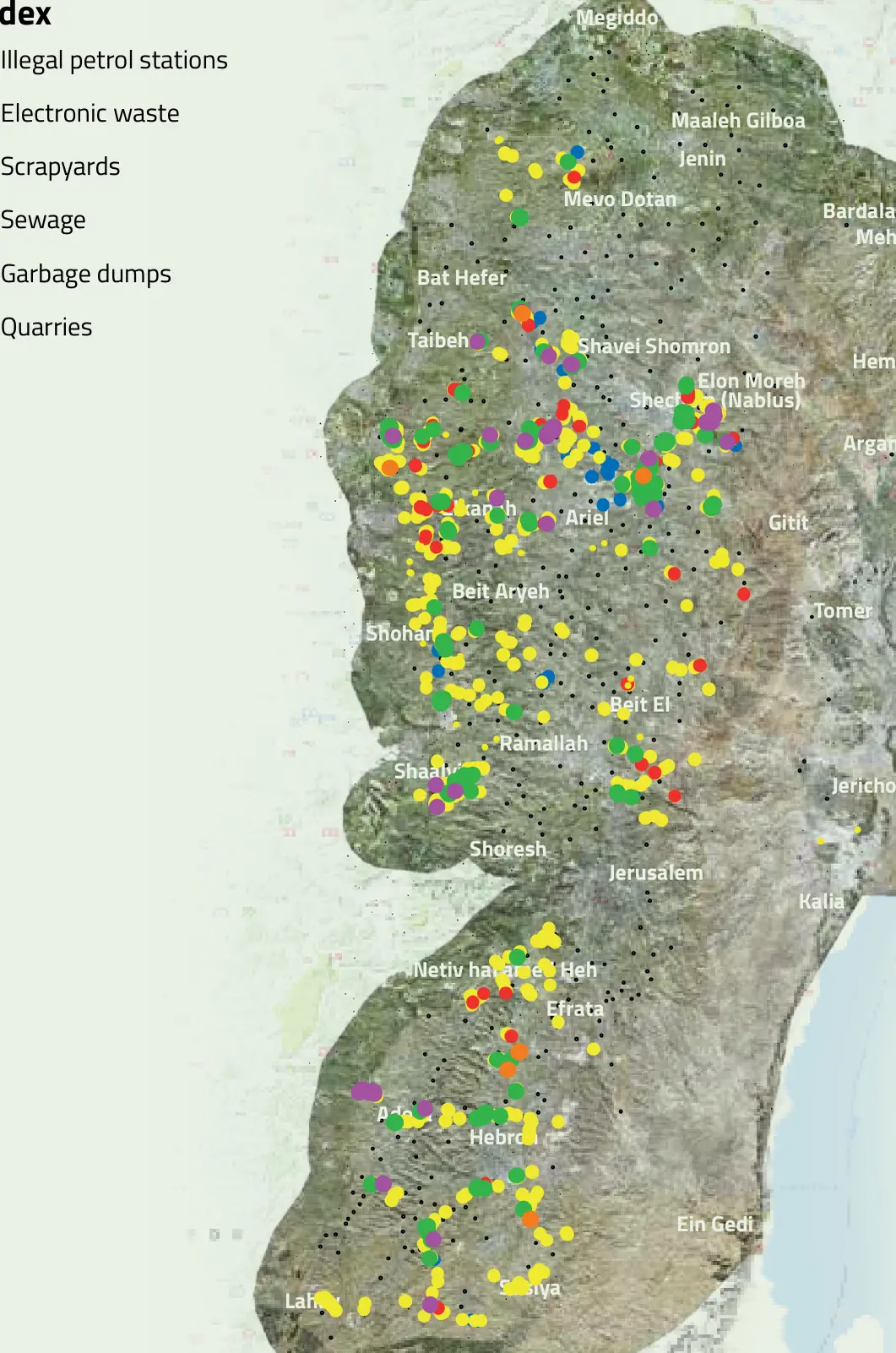
Area B. Because of security risks to surveyors, Area A (which is the most heavily affected) remained beyond the scope of this survey. Therefore, the actual number of hazards is much greater than described in this report.
al-Finjan and al-Minya. Waste from approximately 700,000 additional Palestinian residents is not collected in an organized manner and is not transported to end-sites; it is dumped in open areas, and a large portion of it is buried or burned in hundreds of illegal dumps, causing severe health and environmental damage. Hazardous materials present in the waste seep down and contaminate the the soil and groundwater sources, polluting the Mountain Aquifer and the streams of Judea, Samaria and sovereign Israel. All residents of Judea and Samaria, both Palestinians and Israelis, as well as those who travel through areas near incineration sites, suffer from waste burning. The smoke does not stop at the Green Line; it affects residents of communities within the sovereign borders of Israel, including Jerusalem, the Lachish Region, Shoham, the Modi’in Region, Kfar Saba, and Rosh Ha’ayin. The externalized costs of waste burning in Judea and Samaria are estimated at hundreds of millions of Shekels annually; health damage is estimated at hundreds of deaths per year and thousands of cases of chronic and acute illness, and all residents of Judea and Samaria and the surrounding areas are at risk. The economic damage associated with health impacts is estimated at billions of Shekels annually.
Most illegal waste sites are located above the recharge areas of the Mountain Aquifer, which puts one of the State of Israel’s main water sources at risk of contamination that - a risk that may become a reality in the immediately foreseeable future.
In contrast to the waste treatment situation in Arab sector communities, waste from Israeli local and regional authorities in Samaria and Binyamin is transferred to regulated sorting or landfill facilities. In recent years, waste from the Samaria Regional Council and other local councils has been treated at a modern facility in Emmanuel. This waste is sorted and partially recycled; in the next stages of development of this site, organic components will also be processed to create compost and generate energy.
Recently, the Civil Administration has been promoting the establishment of the Ramon landfill near Rimonim, as a solution (without separation and recycling, contrary to what is accepted worldwide and in Israel) for waste originating in Palestinian Authority-controlled areas that is not currently transported to landfills. The Civil Administration has announced that it plans to build an advanced waste treatment facility near the landfill for use by the entire population.
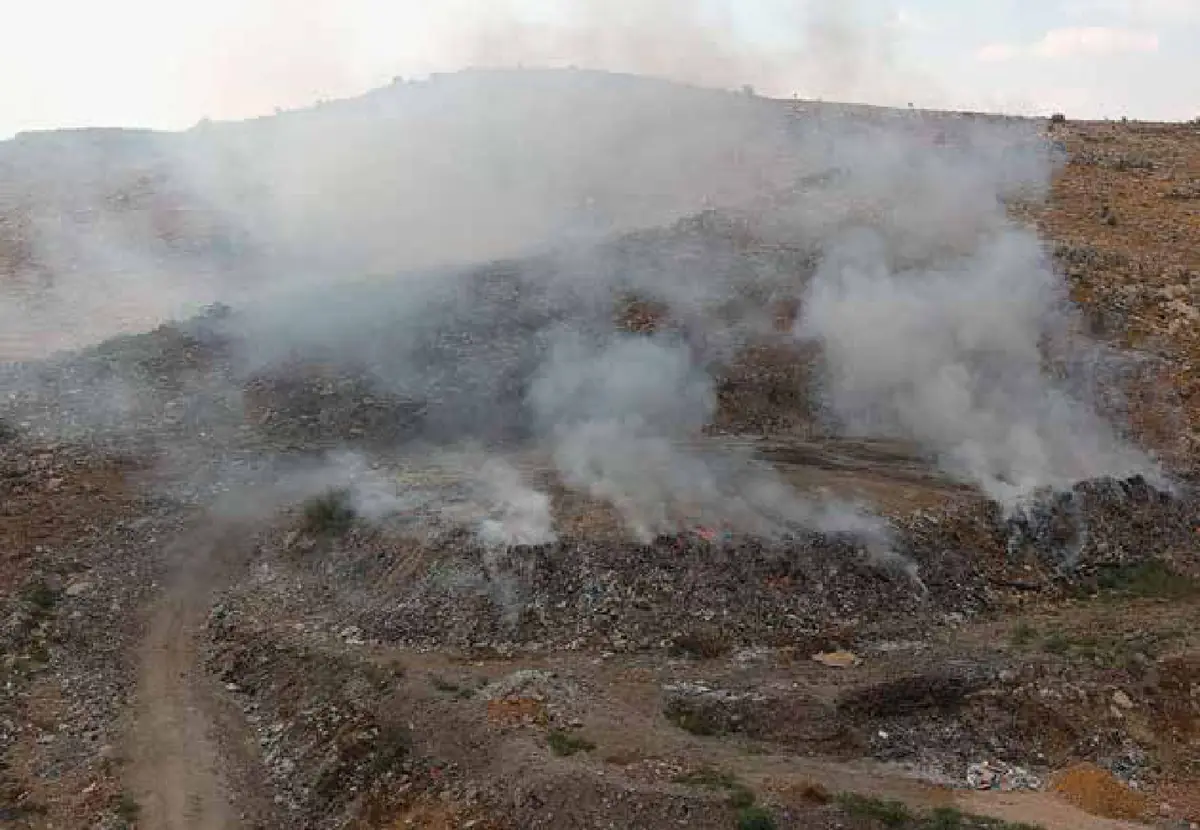
Turmus Ayya: Illegal trash incineration The Palestinian Authority is expected to carry out the routine waste burial activities at this site, but based on experience with other landfills receiving Palestinian waste, it is likely that the operation at this site will also be severely deficient and cause serious sanitary and environmental hazards. The establishment of this landfill under Palestinian management is an inevitable environmental disaster that will erupt at an unknown time. In the summer of 2024, part of the mountain of waste at the PA-adminstered al-Minya landfill in eastern Gush Etzion collapsed, causing severe pollution of the immediate vicinity and the streams below it, which feed into the Dead Sea via the Judean Desert. Environmental authorities warned about the impending disaster for years, but there is no consolation in being proven right. The establishment of a Palestinian landfill in Ramon is a disaster in the making that should not be permitted. The monitoring and ongoing operation of this site must be placed in the hands of Israeli entities and administered according to standards of the State of Israel, with all that implies, especially given that the Ramon site will be located in Area C. Additionally, proper and environmentally sound waste removal must be ensured in dozens of urban and rural communities in the Arab sector that still do not receive this basic service, as well as proper treatment of the waste. This requires extensive educational activity and a reliable logistical system for waste transportation, as well as funding for transportation and waste treatment. Regulation, enforcement, monitoring, and education are required if there is to be a fundamental change in the existing culture of waste burning, burial, and dumping in open areas, as is widely practiced today in the Palestinian sector.
The void of supervision and enforcement has turned Judea and Samaria into a no man’s land where waste is dumped, dismantled, buried, and burned along roadsides and in open areas, severely harming residents’ health and the environment and causing extensive health and economic damage.
Sewage
Untreated domestic sewage contains disease agents that are dangerous to human and environmental health. To reduce the risk from discharged sewage, it must be treated to reduce pollutant concentrations. The treatment process is relatively expensive, and populations with low economic capacity and low environmental-health awareness are not eager to fund it. This applies to most of the Palestinian population.
Two separate populations live in Judea and Samaria: the Palestinian population numbers about 2.7 million (according to Palestinian Central Bureau of Statistics data for 2021), and the Israeli population of about 500,000. Each year, about 90 million cubic meters of sewage is produced in Judea and Samaria by both the Palestinian and Israeli populations combined. About 80% originates from the Palestinian population.
About 38 million cubic meters of sewage per year are not treated and flow into streams or are disposed of through absorption pits into the ground and groundwater—almost all originating from Palestinian towns and villages. Additionally, about 5 million cubic meters per year of sewage or poor-quality effluent still flow from Israeli communities into the environment without adequate treatment, as required by law. At times, there is additional risk from industrial wastewater discharged into the general sewage system. This
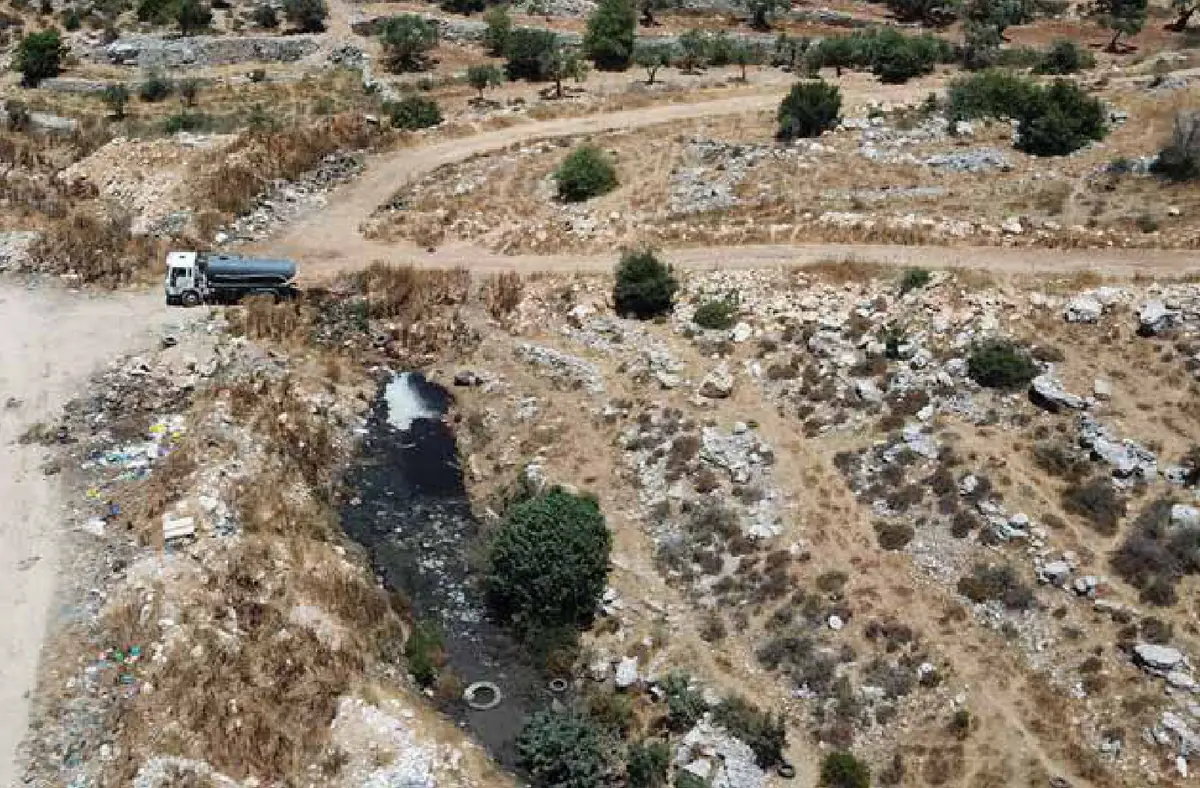
Ein-Yabroud: Sewage truck emptying contents is the case in Hebron, which discharges chrome from the tanning industry and stone dust from the stone industry into the Hebron Stream on its way to the Be’er Sheva Stream and Besor Stream. The same applies to sewage from Nablus, which includes toxic phenolic and oily waste from nearby olive presses, as well as stone dust from the local stone industry, flowing into the Nablus Stream and Alexander Stream.
By contrast, most sewage from Israeli settlements is treated in local facilities at various treatment levels. More than 50% of these facilities, treated effluents are utilized for irrigation, such as in the Gush Etzion area and the Shilo Valley. However, there are still Israeli communities whose sewage facilities need to be upgraded or expanded because of non-compliance with current Israeli law requirements.
The ongoing contamination of streams and wadis with untreated sewage poses a strategic threat to the Mountain Aquifer, the most important natural water source for the State of Israel.
Water Sources
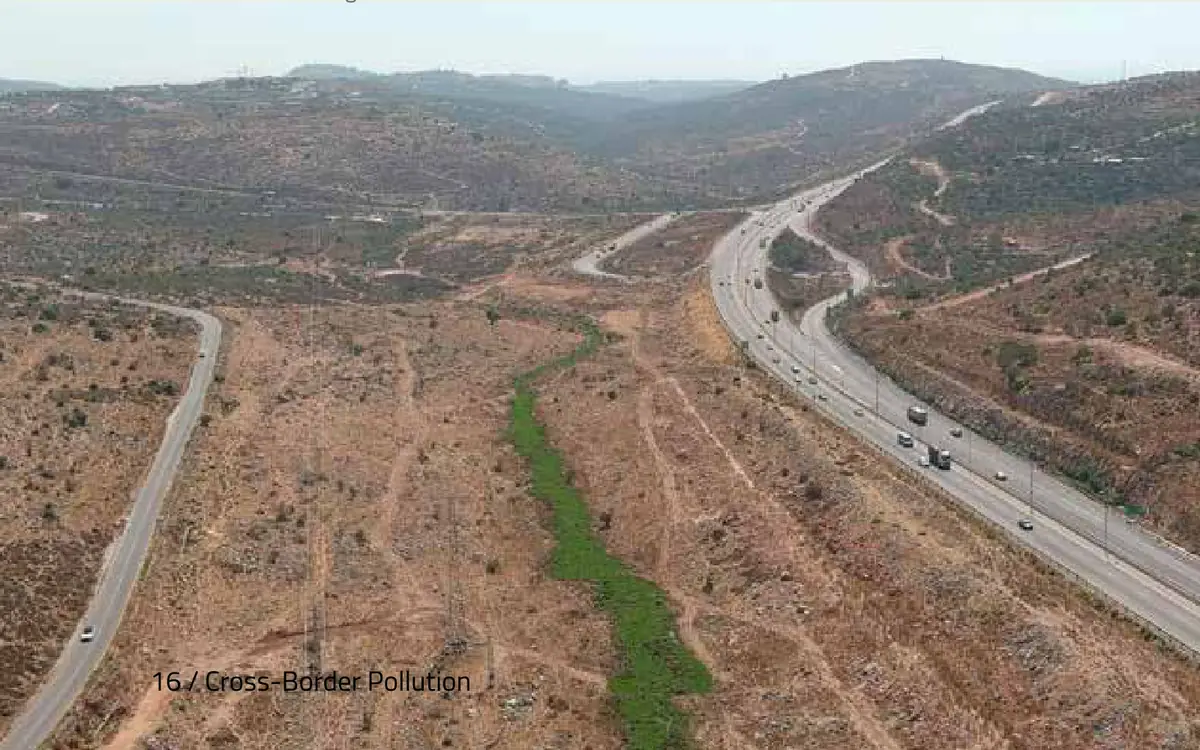
The Western Mountain Aquifer is the largest, highest quality, and most important groundwater reservoir in Israel. About 360 million cubic meters of high quality water accumulate annually in this aquifer on a multi-year average. All renewable water is pumped each year for various uses in Israel proper, Judea and Samaria, serving both Jewish and Arab populations. Numerous streams originating in Judea and Samaria (Kishon Stream, Nablus Stream, Modi’in Stream, Hebron Stream) serve in practice for disposal and conveyance of sewage or low-quality effluent, flowing from the territories of Judea and Samaria to the Israeli coastal plain and the sea.
The flow of sewage and effluent in stream channels causes severe damage to natural habitats and contaminates the water of the Mountain Aquifer, while at the same time preventing access to areas of natural beauty in the area. Additionally, this prevents capturing and exploiting flood waters, which is critically important for preventing flooding in coastal cities.
Quarries
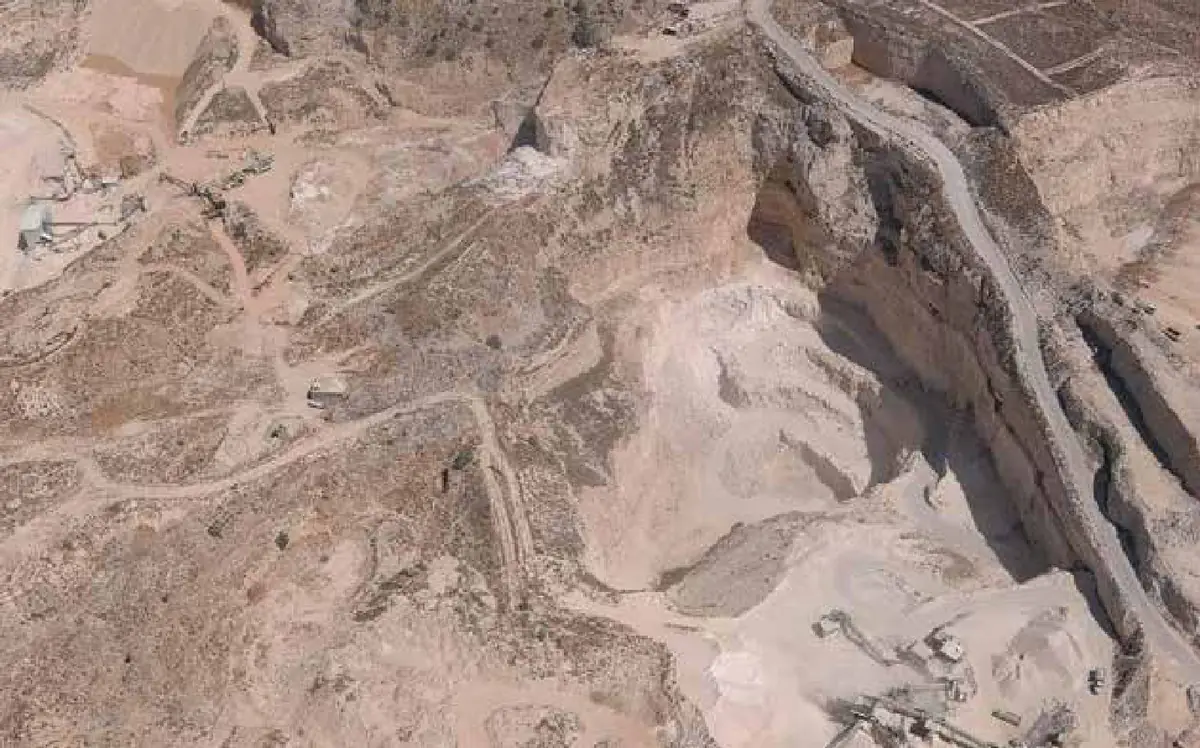
Aside from regulated quarries located for the most part within Israeli municipal jurisdiction, there is effectively no management of the quarrying industry in Judea and Samaria, neither at the planning nor at the operational level. This is equally true of oversight, enforcement, regulation, management of raw material inventory, future reserves, rehabilitation, etc. Operation of illegal quarries in their current form causes extensive environmental damage, including air pollution, landscape damage, severe harm to heritage and archaeological sites, soil contamination, surface and subterranean water pollution, noise, and severe damage to natural habitats of flora and fauna, to the point of complete destruction.
Some of the damage is already irreversible. Mountains have been “wounded,” valleys turned into hills, and mountains turned into valleys. As far as quarries are concerned, the prevailing view seems to be that Judea and Samaria are merely a source of the raw materials needed in Israel, without taking responsibility for the severe environmental aspects that are a direct result of largely unregulated quarrying activity. This is especially true regarding Palestinian quarries, most of which are pirate operations in Areas B and C that take advantage of the lack of regulation, governance and enforcement to gain a competitive advantage and make easy profits. If the current situation continues, more illegal quarries will open, the scope of quarrying is expected to intensify, and the harm to residents’ health and the environment extremely adversely impacted throughout Judea and Samaria and in bordering Israeli territories.
Economic aspects
The environment is by definition a dynamic system. Failure to address the problems detailed in the pages below will result in a worsening and deteriorating situation. Even now, the direct and indirect costs of the damage are dramatic, and estimated in billions of shekels annually.
The economic section of this report reviews in detail the various economic damages and explains the method used to calculate these estimates. Below is a concise digest.
| Annual damage (millions of NIS) | Twenty-year damage (million of NIS) | |
|---|---|---|
| Health and environmental damage from air pollution due to waste burning | 1,180 | 23,600 |
| Damage to the water management system | 127 | 2,540 |
| Economic damage from unregulated burning and disposal of stolen vehicle parts | 1,300 | 26,000 |
| Total | 2,607 | 52,140 |
In contrast to this heavy damage, the total cost of treating waste and sewage hazards in Judea and Samaria is equivalent to less than two years of damage:
| Section | Item | Cost (millions of NIS) |
|---|---|---|
| Waste | Infrastructure setup | 100 |
| 10-year operation cost | 260 | |
| Sewage | Infrastructure setup | 800 |
| 10-year operation cost | 1,790 | |
| Total project cost | 2,950 |
The waste and sewage industry is a powerful economic mechanism that can be harnessed for development and prosperity instead of being a source of damage and loss. To this end, goals must be set—such as waste sorting, water recovery and recycling, reducing landfill volume, streamlining the waste treatment market, and establishing the infrastructure for collecting and treating waste and sewage—and funding must be made available to achieve these goals. Additionally, mechanisms must be established to make environmental solutions for treating waste and sewage economically viable and sustainable.
Summary
This report documents the severe environmental hazards in Judea and Samaria resulting from inadequate treatment of waste and sewage. It sounds a severe and urgent warning: Ignoring this problem causes death and severe illness among both Arab and Jewish residents of Judea and Samaria, as well as residents of nearby communities within Israel proper. These environmental hazards threaten the water quality of the Western Mountain Aquifer, one of Israel’s major high-quality, vital natural water sources. Damage to the quality of the aquifer’s waters is imminent.
Current and future economic damage to Israel from continued neglect of this problem is estimated at 2.6 billion Shekels annually, resulting in mediumterm damages estimated at more than 52 billion Shekels over the next 20 years. By contrast, the investment required from Israel for adequate waste and sewage treatment solutions are estimated at 3 billion Shekels. In other words, the investment required from state budgets are much smaller than the damage costs that will be incurred if the investment is not made.
To prevent this damage, there is a need for legislation, planning, implementation, and regulation of waste and sewage treatment throughout Judea and Samaria, including Areas A and B. To this end, a comprehensive and coordinated policy must be developed between various government and professional bodies to address the issue in cooperation with the Palestinian Authority and international bodies, but not dependent on them. The Israeli government must approve a framework that includes an implementation timeline and multi-year budget.
Introduction
Pages 21–23
The statement “nature knows no borders” serves as the basis for nearly every lecture, legal discussion, or tour focusing on the environmental situation in Judea and Samaria. Environmental hazards do not respect political borders, agreements or treaties, and do not distinguish between Areas A, B, and C in Judea and Samaria and other territories under Israel’s control. There are many severe environmental hazards in Judea and Samaria, including illegal waste burning, discharge of untreated sewage into open areas, accumulation of solid waste, noise, radiation, unregulated construction and quarrying, and improper handling of hazardous materials. These cause harm to protected wildlife, destroy infrastructure, and damage nature and heritage sites and pose a serious threat to public health.
The causes of environmental hazards in Judea and Samaria are many, including the complex geopolitical situation, unique geographic and geological characteristics, severe lack of appropriate legislation and effective enforcement, as well as cultural and operational differences in environmental management between the Palestinian and the Israeli populations.1 Moreover, the ongoing conflict worsens the situation, especially regarding issues such as water pollution and waste treatment.2 Among all environmental issues, the threat of contamination to the Mountain Aquifer stands out particularly, because of the high hydrological sensitivity of the area, characterized by hard limestone and dolomite rocks with karst features. This is the central recharge area of the aquifer, and the risk of contamination is increasing because of accelerated development in both the Israeli and Arab sectors. This report is based on a comprehensive field survey conducted in 2023 by professionals who toured Judea and Samaria and documented various hazards from the ground and using drones.
The survey results, as well as data from parallel professional materials (State Comptroller reports, reports from NGOs and other organizations, academic research, etc.) indicate an urgent need for regional environmental management that crosses political boundaries to provide immediate systematic treatment.3
The present report summarizes the state of the major environmental hazards and their associated health and economic damages. The report presents an economic analysis of pollution costs vs. the costs of implementing an improvement plan, addressing the complex legal aspects and the lack of environmental policy and enforcement in Judea and Samaria.
Recommendations for addressing these problems are provided at the end of the report.
Some of the hazards presented in the report are already irreparable. To prevent further deterioration of the situation, action must be taken without delay.
Judea and Samaria in International and Israeli Law
Pages 25–29
Since the Six-Day War (1967), the area of Judea and Samaria has received different legal definitions and references in both international and Israeli law. Some organizations refer to these territories as “disputed territories” while others regard Israel as a “military occupier.” By contrast, some believe that the outcome of the Six-Day War is the restoration of Judea and Samaria’s original legal status, that is, “territory intended to serve as a national home for the Jewish People which is essentially a ‘holder of strong rights’ who was absent from the territory for several years because of war forced upon it, and has now returned to it.”4
The legal situation in Judea and Samaria, where military government was instituted, differs from that in East Jerusalem, where “the law, jurisdiction, and administration of the State” were applied (Order of Government and Law Arrangements, 1967).
According to rulings of Israel’s Supreme Court, Israeli authorities in Judea and Samaria operate under the limitations and obligations of the laws of belligerent occupation in international law. These laws include the regulations annexed to the Hague Convention of 1907 concerning the Laws and Customs of War on Land, and the Fourth Geneva Convention of 1949 regarding the Protection of Civilian Persons in Time of War. The purpose of these laws is to regulate temporary control of territory captured in war until a decision is made about its future.
The Hague Conventions deal with two main elements concerning territory under belligerent occupation: protecting the legitimate security interests of the occupier and ensuring the needs of the civilian population.
Israeli governments have presented their approach to the application of belligerent occupation before the Supreme Court, and this approach has been accepted and upheld: The practical implications of belligerent occupation are twofold: first, the law, jurisdiction, and administration of the State of Israel do not apply in these areas; second, the legal regime that applies is determined by the rules of public international law, particularly the rules dealing with belligerent occupation.5
The Supreme Court has accepted the view that the Hague Regulations are declarative in nature and reflect customary international law applicable in Israel even without legislative action.6 Still, there is no clear legal determination regarding the Geneva Convention. According to the Israeli government’s position, the Geneva Convention does not apply to Israel’s belligerent occupation in Judea and Samaria7 (on the grounds that the territory was not conquered from a state recognized as sovereign over the territory under international law and also because it is a conventional treaty that was not ratified by law as required). Nevertheless, beyond the letter of the law, the Israeli government took the decision to treat the area’s population in accordance with the humanitarian sections of the Convention, and in light of this position, the Supreme Court has not been required to rule on the issue of applicability of the Fourth Geneva Convention to Judea and Samaria. Regulation 43 of the Hague Conventions concerns maintaining public order and security while ensuring normal life in occupied territory. According to Israeli Supreme Court rulings, this is “the overriding provision guiding the military commander and serves as a quasi-constitutional framework for the laws applicable in the area.” It establishes a general framework for how the military commander should exercise his duties and powers in the area (HCJ 2164/09 Yesh Din - Volunteers for Human Rights v. Commander of IDF Forces in the West Bank, paragraph 8 (26.12.2011); HCJ 3240/15 Head of Anata Council v. Commander of IDF Forces in the West Bank, paragraph 14 (7.1.2019)). According to Regulation 43, the military commander must respect the laws that were in force in the area before occupation unless absolutely prevented from doing so for the sake of the population’s welfare or security needs. Furthermore, the military commander may, and at times must, deviate from local law and respond dynamically to changing reality to maintain public order (HCJ 202/81 Tabib v. Minister of Defense, P.D. 36(2) 622, 631-632 (1982); HCJ 548/04 Amana - Settlement Movement of Gush Emunim v. Commander of IDF Forces in Judea and Samaria Area, P.D. 58 373, 382-383 (2004)).8
Note that the Levy Report concluded that from the perspective of international law, the laws of occupation, as expressed in the various conventions, do not apply in Judea and Samaria because of the special historical and legal circumstances of the Israeli presence there over decades, given that Israel effectively returned its territories to itself.
In practice, since the Six-Day War, a military government was established in Judea and Samaria, headed by a military commander: the Commander of Central Command. According to the laws of belligerent occupation, he serves as a substitute for the sovereign and his powers are based on rules of public international law concerning military occupation. Under this authority, the Proclamation Concerning Law and Administration Arrangements (Judea and Samaria) (No. 2), 1967, was issued. The military commander’s powers are based both on the law that applied in the area before military occupation and on new legislation enacted in the area: Ottoman law, law from the British Mandate period, law from the period of Jordanian occupation, as well as legislation established since then, primarily orders enacted by the military commander known as “security legislation,” enacted from time to time according to emerging security and civil needs.
The Civil Administration was created by virtue of the Order Concerning the Establishment of a Civil Administration (Judea and Samaria) (No. 947), 1981. It was intended to manage civil affairs in Judea and Samaria. The Civil Administration uses staff officers to serve as professional representatives of government ministries who are authorized to carry out various activities, including law enforcement actions, to fulfill their duties. The Civil Administration reports to the Coordinator of Government Activities in the Territories.
Within the framework of the Oslo Accords, the “Interim Agreement on the West Bank and Gaza Strip” was signed in Washington on September 28, 1995, also known as “Oslo II Agreement” or “Taba Agreement” (hereinafter, “the Interim Agreement”). Under this agreement, the territory of Judea and Samaria was divided into three categories:
Area A: full Palestinian Authority jurisdiction, including security and civil affairs, constituting some 18% of the territory of Judea and Samaria; Area B: Palestinian civil control and Israeli security control, constituting some 22% of the territory of Judea and Samaria;
Area C: full Israeli control, constituting approximately 3.4 million dunams or some 60% of the territory of Judea and Samaria.
In the exercise of his authority, the military commander enacted the Order Concerning Management of Local Councils (Judea and Samaria) (No. 892), 1981, and the Order Concerning Management of Regional Councils (Judea and Samaria) (No. 783), 1979. Under these orders, the Local Councils Regulations (Judea and Samaria), 1981, and the Regional Councils Regulations (Judea and Samaria), 1979, were enacted. These regulations applied Israeli legislation to Israeli local authorities in Judea and Samaria regarding their municipal governance and the everyday lives of residents of these municipalities. This legislation is also known as “enclave law.”
Additional Knesset legislation relevant to this area consists of extraterritorial legislation with personal applicability9 (such as taxation and criminal matters, Security Service Law, and Knesset election laws), emergency regulations, and indirect applicability through interpretation of the scope of Israeli law provisions,10 such as labor laws and administrative law.
Law and Environment in Judea and Samaria
Pages 31–48
International law and environmental protection in Judea and Samaria
Given the worldwide environmental situation, including climate change and its inherent dangers, nations of the world have come to understand that if the environment is to be protected, action must be taken through local legislation and cooperation. This understanding is reflected in, among other things, international agreements, conventions, declarations, legislation, regulations, and government decisions. Israel has joined various agreements and conventions such as the Vienna Convention for the Protection of the Ozone Layer (1985), the United Nations Framework Convention on Climate Change (UNFCCC), which entered into force in 1994 and was ratified by Israel in 1996, and Decision CP.21/1 (2015) regarding the Adoption of the Paris Agreement, which was signed and ratified by Israel in 2016 (ratification in Government Decision No. 2041 dated 14.11.2016). Israel joined the Barcelona Convention for the Protection of the Marine Environment and Coastal Region of the Mediterranean in 1995.
The Paris Agreement imposes various obligations on member states, including Israel, such as the obligation to submit a national target for reduction greenhouse gas emissions every five years, promotion of a strategy to reduce greenhouse gas emissions by 2050, implementation of national measures for climate change adaptation, and mutual support of member states in achieving a global goal for climate change preparedness.
Israel’s commitments to these international agreements and conventions have led to the expansion of local environmental legislation and decisionmaking, and to further participation in international agreements and declarations.
Government decisions intended to promote preparedness for climate change and reduce greenhouse gas emissions include:
Government Decision No. 1685: Encouraging Israeli technological innovation and harnessing the high-tech industry to combat climate change and meet national targets - 26.06.2022 Government Decision No. 207: Promoting infrastructure and flood risk management - 01.08.2021 Government Decision No. 542: Reducing greenhouse gas emissions and streamlining energy consumption in the economy - 20.09.2015. Following this decision, Israel submitted its first targets set for greenhouse gas emissions reduction by 2030 to the Climate Convention Secretariat.
Israel’s global commitment to fighting climate change and protecting the environment naturally includes all territories under its control, including Judea and Samaria, even according to those who view these as occupied territories. According to Regulation 43 of the Hague Regulations, states are obligated to ensure order and normal living conditions in territories under occupation, and act to meet the needs of society . This applies to all areas of civil life, and includes the duty of the state, through military government, to protect the environment. This is all the more true when environmental damage directly and severely affects residents’ health. In addition, international environmental laws also impose a duty on the state to protect the environment and act decisively to reduce risks in light of climate change.
Given their cross-border nature, environmental matters provide a unique perspective on the principle of sovereignty and suzerainty, according to which a state is entitled to exercise independent sovereign authority in relation to its residents and a specific territory, as an owner would. The understanding is that because “the environment knows no borders,” a state has certain responsibilities, depending on circumstances, even over territories that are not under its sovereignty.
According to environmental statutes in international law, a state has no right to use its territory in a way that causes severe and proven damage to the territory of another state. Furthermore, international law holds that there exists a human right to environmental quality: the right to enjoy proper environmental conditions and sustainability.11 As an illustration, we mention the Stockholm Declaration of the United Nations Conference on the Human Environment of 1972, which first defined the relationship between environmental protection values and human rights, recognizing environmental improvement and protection as a foundation for achieving basic human rights such as freedom and equality. Following these declarations, as noted, various conventions and agreements on environmental issues were signed by many countries.
Even an examination of Israel’s actions through the lens of belligerent occupation would yield the conclusion that it is obligated to exercise proper environmental management, because the occupier of the territory must protect the interests and fundamental rights of the population in the occupied territory, including the residents’ right to environmental quality and its protection, and certainly their right to health. This view also leads to the conclusion that the sovereign must legislate and update environmental legislation “because society’s needs change over time.”12
A study by the Concord Center at the College of Management, which conducted a legal analysis of the duty to protect the environment in Judea and Samaria, concludes: “In sum, the principle of permanent sovereignty over natural resources13 fits well within the normative framework of occupation laws and obligates the military government to avoid harming natural resources whose sovereignty belongs to the occupied state or the population entitled to realize its right to self-determination in the relevant territory.”14
In the Oslo Accords (Interim Agreement,)15 it was agreed, among other things, that “both sides will strive to use and exploit natural resources in accordance with their respective environmental and development policies, in a manner that prevents damage to environmental quality and will take the necessary measures to ensure that activities in their territory will not cause harm to the environmental quality of the other side. Each side will act to protect the environment and prevent environmental risks, hazards, and nuisances, including all types of soil, water, and air pollution, according to accepted international standards... Both sides will adopt, apply, and ensure compliance with internationally recognized standards... Each side will take the necessary measures to prevent uncontrolled discharge of sewage and/or wastewater to water sources, water systems, and water bodies, including groundwater, surface water, and rivers, which might affect the other side, and to promote the proper treatment of domestic and industrial wastewater, as well as solid and hazardous wastes.”
Additionally, the parties agreed to establish a committee of environmental experts. In practice, the agreements held up only for the first five years (and even in that short period, not fully), but there is some communication between the parties, mainly in attempts to coordinate water issues.16 Section 5 of Appendix 1 of the Cairo Agreement of 1994 states: “Israel and the Palestinian Authority will adopt, apply, and ensure compliance with internationally recognized standards regarding acceptable levels of land, water, and air pollution, and regarding acceptable levels for treatment and disposal of liquid and solid waste, and for treatment and use of hazardous substances including pesticides...”
Thus, from any perspective on the territories of Judea and Samaria from the point of view of international law, Israel is obligated to protect the environment in Judea and Samaria. These matters are also valid from global environmental perspectives, which are long-term and cross-border.
The obligation of the State of Israel to its citizens regarding environmental protection in Judea and Samaria
The State of Israel is committed to environmental protection in Judea and Samaria also by virtue of its general and basic commitment to its citizens, reflected in Basic Law: Human Dignity and Liberty. Moreover, the UN Universal Declaration of Human Rights, from 1948, includes various rights that every state must ensure for its citizens, such as life, dignity, property, freedom of expression, freedom of occupation, freedom of movement, and more. The obligation of the state also stems from administrative law, according to which the State of Israel is obligated to act with equality and without discrimination toward its citizens residing in Judea and Samaria, and it is not appropriate that Israel’s environmental legislation should not apply in Judea and Samaria. The sovereign State of Israel should operate in Judea and Samaria with the same standards it applies in the Negev, Galilee, and coastal plain to protect the environment because environmental and nature protection matters are cross-border and their impact does not distinguish between national and territorial boundaries.
In conclusion, Israel is obligated under international law to protect the
environment in Judea and Samaria, based on its legal and moral obligation to participate in the international struggle to control the climate crisis. Israel also has a duty to protect the environment and the public for this and future generations and to promote sustainable development in Judea and Samaria as well.
Lack of sufficient and suitable legislation in Israeli settlements and other territories areas in Area C
In Area C, there is a substantial legislative gap between the Israeli settlement area and the rest of the territory. In Israeli settlement areas, by order of the military commander, the Local Councils Code and its appendices, which implement part of Israeli environmental legislation, apply. This includes:
- 1. Collection and Disposal of Waste for Recycling Law, 1993
- 2. Hazardous Materials Law, 1993 – except for Hazardous Materials Regulations (import and export of hazardous waste)
- 3. Chapter 1A of the Water Law, 1959
- 4. Rivers and Springs Authorities Law, 1965
- 5. Prevention of Hazards Law, 1961, and regulations enacted under it - except for vehicle air pollution regulations and Hartridge test standard regulations (Note: Under the Clean Air Law, which does not yet apply in Judea and Samaria, related hazards prevention regulations were included, but because this law does not apply in Judea and Samaria, there has been backsliding in the matter)
- 6. Environmental Hazard Prevention Law (Civil Actions), 1992
- 7. Deposit Law on Beverage Containers, 1999
- 8. Cleanliness Maintenance Law, 1984
- 9. Tire Disposal and Recycling Law, 2007
- 10. Environmental Protection Law (Enforcement Powers), 2011
- 11. Chapter 21 of the Economic Efficiency Law (Legislative Amendments for Implementation of the Economic Plan for 2009-2010), 2009, and all subsidiary legislation under them
- 12. Packaging Treatment Regulation Law, 2011
- 13. Prevention of Asbestos and Harmful Dust Hazards Law, 2011
- 14. Public Health Ordinance, 1940
- 15. Prevention of Smoking and Exposure to Smoking in Public Places Law, 1983
- 16. Business Licensing Law, 1968 17. Water and Sewerage Corporations Law, 2001
- 18. Section 83c of the Planning and Building Law, 1965 (Protection of Mature Trees – main provisions of Amendment No. 89).
When the abovementioned Israeli legislation is updated, the legislation that was adopted in the military commander’s order and the code is also updated, together with the modification enacted by the regional commander. From the point of view of criminal law, regarding certain offenses, the application of environmental legislation in Area C is personal and extra-territorial, meaning that some environmental laws apply only to Israeli citizens.
In Area C, outside Israeli communities, military legislation applies, which is not updated following updates in general law. For example, in these areas, the following regulations apply: the Order Concerning Cleanliness Maintenance (in its old version, which does not include new regulations), the Order Concerning Hazardous Materials; the Crafts and Industries Law, a Jordanian law partially parallel to the Business Licensing Law (less relevant today because according to the Interim Agreements, business licensing in Area C is carried out by the PA and in Israeli authorities the Israeli law applies); the Order Concerning Planning of Towns, Villages and Buildings (Judea and Samaria) No. 418; the Public Health Law, a Jordanian law that replaced the Public Health Ordinance; the Order Concerning Hazardous Materials, concerned mainly with restrictions on the entry of hazardous materials that pose a security risk.
The main environmental laws that apply in Israel and do not apply (or apply only partially) in Judea and Samaria are:
- 1. Clean Air Law, 2008
- 2. Local Authorities Law (Environmental Enforcement – Inspector Powers), 2008 (applies to green police and civil administration and not to IDF bases)
- 3. Environmental Treatment of Electrical and Electronic Equipment and Batteries Law, 2012
- 4. Environmental Protection Law (Environmental Emissions and Transfers Reporting and Registration Requirements), 2012
- 5. Non-ionizing Radiation Law, 2006
- 6. Law for the Reduction of Single-Use Carrier Bags, 2016
- 7. Animal Protection Law (Animal Welfare), 1994, and its regulations
- 8. Wildlife Protection Law, 1955, and its regulations
- 9. Regulation of Dog Supervision Law, 2002, and its regulations 10. Administrative Offenses Regulations (Administrative Fine – Animal Welfare), 2011
- 11. Environmental Protection Law (Enforcement Powers), 2011 (although the inspection unit in Judea and Samaria has broader powers)
- 12. Cleanliness Maintenance Law and its regulations (in all of Area C)
- 13. National Fire Authority regulations ut dealing with bonfires
- 14. Regulation of Pest Control Operations Law (in municipal jurisdictions). Despite the lack of sufficient and suitable legislation, the environmental situation in Israeli communities in Judea and Samaria is improving and becoming closer to that in Israel. The reasons for this include the fact that Israeli environmental law is being updated and there are many supervisory bodies, including the Civil Administration, the Ministry of Environmental Protection, the Israel Police, local authorities, and environmental associations. In addition to these, the prevailing culture is one of environmental protection and desire for improvement in this field.
The problematic environmental situation is in Area C outside the municipal lines of Jewish communities, which is the lion’s share of Area C, and in Areas A and B. These areas are the focus of the present report, which also incorporates environmental hazards that are caused by Israeli settlements in Judea and Samaria.
Lack of proper environmental management in Areas A, B, and in Area C outside Israeli communities’ jurisdiction
In general, compared to the situation in Israeli communities in Judea and Samaria and the State of Israel, the environmental damage is extremely severe in Palestinian Authority-controlled areas. The findings presented in the pages that follow are clear and unmistakable.
Activities that are environmentally damaging are being carried out without supervision or regulation, contrary to law and agreements.
In Area C outside Israeli communities and in Areas A and B, there are thousands of illegal waste sites, sewage flows into wadis and open spaces, severe air pollution resulting from hundreds of waste burning sites and factories is common, construction is carried out in violation of all laws without properly approved planning, causing severe environmental damage and destruction of heritage sites, quarries operate without any regulation, polluting fuel stations and accumulations of vehicle scraps contaminate the soil, and more. Several causes combine to create this severe situation. Among these, aside from the objective conditions in the field, we can list the lack of supervision, insufficient regulation, Palestinian Authority encouragement of illegal construction of mega-infrastructure and private building, a view of the environment and sustainability as esoteric matters, “profiteering” on environmental treatment costs for waste transport and handling, and weakness in environmental management capability. All these must be considered alongside the poor economic condition of the Palestinian population.
In the 1995 Interim Agreement, certain civil and security authorities in Areas A and B were transferred to the Palestinian Authority. This has created a perception that Israel has no authority to supervise Areas A and B. For example, the State Comptroller Report 67b 16/05/2017, regarding “Water Pollution between the State of Israel and the Territories of Judea, Samaria and Gaza Strip” (hereinafter, the Water Pollution Report): “In Areas A and B, which constitute about 40% of all Judea and Samaria, Israel has no authority to supervise what is done in the environmental field, and the relevant territory under its authority is Area C.”
Nonetheless, in our view, in certain situations, Israel must act in various ways regarding Areas A and B as well to protect Israel’s environmental interests, including protecting the residents of Judea and Samaria and all parts of the State of Israel. In our opinion, it is not appropriate to acquiesce when millions of cubic meters of untreated domestic and industrial sewage flow from Areas A and B into Area C and to the State of Israel. These sewage flows contaminate the soil, streams and groundwater. The same is true for waste, which routinely is disposed of in thousands of pirate sites, and is often burned or buried without being sorted or treated.
The environmental hazards created in Areas A and B reach into and beyond Area C; they are not confined to their location, and pollute air, water, and soil across a wide geographic range. The waste burning in Areas A and B is carried out for various purposes: burning for waste volume reduction to make room for new waste, burning for metal extraction, burning agricultural waste (for disposal and prevention of plant diseases), burning agricultural plastic for disposal, unintentional fires resulting from embers, and so on. Recently, the Environmental Protection Officer in the Civil Administration explained that handling cross-border hazards from Areas A and B is subject to approval from the political echelon (Minister of Defense).17 This statement needs to receive legal foundation and approval from senior officials in the Civil Administration and Israeli government.
The Supreme Court indirectly addressed these matters when dealing with the blight of charcoal kilns, unregulated sites that produce charcoal from the incomplete burning of wood: “...we have not overlooked the fact that treating the environmental hazard in Area C does not provide a comprehensive solution to the environmental problem, because the smoke emitted from charcoal kilns in Area B does not distinguish between one piece of land and its neighbor.”18
Indeed, the Civil Administration took comprehensive action to eliminate the polluting charcoal producers in northern Samaria, including in Area B, with approval from the political authorities, proving that it is possible to stop a severe hazard in Areas A and B if there is a desire to do it.
Lack of environmental enforcement in Judea and Samaria
Over the years, the lack of law enforcement in Judea and Samaria in general, particularly regarding environmental quality, has been a serious problem. For example, in 2011, Civil Administration commander, Brigadier General Moti Almoz informed the Coordinator of Government Activities in the Territories, Major General Eitan Dangot, and the Head of the Operations Branch, Brigadier General Yaakov (Kobi) Barak, that although the IDF is responsible for law enforcement in Judea and Samaria but “we are very far from fulfilling our role.” In 2012, the Legal Advisor for Judea and Samaria informed the Central Command Commander at the time, Major General Avi Mizrachi, and the Coordinator of Government Activities in the Territories that “the final result [of efforts to enforce the law in Judea and Samaria] is far from satisfactory.”19 Because of the general lack of enforcement, the environment was also neglected. As the State Comptroller stated: “The Shamgar Committee recommendations regarding law enforcement in Judea and Samaria established, as noted, that a precise definition of police duties is required. Despite more than 18 years having passed since these recommendations were published, at the time of the audit completion, in July
Status of investigations, waste violations in Judea and Samaria: 2020-2022
AG or lawsuits
Under investigation
Pending closure of case
Case shelved
Credit: State Comptroller 2024
2012, there were still disagreements between the Israel Police and other law enforcement bodies regarding the responsibility of the police to handle enforcement in the areas of planning, building, and environmental protection in Judea and Samaria. Meanwhile, Supervision Unit employees do not use the authority granted to them to conduct investigations according to the order that authorizes them to do so. This reality has the potential to harm the rule of law.”20
In 2014, the the military commander issued an order creating the David Unit, as a cooperation between the Environmental Protection Officer and the Nature and Parks Authority. This unit deals with environmental enforcement at crossing points to prevent the illegal transfer of waste from Israel to Judea and Samaria. The inspectors undergo professional training by the Civil Administration, the Ministry of Environmental Protection and the Nature and Parks Authority. The unit is employed by the Nature and Parks Authority for the Ministry of Environmental Protection and currently consists of 17 employees (15 inspectors and two sector managers, north and south) and an operations coordinator. According to Civil Administration data, in 2020, the David Unit filed four police complaints about repeat waste offenses (one case was closed and three cases are still being processed). In 2021, 28 complaints were filed with the police against waste violations, of which 19 are under
Impounded vehicles and hearings conducted at crossings
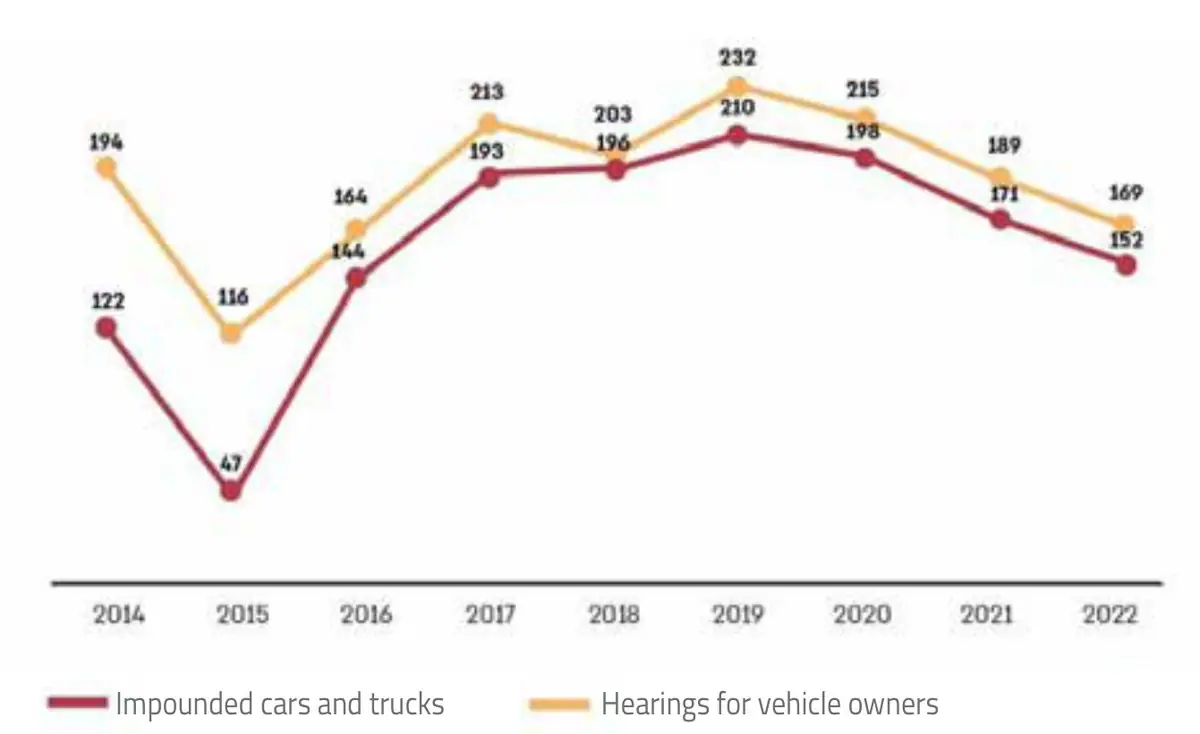
investigation (three complaints ultimately resulted in indictments and six complaints were closed).
Additionally, between 2014 and 2021, approximately 200 trucks were seized each year.21 Relative to the scope of waste crime in Judea and Samaria, this represents a very small number of seizures, complaints, and indictments. The State Comptroller addressed the enforcement issue in 2016 and determined that there were significant deficiencies in the activities of the Supervision Unit of the Civil Administration.22 In his concluding remarks, the State Comptroller ascribed great importance to enforcement and the rule of law in Judea and Samaria: “The handling of the deficiencies raised in this report, some of which have existed for many years, concerning important areas of law enforcement in Judea and Samaria, has national implications of the highest order: security, political, and economic. Therefore, it is the duty of the Head of the Civil
Enforcement action and impounds carried out by the Oversight Unit against all environmental hazards, 2017 – 2022
Administration, together
with the Coordinator of
Government Activities in the Territories and the senior military and political echelon— the Minister of Defense and the Prime Minister—to actively engage and ensure that the deficiencies detailed in the report are corrected and will lead to improvement in maintaining the rule of law in Judea and Samaria.” From the State Comptroller’s report published in 2023, 23it appears that the main environmental enforcement activity in Judea and Samaria is carried out by the
Impounds
Demolitions
Work-stop
Roadblocks
David Unit, and only in
orders
the area of waste at
Vehicle and truck seizures at crossings, 2014-2022.
crossing points.
The
Credit: State Comptroller 2024
Civil Administration and the Ministry of Environmental Protection did not present information indicating substantial enforcement actions in environmental protection outside the areas within jurisdiction of Jewish communities. The Ministry of Environmental Protection explained (and the Civil Administration agreed) that “all environmental enforcement carried out by the Supervision Unit of the Civil Administration in environmental protection constitutes a small part of their total activity as a result of priorities related to their ongoing activities and lack of personnel... Their main enforcement is that of orders in planning and construction laws, permits, and licenses for illegal construction.”24 Thus, the Ministry of Environmental Protection and the Civil Administration fully admit that environmental enforcement in the environmental field is very limited.
Recently, it appears that the Judea and Samaria Division Commander has emphasized environmental issues,25 but as evidenced by this report, which reflects the situation on the ground based on State Comptroller reports and thousands of complaints reaching Green Now, the environmental hazards are numerous, enforcement is absent, and the health and environmental dangers are growing.
The severity of environmental hazards in Judea and Samaria stems from a lack of environmental management policy
In the above-mentioned Water Pollution Report, the State Comptroller commented on the insufficient application of environmental legislation in Judea and Samaria and the lack of action in compliance with a proper multi-year plan with clear priorities and reasonable timelines. The report mentions that the CEO of the Judea Environmental Association informed the State Comptroller’s Office that the non-application of environmental laws to all of Area C constitutes a severe problem that allows environmental offenses to be committed in open areas, such as waste dumping and sewage discharge. The CEO added that environmental laws in Area C based on orders issued under Jordanian law are not sufficiently enforced. According to him, the problem of the legislative gap is compounded by “geographic, administrative, and enforcement fragmentation” that creates a “paradise for polluters” in Area C areas outside the jurisdiction of Israeli local authorities, and even within the jurisdiction of regional councils in open areas between settlements.
Regarding the application of environmental legislation in Judea and Samaria, the State Comptroller noted that regardless of the political question of control over Judea and Samaria territories, as long as there is Israeli control over a significant part of the territory, Israel must “urgently define clear multi-year goals and timelines for applying relevant Israeli environmental legislation in Judea and Samaria and meet these goals, while emphasizing expanding enforcement tools, both for Israeli settlement areas and for the rest of Area C. All this in consideration of obligations applying to the State of Israel under international law and under the Interim Agreements with the PA.”
The State Comptroller concluded that the Israeli government lacks a policy for environmental management in Judea and Samaria. In his words, “The Israeli government has not yet formulated a policy for cross-border environmental management in general and management of such water pollution in particular, and has not even discussed this issue in recent years. In doing so, it has ignored the broad implications of the issue, including on Israel’s water reserves, public health, and even politicalsecurity aspects. On a series of issues, despite efforts by government bodies at various executive levels to resolve disagreements and remove environmental hazards, the lack of treatment and decision-making at the government level, as well as the absence of a single government body in charge of this issue and its coordination with all treating bodies prevented or delayed finding solutions, causing ongoing damage to the environment, public health, and public interest. This difficulty appears as a common thread through problems in various areas whose solutions have been delayed, often for decades, such as the Jerusalem area sewage flowing to Kidron, the Alexander Stream pollution, the Hebron Stream pollution, the al-Bireh effluent, and Gaza Strip sewage flowing to the sea and streams...” In the report published by the State Comptroller in March 2024, he added: “This audit report reflects a grim picture of years-long failure regarding the activities of government bodies, primarily the Civil Administration (responsible for environmental protection in Area C, among others, by means of the Environmental Protection Staff Officer Unit and the Supervision Unit) and the Ministry of Environmental Protection (entrusted with protecting environmental quality in Israel), in preventing and treating waste fires in Judea and Samaria that have cross-border impact. It was found that between 2017 and 2022, air pollution and odor hazards from these fires expanded and intensified in a way that affected the daily lives of Israeli and Palestinian residents, and even worsened during Operation Iron Swords.”26
These facts speak for themselves: the environmental situation in Judea and Samaria is in dire condition. The various complexities we noted above, the lack of environmental management policy, and especially the lack of legislation and enforcement are causing severe environmental damage both in the short and long term. The difficult environmental situation in Judea and Samaria requires the State of Israel to enact a proper and systemic environmental policy in Judea and Samaria, including planning, budgeting, and implementing a proper program to improve the situation. The State Comptroller determined that it is not doing so, and as we shall see below, the situation on the ground proves it.
Government decision for dealing with environmental hazards in Judea and Samaria
In light of the State Comptroller’s findings and recommendations, the recommendations of professional bodies, and the understanding that the environmental situation in Judea and Samaria is highly problematic, in June 2018, the Ministry of Environmental Protection prepared a draft government policy directive: “Environmental Hazards in Judea and Samaria and Cross-Border Hazards: Strategic Plan for Dealing with Environmental Hazards in Judea and Samaria and Cross-Border Hazards” (hereinafter, the Dolicy Directive).
Main points of the Policy Directive
- 1. The Policy Directive recommends the establishment of a team that will prepare and submit a plan for preventing environmental hazards in Judea and Samaria and formulating a comprehensive environmental management policy.
- 2. Water and Sewage Connections: The directive instructs the Civil Administration to act on connecting communities to modern water and sewage systems, and the Water Authority to promote the planning and implementation of water and sewage projects, as well as instructing the Director General of the Energy Ministry to appoint a team that will prepare a multi-year plan for developing advanced sewage solutions.
- 3. Reduction of Hazards in Judea and Samaria: The directive instructs the Ministry of Environmental Protection and the Civil Administration to prepare a plan for reducing cross-border hazards and waste treatment in the area, using the funds of the Cleanliness Maintenance Fund, both from its Judea and Samaria account and from its resources in Israel.27
- 4. Promoting Environmental Legislation in Judea and Samaria: The directive recommends promoting funding to advance environmental legislation in Judea and Samaria and throughout Area C, to improve tools for reducing environmental and cross-border hazards according to a legislative plan to be coordinated between the Ministry of Defense and the Ministry of Environmental Protection. Additionally, the directive instructs the Ministry of Environmental Protection and the Civil Administration to formulate a plan for organizational structure change to increase the effectiveness of supervision and control over environmental hazards throughout the region and over cross-border hazards.
- 5. Energy Recovery Facility: Following a previous government decision, the government shall allocate funding from the Cleanliness Maintenance Fund for an energy recovery facility in Mishor Adumim. (This proposal has been temporarily removed from the agenda following a petition to the High Court of Justice by Green Now together with the Tzalul Association and others.)28
- 6. Infrastructure for Parks to Serve for Recycling, Recovery, and Waste Treatment: The government will request approval from the Sanitation Maintenance Fund to assist authorities in Judea and Samaria, from the Judea and Samaria account, to develop and build infrastructure for parks for waste treatment and recycling, provided these infrastructures will serve recycling plants, recovery, and waste treatment.ח29 The Policy Directive was intended to increase government assistance and investment in treating environmental hazards in Judea and Samaria, which cause significant pollution and severe harm to humans, natural resources, and water sources. As stated in the Policy Directive Proposal: “It is all intended to improve the environmental situation in the region and in the State of Israel and prevent the continuation and spread of concentrated pollution without treatment.”
The Policy Directive remained a draft and did not become a binding government decision but it provides an indication of the awareness and understanding of the main actions required.
The State Comptroller concluded his latest report (March 2024) in a discouraging tone: “In June 2023, during the current audit and about six years after the Ministry of State had drawn the attention of the government to this need (in the June 2017 report), the Israeli government decided to establish an inter-ministerial team to lead the staff work formulating government policy for cross-border environmental management and a plan for dealing with waste hazards in Judea and Samaria, and would present its recommendations on these matters to the government by the end of January 2024. At the time of the conclusion of this audit (December 2023), it is doubtful whether the team will complete its work by the deadline. Taking this into account, and given that according to the principles established in the government’s decision of June 2023, two more government decisions will be required after the team completes its work before any government plan for handling waste hazards in Judea and Samaria can be implemented (one government decision that will deal with approving such a plan from the declarative aspect only, and a separate government decision will discuss and approve the budget framework and funding sources for implementing the plan), it appears that the path to a radical solution to the problem of waste hazards in Judea and Samaria is still very long.”
In our opinion, despite the legal responsibility that falls on the Palestinian Authority in Areas A and B and the advantage of treatment by the local body, because of the special circumstances and situation on the ground described in this report, the State of Israel must act in accordance with the principles outlined in the Policy Directive. We must also mention the administrative weakness of the Palestinian Authority, its priorities, and the large fiscal deficit it faces. All these require the State of Israel to implement short-term and long-term actions without waiting for action from the Palestinian Authority.
Hazards
Pages 49–113
Waste
Background
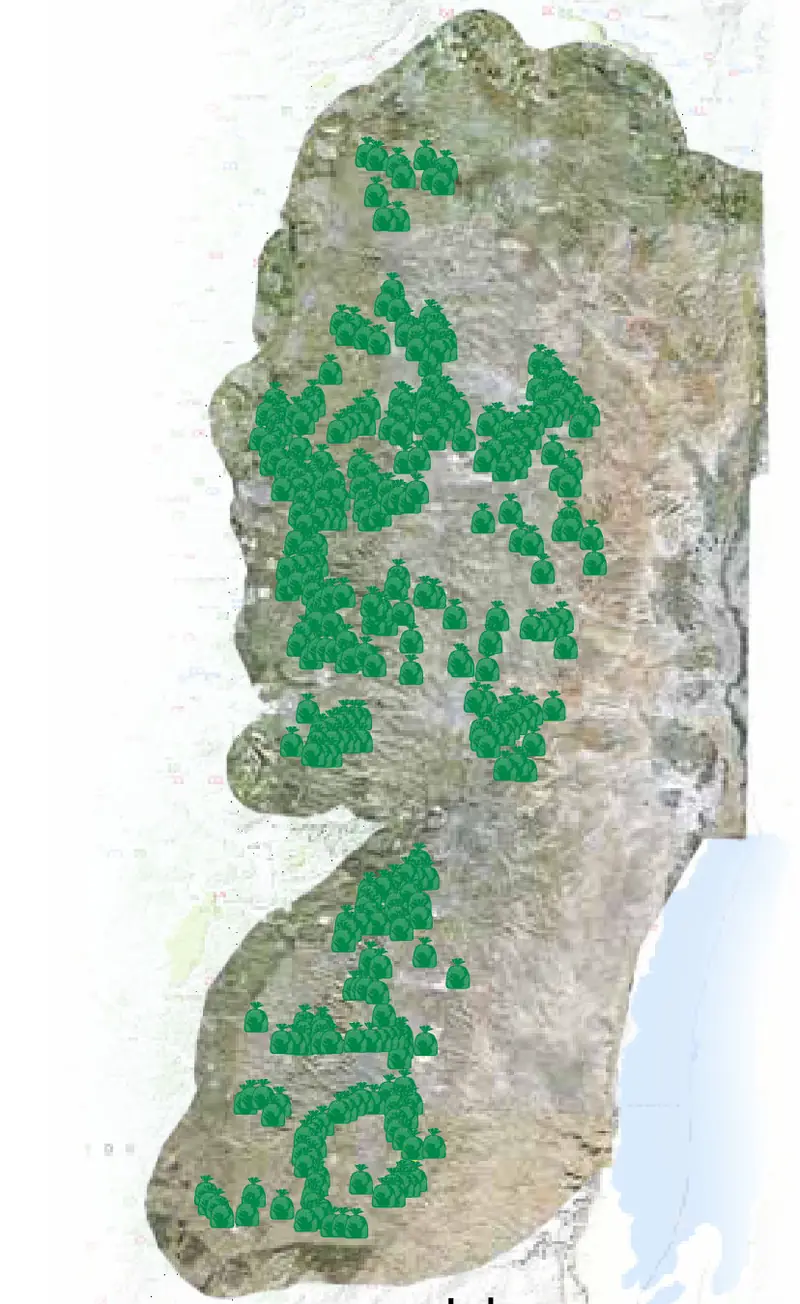
Waste treatment for the prevention of harm to health and the environment is one of the central environmental challenges worldwide, in light of the constant increase in the manufacture of consumer products and consumption rates. According to Civil Administration estimates (based on Palestinian Central Bureau of Statistics data, which many experts believe are exaggerated), about 2,700,000 Palestinians live in Judea and Samaria, together with more than 500,000 Israeli residents. Waste from some 2,000,000 Palestinian Arab residents is collected at two poorly maintained PA-administered landfills: Zaharat al-Finjan in the Bethlehem area and al-Minya in the Jenin area. The waste produced by Israeli residents, for the most part, is collected by local authorities and transported to Israeli final disposal sites, with the exception of 5 local authorities that transfer their municipal waste to the al-Minya landfill. Theoretically, the landfill sites operate under the supervision of the Map of unauthorized landfills and Environmental Protection Staff Officer
dumps in Judea and Samaria
in the Civil Administration, but in practice, unlike landfills in Israel which must meet environmental and health conditions as required by the Ministry of Environmental Protection and under its enforcement, the Palestinian sites do not meet the standards accepted in Israel and cause harm to health and the environment. We are not aware of any enforcement being carried out against them.
According to Civil Administration estimates, waste from at least 25% of the Palestinian population, which is about 700,000 residents, is not collected in an organized manner and not transported to final disposal sites.30 This waste is dumped in open areas, and a large portion of it is buried or burned illegally, creating health and environmental damage.
Our survey reveals that there are hundreds of unregulated waste sites in Judea and Samaria (“waste sites,” “dumps,” or “illegal sites”). At these sites, various types of waste are dumped: household, bulk, industrial, automotive (vehicle scrap), agricultural, agricultural plastic, construction, electronic, and even medical and hazardous waste. The local “treatment” of waste includes dumping in valleys, open spaces, and anywhere possible, as well as burning, dismantling, and burying. The common method is a burning dump next to every village or town.
This report deals primarily with household and electronic waste, but agricultural and construction waste also account for a large part of the unregulated waste of Judea and Samaria. Thus, whereas in Israel regulation and enforcement in the waste sector are increasing, including for agricultural and construction waste, in Judea and Samaria lawlessness is increasing in this domain both in self-generated waste production and in waste transfer from Israel.
Agricultural waste generated as part of agricultural activity includes organic and inorganic waste. Organic waste includes animal manure, carcasses, various types of plant waste such as pruning waste, surplus agricultural produce, plant remains, various effluents during growing and washing, waste generated in olive presses during oil production, and more. Inorganic waste includes plastic (greenhouses, net houses, etc.), produce packaging, pesticide containers, cardboard boxes, and various materials used by farmers such as tires, fuels, oils, and pesticide packaging waste, which often contain materials prohibited for use in Israel.
Construction waste is a byproduct of construction and infrastructure work such as road paving, sewage works, and more. This waste consists of various materials such as concrete, bricks, tiles, and ceramics.
The State of Israel invests significant resources, combining supervision and enforcement authorities, to deal with the phenomenon of illegal construction waste dumping in Israel. Yet, of approximately 3.6 to 6.2 million tons of construction waste produced in Israel annually, only 2.7 million tons of
construction waste reaches regulated treatment and disposal facilities. Thus, between 1 and 3.5 million tons of construction waste are dumped illegally in open areas each year.31
The situation in Judea and Samaria is seven times worse because there’s no need to evade police officers or make an effort to transport waste, and dumping is done routinely in every wadi, stream, and open space.
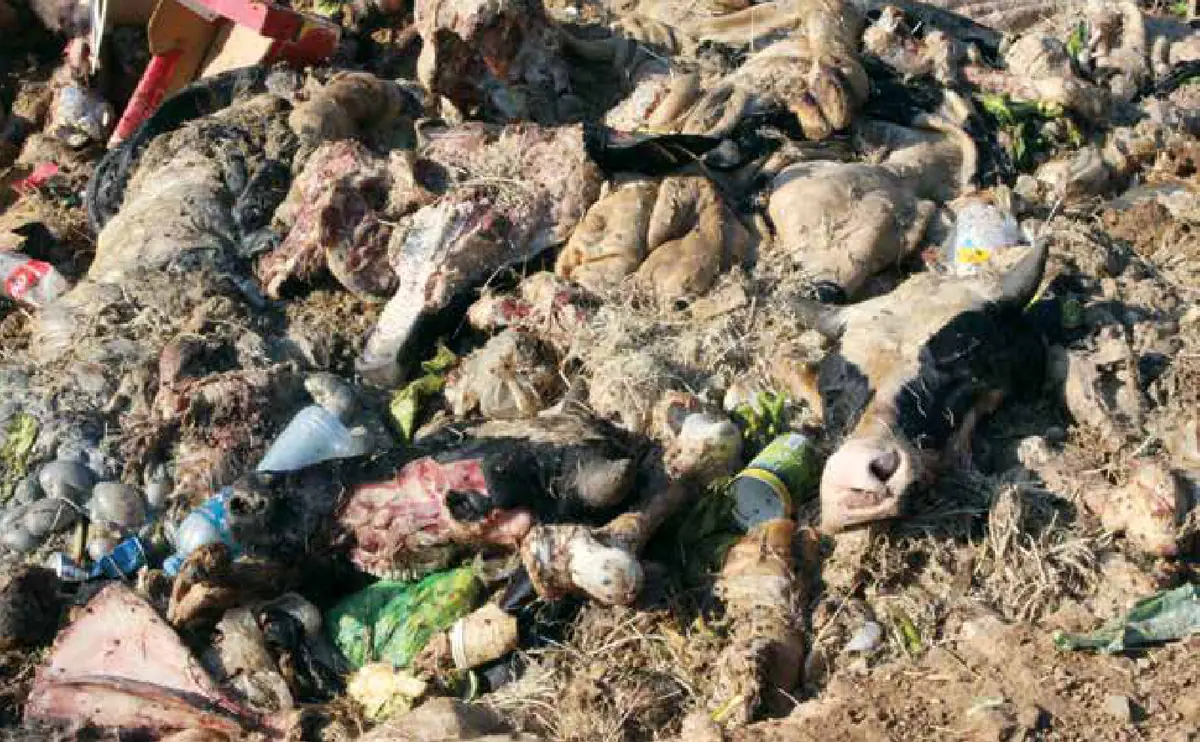
The waste sites in Judea and Samaria include dumping, burning, and burial sites operating without meeting any standards32 and harming both health and the environment. At these sites, there is no infrastructure preventing leachate seepage into the ground. Thus, various materials present in the waste, including hazardous materials, paints, solvents, oils, fuels, medications, and pesticides, seep through and harm the soil and water sources. The sites themselves and their leachate contaminate the soil and damage surface water sources and groundwater, causing pollution of the Mountain Aquifer as well as contamination of flood waters in streams, including those flowing into Israeli territory.
These sites cause severe health damage to nearby populations, Arab and Israeli alike. The damage is caused by smoke and its components; deposits of toxic materials, including heavy metals in soil; proliferation of pests and the spread of diseases. These also cause odor nuisances to nearby communities, harm travelers on nearby roads, damage the landscape, harm the area’s tourism potential, lower property values and harm wildlife, vegetation, and natural habitats.
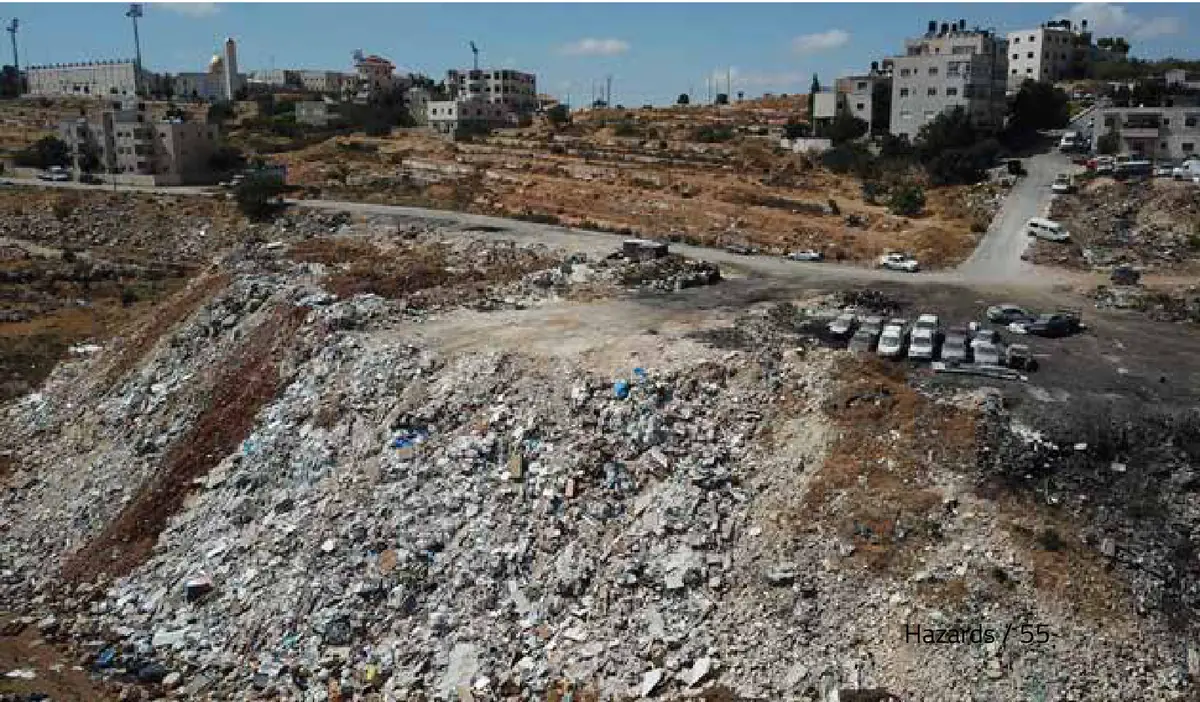
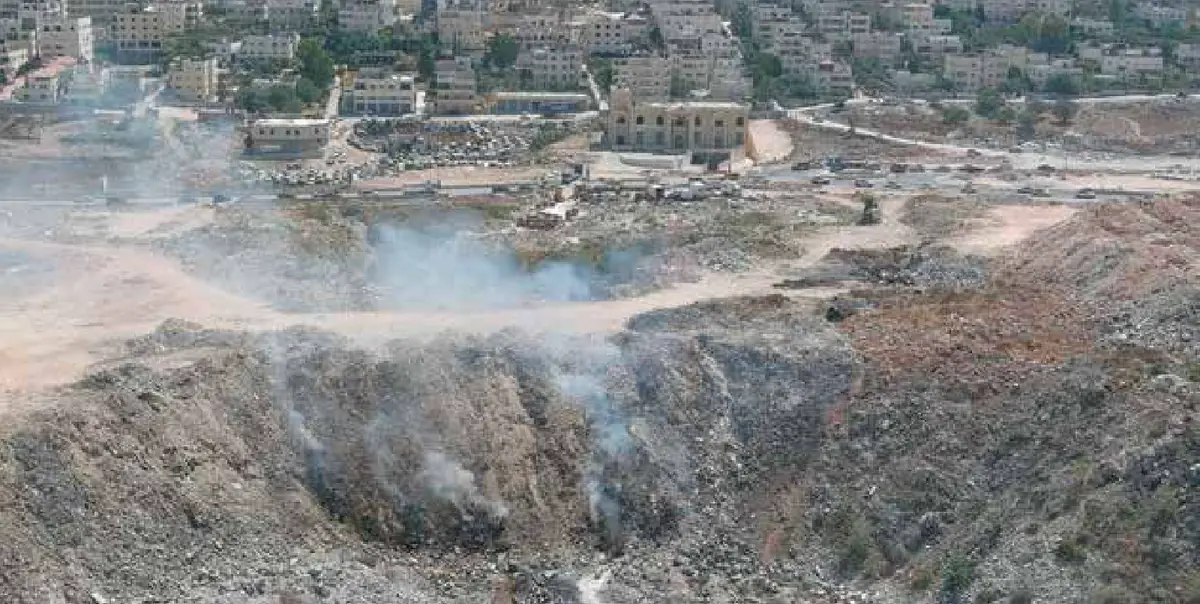
The waste sites create severe air pollution and emit greenhouse gases, especially methane, which is a potent greenhouse gas, causing harm at the global level as well. Air pollution is exacerbated by waste burning, which occurs at very high frequency, causing the emission of dangerous gases and bad and disturbing odors.
The rise in living standards in Judea and Samaria contributes to an increase in per capita waste and consequently increases the total amount of untreated waste. Paradoxically, as regulation is added and enforcement increases in the waste sector within the State of Israel, the motivation for waste “export” increases, including electronic, construction, and agricultural waste—for “treatment” in Judea and Samaria.
Waste treatment in Israeli settlements
The state of waste treatment in the twenty-three local authorities in Judea and Samaria needs improvement, mainly regarding recycling and recovery percentages (similar to all of Israel), but the situation is much better compared to the rest of Judea and Samaria. Regarding the Israeli local authorities, there is enforcement by the Ministry of Environmental Protection and by the Samaria and Judea Environmental Associations, and the trend, as in all regions of the country, is to increase separation and recycling percentages. Packaging is transferred for sorting, and most authorities also have collection and recycling of glass and cardboard.
Most of the waste produced in Israeli settlements is transported to waste disposal sites within the territory of the State of Israel (mainly to the Haruvit landfill and the GreenNet sorting facility in Jerusalem). For example, Modi’in Illit and Givat Ze’ev transport their waste to GreenNet. Israeli settlements also transfer waste to the Tovlan landfill in the Jordan Valley. The Masua composting plant in the Jordan Valley also receives waste that has been sorted at the GreenNet facility, treats the organic portion through composting, and transfers non-compostable waste for burial at the Tovlan landfill. A Palestinian site, al-Minya, receives waste from Gush Etzion and elsewhere. In the past year, waste from most Samaria and Benjamin authorities has been treated at the modern Univerve facility in the industrial zone adjacent to the Emanuel settlement. This waste is sorted and materials that cannot be recycled are sent for burial at Tovlan. In the future, the organic components will also be treated for composting and energy production.
Landfills
Waste burial is at the bottom of the waste treatment hierarchy and is considered the most environmentally harmful method of the various options available. Waste burial has negative impacts on health and the environment in multiple areas, with
International waste treatment hierarchy
both short- and long-term effects, lasting until future generations:
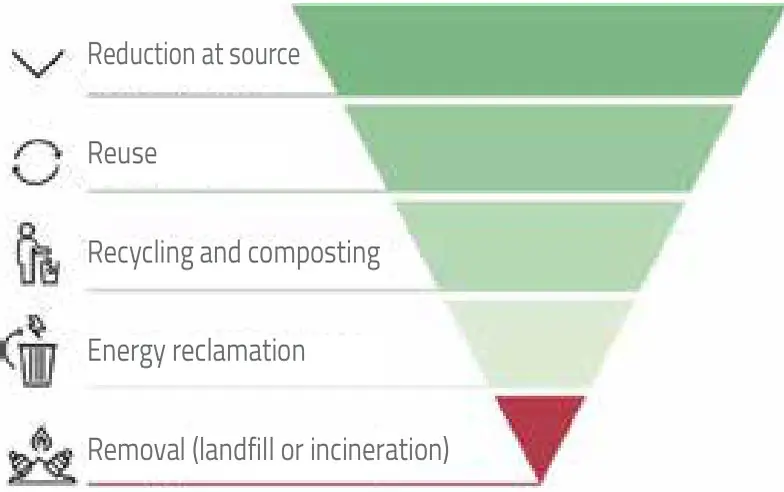
greenhouse gas emissions, air pollution, and groundwater and soil contamination following leakage of leachate containing high concentrations of organic and inorganic compounds, including heavy metals. In addition, burial creates pest and odor nuisances, damages open spaces, causes odor problems for nearby settlements, affects travelers on nearby main roads, damages the touristic potential of the area, reduces land values, and harms wildlife and their natural habitats.
Many steps have been taken in the State of Israel to reduce the severe damage from waste burial: education and culture, source reduction, sorting and recycling, reducing burial at landfills through various means such as advanced waste treatment, landfill levies, and more. Additionally, there is a clear government policy not to establish new waste landfill sites. However, in Judea and Samaria, the Civil Administration intends to establish new landfills, because of the phenomenon of illegal waste burial.
In all developed countries as well as in Israel there is a clear downward trend in the percentage of waste being buried, which, as explained above, is the least favored solution for waste. In Judea and Samaria, however, the burial of waste is only increasing and the State of Israel (through the Civil Administration) is even assisting in establishing a new landfill (the Ramon landfill, see below) and expanding the use of existing ones.
Many tools for promoting landfill reduction—such as legislation and landfill prohibitions on recyclable waste, landfill levies, landfill targets, education and outreach, and enforcement—are lacking in the Palestinian sector in Judea and Samaria. Thus, in addition to official and recognized landfills, pirate ones operate undisturbed.
There is a clear correlation between landfill costs and the rate of waste that is recycled or transferred to composting: the higher the landfill cost, the larger the amount of waste that moves up in the waste treatment hierarchy.33 In Israel, there is a landfill levy and its rate has been increasing.34 In contrast, in Judea and Samaria, in the absence of legislation and enforcement or any incentive for environmental waste treatment, and in the absence of proper
alternatives, the rate of waste burial continues to increase. Six waste transfer stations operate in Judea and Samaria, performing only primary sorting. One station operates in western Samaria (Qalqilya), three in the Hebron-Bethlehem area (Yatta, Ubeidiya, and Abu Dis), one in the Jerusalem area (a-Ram), and one north of Jerusalem (Psagot - al-Bireh). By any measure, these are too few stations spread over a large area of almost 6,000 square kilometers.
In addition to these six transfer stations, there are three official landfills in Judea and Samaria: in the Jenin area (Zaharat al-Finjan), in eastern Gush Etzion (al-Minya), and in the Jordan Valley (Tovlan). The Zaharat al-Finjan landfill receives about 1,400 tons of Palestinian Arab waste per day and the al-Minya landfill 1,200 tons, 260 of which are from nearby Israeli settlements. The Tovlan site receives Israeli waste only and because its operators are Israeli, it is required to collect a landfill levy. As noted, according to the assessment of the Civil Administration, about 700,000 Palestinian Arabs, constituting about 25% of the total Arab population of Judea and Samaria, are not served by any waste treatment facility. The plan is for this population to be served by the Ramon landfill, which is to be established near the settlement of Rimonim in the Binyamin Region.
The Ramon landfill
The Ramon landfill project, which is being advanced by the Civil Administration with Palestinian entrepreneurs and assistance from the German Development Bank KfW, is intended to provide a solution for waste produced by about 700,000 Palestinian Arab residents, which is currently being illegally dumped, buried, and set on fire in hundreds of sites, severely harming health and environment. Green Now previously petitioned the High Court of Justice against the establishment of the landfill and renewed its petition, together with the Samaria Environmental Association. The petition was heard in 2022.35
Note that Green Now views very positively the desire to solve the existing environmental problems, but petitioned against the proposed Ramon landfill for several reasons:
- 1. Burying waste is now considered the least favorable method for waste treatment, and it is not environmentally correct to use this method as a primary and main approach.
- 2. The policy of the State of Israel is not to establish new landfills.
- 3. The site planned for this landfill lies on the border of the Makukh Stream Nature Reserve. This is a unique reserve, located at the edge of the desert, that is known for its rich biodiversity of both desert and Mediterranean region species. The reserve is unique in its ecological diversity and its geomorphological and geological characteristics.
- 4. The establishment of the landfill completely contradicts the policy of the German government, which is actively seeking to establish it. It does not meet international standards, and does not represent the interests of the area’s residents.
- 5. Many objections from authorities and environmental organizations were submitted against the establishment of the landfill,.
- 6. Improper operation of the site, which is projected to be managed and supervised like other Palestinian landfill sites that cause severe hazards, could lead to many environmental hazards as well as health damage and nuisances to area residents.
- 7. The approval of the plan is fundamentally flawed, especially in the environmental aspect, including failure to consider appropriate alternatives that were submitted to the Civil Administration but were not discussed at all.
- 8. Legal arguments include the fact that international law requires Israel to provide proper environmental treatment.
- 9. In addition to the technical problems, the Ramon landfill project is discriminatory. The project’s backers, the German Bank KfW, stipulated that the Ramon landfill will serve Palestinian Arabs exclusively – and the Civil Administration agreed to this condition.
Following the Green Now petition to the High Court of Justice, the state announced that alongside advancing the Ramon plan, the Civil Administration is promoting a plan to establish a waste sorting and recycling facility that will serve all residents of the area. In light of the proposed solution, the petition was dismissed; Green Now welcomed the commitment to achieving an advanced solution for the entire population.
We intend to monitor developments closely and to demand that the anti-environmental solutions be replaced with forward-thinking, environmentally sound solutions for the entire population and all areas in Judea and Samaria (see detailed proposal by the Samaria Environmental Association, below).
The landfills and some of the transfer stations were originally established by the World Bank, and as long as they were operated by European entities, they met certain environmental standards. But after five years of operation under European supervision, they were transferred to local management and rapid deterioration in maintenance levels ensued. Preliminary sorting facilities ceased to operate, landfill gas collection pipes were buried under waste, leachate collection pipes became blocked, leachate pools were not maintained, and at al-Minya, for a certain period, the Palestinians even dug an additional leachate pool with no protection against seepage into the subsoil. The environmental damage resulting from poor maintenance of the landfills is severe and undeniable. Inadequate covering of garbage causes severe odor problems within a radius of more than two kilometers around the site. The shallow covering can cause internal combustion of waste that is not properly buried and is exposed to oxygen. Failure to collect landfill gas leads to the release of greenhouse gases, the worst of which is methane gas (CH₄). Poor collection of leachate can contaminate groundwater and cause odor nuisances.
Landfills are an outdated practice that is no longer accepted in the world. As far as the landfills under Palestinian management are concerned, the al-Minya landfill is an example of the severe ecological disaster that this practice
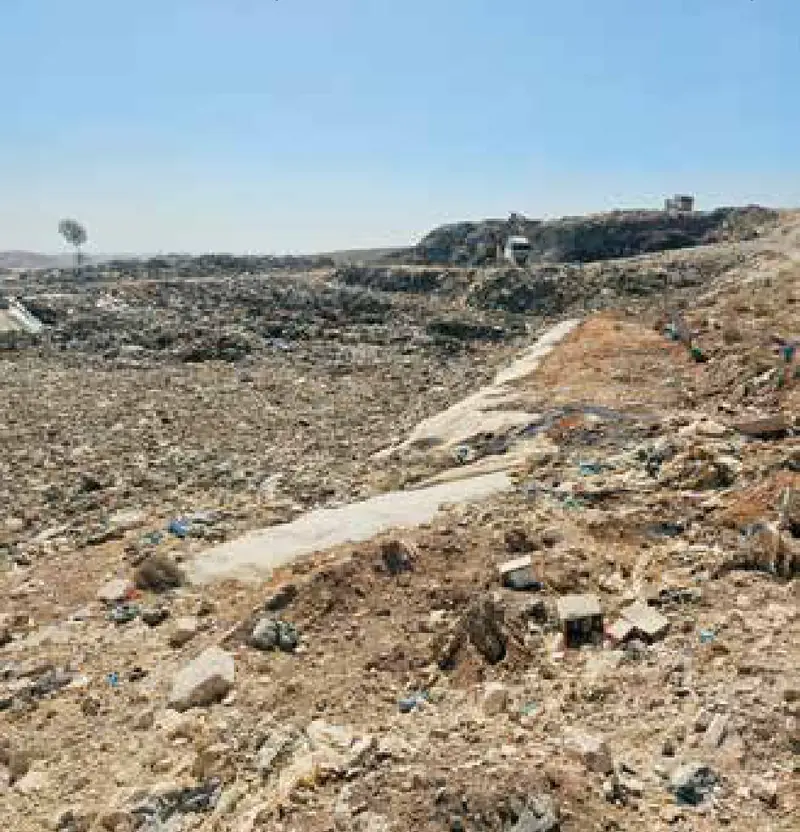
can cause. In the summer of 2024, one of the slopes of the waste mound at al-Minya collapsed. As a result, large amounts of waste and contaminated leachate slid into the Amos Stream below the site. Various environmental bodies mobilized to map the extent of the damage and suggest urgent solutions to prevent the spread of damage to the Darga Stream and the Dead Sea, but as of this writing, the threat remains.
Green Now and other environmental organizations have pointed out the double threat posed by a dangerous, substandard landfill that is administered by indifferent, negligent Palestinian management.
Therefore, the Samaria Environmental Association and the Benjamin Regional Council propose an alternative plan for the Ramon waste disposal facility site: an advanced and comprehensive solution for waste from all population groups in the area.
Main Points and Advantages of the Plan
1. The facility will operate under Israeli law. Technology specifications, supervision, and enforcement will be under the Ministry of Environmental Protection, the Binyamin Regional Council, and the Samaria Environmental Association.
- 2. Establishment of an advanced facility, by an entrepreneurial company, for sorting, composting, anaerobic digestion (including electricity production), and disposal of remnants, for about 800 tons of mixed waste per day. The solution complies with the Ministry of Environmental Protection policy. About 700 tons/day of Palestinian waste (Environmental Protection Staff Officer estimate) and about 110 tons/day of waste from the Benjamin Regional Council.
- 3. The solution will enable complete treatment of mixed waste from all populations in the area for 15-20 years, compared to the existing landfill plan which will suffice at current quantities for only 10 years. Advantages:
1.
2.
Support from the Ministry of Environmental Protection for planning and construction according to standards accepted in Israel and in accordance with the Ministry of Environmental Protection policy. Licensing, supervision, and enforcement regarding all sorting,
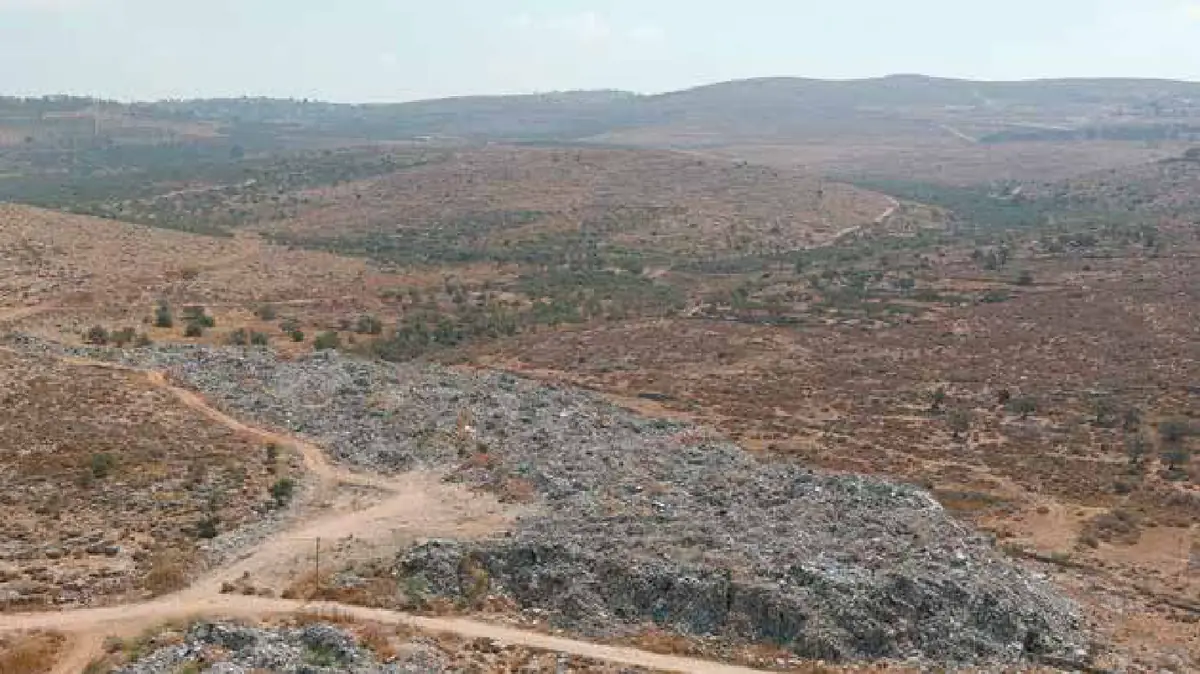
treatment, and disposal facilities, including the rehabilitation phase (which will continue for over 20 years after disposal ends) will be according to procedures of the Ministry of Environmental Protection and the Samaria Environmental Association. This contrasts with the existing plan specifying that operations will be performed by Ramallah-al Bireh Sanitation Authority with Civil Administration supervision. The al-Minya and Zaharat al-Finjan landfill sites operating in this way cause many environmental hazards.
- 4. Responsibility of Palestinian Authority and the Civil Administration for establishing transfer stations and transporting Palestinian waste from all relevant areas. The German Bank’s contribution can be directed to this issue. System operation can be performed by the Ramallah-al Bireh Sanitation Authority.
Illegal waste sites
A quantitative analysis of the survey data shows that out of many hundreds of unauthorized waste sites, most cover an area not exceeding one dunam. About 300 waste sites are larger than one dunam and reach up to an area of about ten dunams.
Most illegal sites are located above the recharge areas of the Mountain Aquifer, which puts one of Israel’s main water sources at risk of contamination; the dumped waste produces leachate which can seep through permeable rock, and sometimes even karstic rock (rock containing open cavities), directly to the groundwater.36
In the absence of supervision and enforcement, Judea and Samaria has become a lawless area, where waste is dumped, dismantled, buried, and burned along roadsides and in open spaces, severely harming residents’ health and the environment. These things are known, but Hanan Greenwood’s article provides an adequate illustration:
“Almost next to every Palestinian village, one can clearly see the place where residents dispose of their waste. For example, opposite the settlement of Nili, there is a mound covered in garbage. During a tour in Benjamin, an initiative of the Regional Council and the Samaria Environmental Association, a body with a membership of more than 100 settlements in Judea and Samaria, we drove for long minutes between mounds of garbage. Starting from simple garbage bags, through furniture and electronic waste, to carcasses of sheep and goats. Fires are lit daily, and we’re talking about Area C, under full Israeli
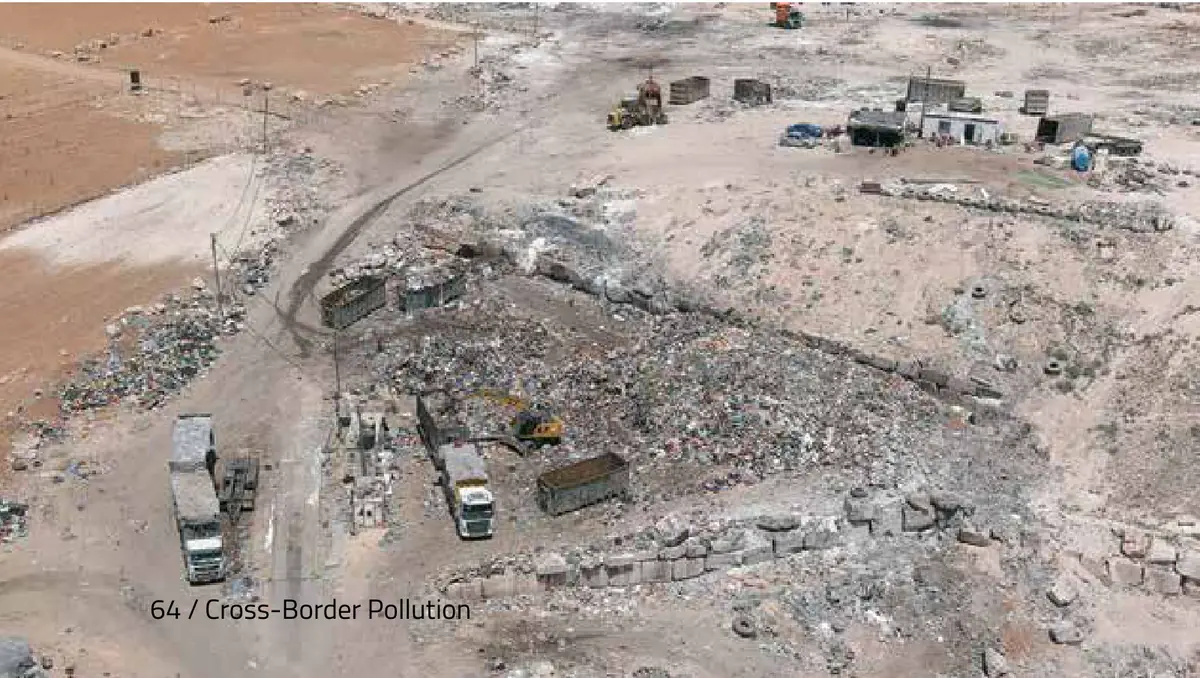
civil and security control.”37 Although from time to time the Civil Administration seizes trucks from waste offenders, this is just a drop in the ocean. Recently, in a single joint operation between the police and Civil Administration, 35 trucks carrying waste to illegal waste sites and landfills were seized, 34 suspects were detained for investigation, and 159 investigation files were opened.38 Out of thousands of trucks and vehicles that transport waste to Judea and Samaria, only about 200 are seized per year. For example, it was reported that in 2020, 215 trucks and vehicles that transferred waste to Judea and Samaria were confiscated.39 The Ministry of Environmental Protection is closely familiar with this phenomenon, especially with the lack of treatment on the Palestinian side, which affects all populations in the area and the environmental conditions in Judea and Samaria. Aware of this situation, in May 2021, the Cleanliness Fund of the Ministry of Environmental Protection approved a three-year budget transfer of about 10 million shekels for planning and establishing household waste transfer stations for Palestinian local authorities,40 and additional budgets were later approved, but in practice, there is no significant change in the field.
Waste burning in Judea and Samaria
In the Palestinian sector in Judea and Samaria, there is a widespread phenomenon of waste treatment through burning at hundreds of illegal sites near villages. The waste sources are diverse: household, industrial, construction, agricultural, and electronic.
Waste burning in Judea and Samaria serves various purposes: intentional burning meant to reduce waste volume to make room for new waste; burning for metal extraction; burning of agricultural pruning waste (for disposal and prevention of plant diseases); burning of agricultural plastic for disposal; unintentional fires resulting from sparks, etc.
The burning waste accumulations cause health and environmental hazards and harm the quality of life of nearby residents. It also harms travelers on main and rural roads passing near waste sites and landfills. For example, on Roads 60 and 55, tens of thousands of vehicles pass daily, and their passengers are exposed to air pollution and health damage.
Waste burning releases various toxic materials, some of which are known carcinogens and harmful to health and the environment. The section dealing with air emission of suspected or known carcinogenic materials in the PRTR report of the Ministry of Environmental Protection (2022) states: “Combining inventory data for 2021 with the Pollutant Release and Transfer Register (PRTR) for 2021 shows that 76% of the quantity national emissions of carcinogenic materials is caused by illegal burning of municipal waste and burning of agricultural plant waste.”41 These data refer to waste burning within sovereign Israel, where there is legislation, regulation, and enforcement. In the absence of all these in Judea and Samaria, it is clear that the situation beyond the Green Line is much more severe. Furthermore, the burning causes economic damage and, of course, a safety hazard.
Air quality monitoring in Judea and Samaria is conducted at monitoring stations in Ariel and in Alon Shvut in Gush Etzion, but it is far from providing a reliable picture of the air pollution affecting settlements located near burning dumps, both in Judea and Samaria (Sha’arei Tikva, Elkana, and many others) and within the State of Israel (such as Rosh Ha’ayin, Hadera, the Lachish settlements, and many others).
Our fieldwork, which includes work with field personnel, drones, and various aids, as well as based on hundreds of citizen inquiries, revealed dozens of
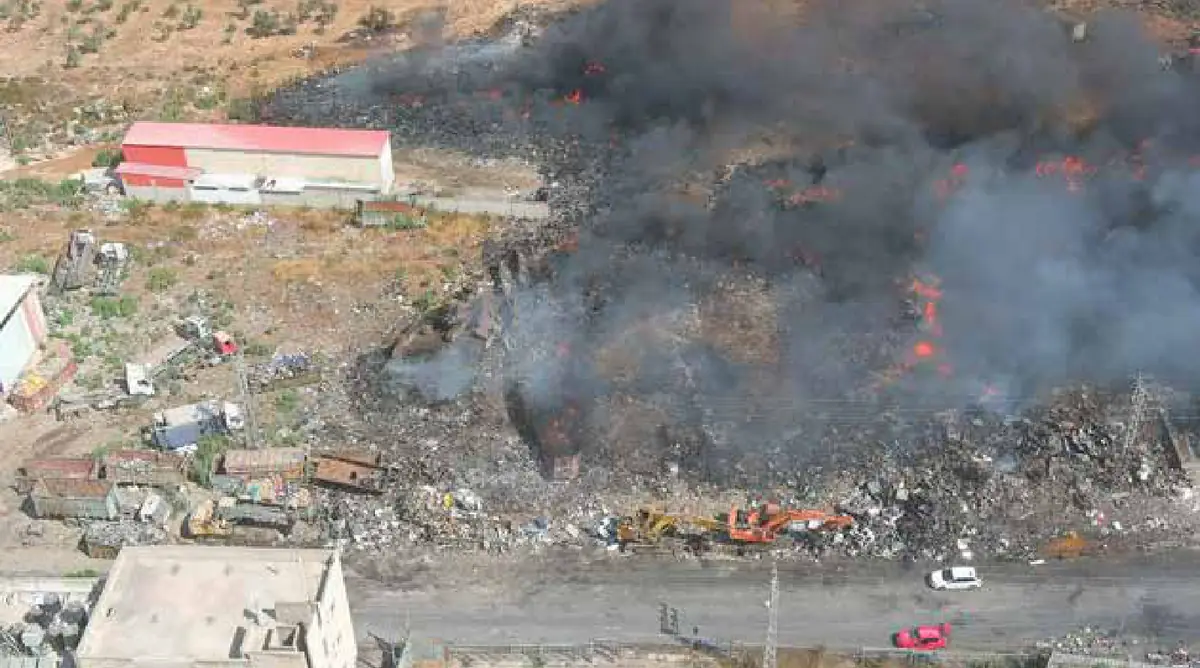
waste sites burning on any given day; counting small sites of families and clans, the number of sites climbs to the thousands. Some of the sites burn constantly, without interruption. The Samaria Environmental Association has conducted mapping based on reports and observations, which reveal part of the scope of the problem. Over a period of about half a year, in 2020, an average of 46 burning sites were recorded daily in the Samaria and Binyamin regions alone.
All residents of Judea and Samaria suffer from waste burning, Arabs and Israelis alike, as well as travelers on roads adjacent to waste sites. As stated in Section 3, the State of Israel is committed to the welfare and wellbeing of all affected residents. Furthermore, the smoke does not stop at the Green Line and it affects nearby residents throughout the State of Israel. Residents are affected in Jerusalem, Eastern Lachish, Or Yehuda, Yehud, Shoham, Modi’in Region, Kfar Saba, and Rosh Ha’ayin.42
Several reasons listed above contribute to this grim picture detailed regarding all hazards in Judea and Samaria, but there are additional factors including the lack of waste collection container deployment in villages, the costs of collection and transport to transfer stations and landfills, and their entrance fees, which the Palestinian authorities cannot easily afford.
Health impact of waste burning
Many studies have been conducted on the health hazards of waste burning, and the State of Israel is trying to cope with the challenge, among others, through legislation and enforcement.43 Various pollutants are released into the air during uncontrolled waste burning: respirable particles, dioxins, furans, polyaromatics, volatile organic compounds, carbon monoxide, ash, and odor nuisances. The health damage caused by burning electrical and electronic devices is discussed in detail below.
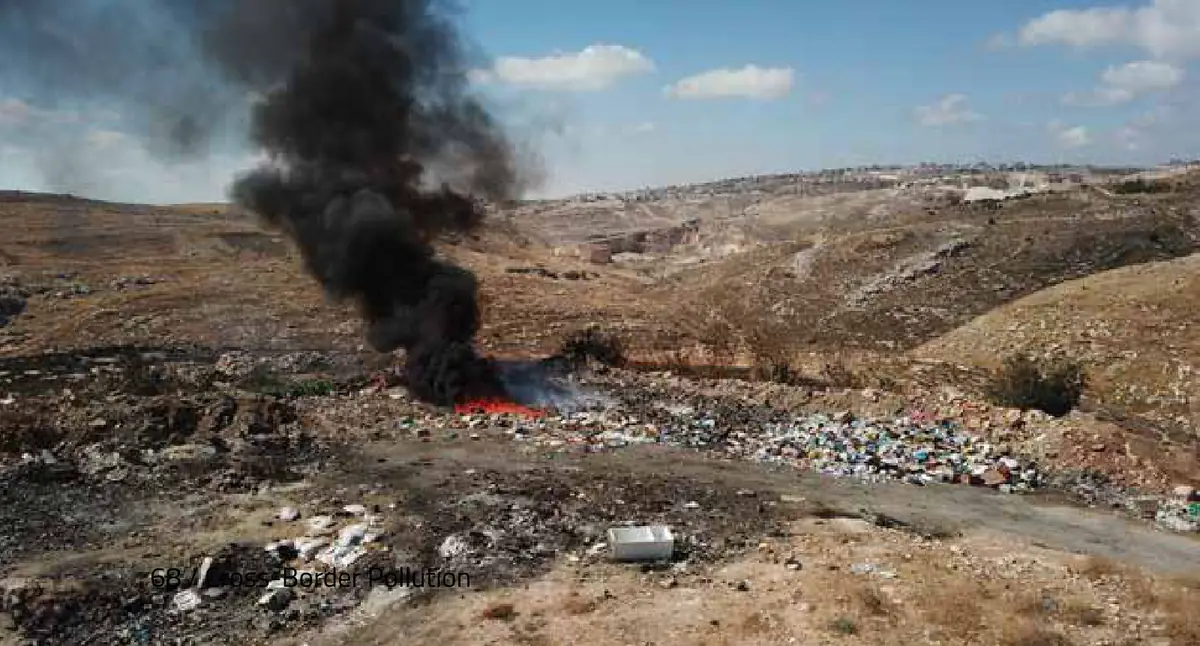
On the environmental and economic impact of waste burning
Our fieldwork identified hundreds of burning waste sites in Judea and Samaria. For many years, almost every time a drone is launched, the emerging picture is one of burning waste sites. Thousands of citizen complaints about environmental issues in Judea and Samaria deal with waste burning, and various organizations are trying to address this severe hazard without success. For example, a report by the Samaria Environmental Association states: “The most difficult, Sisyphean, and widespread nuisance in Judea and Samaria is caused by the burning of household waste, tires, and electrical cables to collect and sell copper. There is hardly a Palestinian village that does not have at least one waste-burning site in its vicinity. Already in 1996, in a survey conducted by the Municipal Environmental Associations, approximately 400 garbage dumps were mapped.”44 The economic damage caused by waste burning in Israel was estimated by the Ministry of Environmental Protection to be hundreds of millions of Shekels annually, resulting from loss of productivity and medical treatment costs due to pollutant emissions.45 In the assessment of the Ministry of Environmental Protection, the external cost resulting from public health damage due to air emissions from organic waste burning alone is estimated at approximately NIS 415 million per year.46 The calculation of the Ministry of Environmental Protection does not include the decrease in land values, environmental costs due to soil contamination, water source pollution, the cost of removing burned waste remnants or soil rehabilitation costs.47
In a 2019 study by the Ministry of Environmental Protection, the amount of waste burned in Israel was estimated at approximately 250,000 tons per year. According to an estimate by the Knesset Research and Information Center, based on this amount, the external cost is approximately NIS 572 million.48 Additionally, there are long-term economic costs associated with the high morbidity rate among residents of communities adjacent to burning sites, as air pollution directly affects illness and mortality. A 2017 OECD report 49estimated the deaths and economic costs due to polluting particles (APMP) resulting from pollution emissions caused by power generation, industry, and transportation. According to the report, in 2015, there were approximately 2,200 deaths in Israel due to polluting particles, and the economic cost was estimated at 2.3% of GDP, namely about NIS 26.7 billion. According to CBS data, Israel’s GDP in 2022 stood at NIS 1,756 billion, meaning that damages from premature death due to particle inhalation in the last year amounted to NIS 40.4 billion annually. These figures do not address waste burning in Judea and Samaria but demonstrate the enormous potential for health and economic damage from pollutant emissions. For an estimated assessment of these damages, see the Economic Aspects section.
Waste fires at hundreds of sites in the West Bank cause severe air pollution and widespread health and economic damage. Without a detailed waste management plan in PA-controlled areas (A and B) and much of Area C, the main effort of the Civil Administration focuses solely on extinguishing fires (literally and figuratively), primarily responding to daily complaints received through the Civil Administration and Environmental Protection Ministry hotlines. The Environmental Protection Officer at the Civil Administration works with Regional Coordination and Liaison offices, usually in response to reports by Israeli residents, using Palestinian contractors to extinguish waste fires by covering them with soil. This “solution” is effective only for 1-2 days, after which the waste is reignited and burned again in a continuing cycle.
Committee on 20.02.2023.
Examples of waste burning in Judea and Samaria
In August 2022, the Dahariya Municipality decided to save the transportation costs to the Yatta transfer station and the al-Minya landfill, and opened an illegal dumping site above Hebron Stream where garbage was occasionally burned. The burning of waste at this site caused severe smoke nuisances to residents of nearby communities. In a joint operation by the Land Unit of the Har Hebron Regional Council, the Judea Regional Brigade, and the Supervision Unit of the Civil Administration, in January 2023, several heavy machines were confiscated and the site ceased to operate. In its place, dozens of smaller fires now burn the same or greater quantities of waste. For further illustration, Hanan Greenwood reports: “In the Samaria Regional Council area, residents in the ‘Western Bloc’ in central Samaria have been monitoring the lawlessness for an extended period. In a firing zone bordering nearby Rosh Ha’ayin, four illegal incinerators operate, run by Bedouin clans, and each time the Palestinians ignite the fires, the smoke makes its way directly into residents’ homes beyond the fence.”50
For years, the substantial waste from Jericho and nearby villages has had no proper environmental solution, nor did the large quantities of pruning waste from date palm orchards. Waste trucks from Jericho and neighboring Palestinian villages dump waste directly into the environment in several areas, both at large and small sites. To deal with the large quantities of waste and extensive pruning waste and make room for new waste, Palestinians set fire to the waste piles and burn the pruning waste mostly within the orchards. Area residents, both Palestinians and Israelis, suffer greatly from the thick smoke, and there are reports of respiratory diseases, especially in children, and of the parents’ anxiety about serious illnesses.
Another prominent example is found in an area defined as a “Consensual Reserve,” a nature reserve in the Judean Desert and Dead Sea area in eastern Gush Etzion and its surroundings. This area constitutes 3% of the territory if Judea and Samaria and was transferred, as part of the agreements between Israel and the Palestinian Authority, to Israel’s security control and the Palestinian Authority’s civil control. In this area, extensive illegal construction is taking place, and waste is being dumped at several locations, which have become permanent burning sites containing various types of waste, including tires, hazardous materials, and electronic waste. As a result of waste burning at this site, residents of eastern
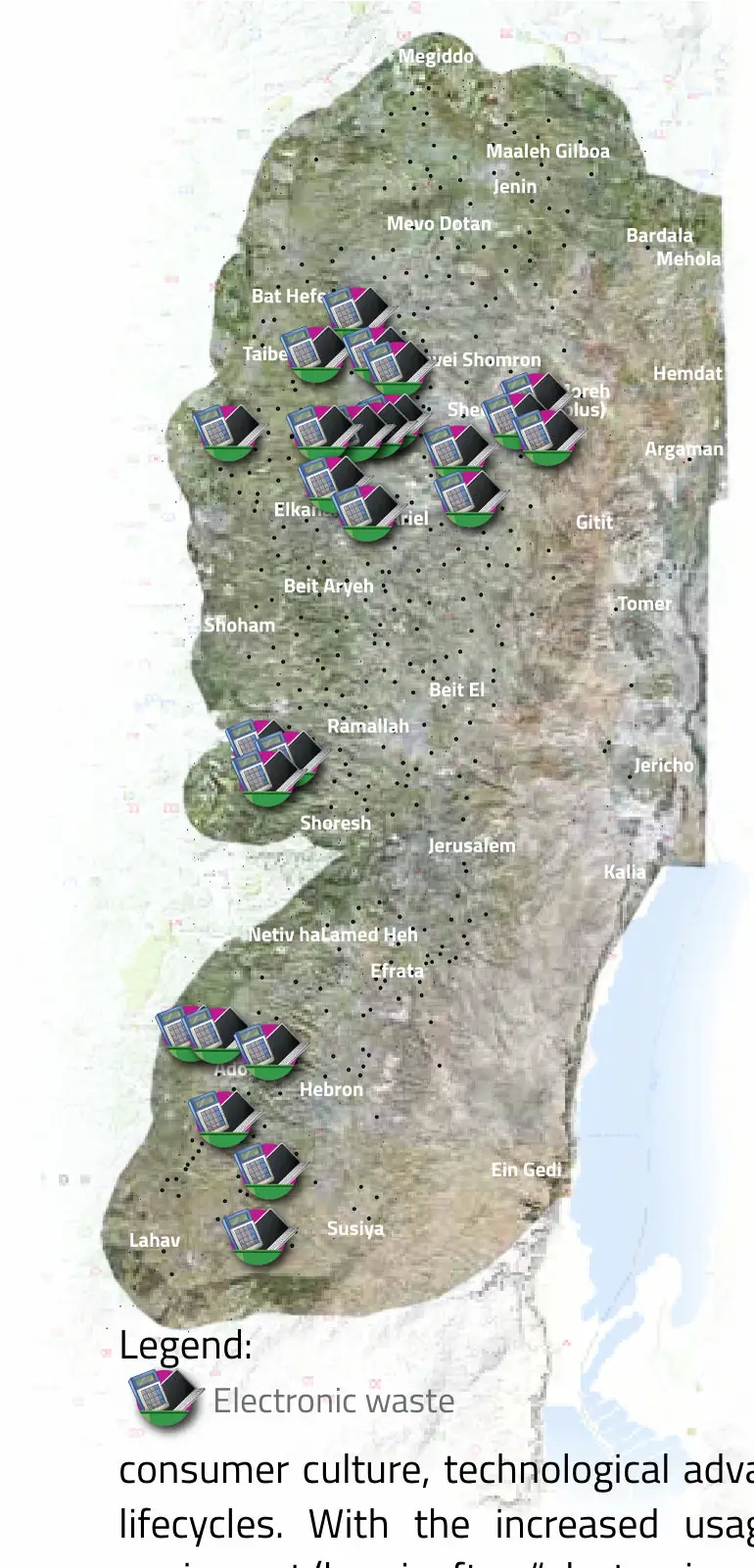
Gush Etzion and Herodion suffer from severe air pollution. The unique desert environment is also being damaged, and greenhouse gas emissions are intensifying.
Recently, several suspects were caught in real time while burning cables to extract copper, and bags of copper, vehicles, and tools were confiscated. From complaints we received and field inspections, it appears that the phenomenon is intensifying and causing great suffering to residents, some of whom are forced to stay indoors and even leave for remote locations to escape the effects of air pollution.51
Electronic waste
The growth in the use of electronic equipment, electrical devices, batteries, and related products (hereinafter, “electronic equipment”) worldwide continues to increase over the years because of rising living standards, lifestyle changes, consumer culture, technological advancement, and relatively short product lifecycles. With the increased usage, the amount of waste from this equipment (hereinafter, “electronic waste”) has also grown, together with its potential for health and environmental damage.52
Electronic waste contains various components and hundreds of materials, some of which are toxic and hazardous, which can cause direct and indirect long-term damage to human health and the environment. This occurs in all forms of waste treatment, including disposal, dismantling, burning, and burying.
Electronic waste also contains precious metals such as gold and copper, as well as iron and other elements that can be sold either assembled or as components. Many extensive waste fires are carried out in Judea and Samaria to extract precious metals, primarily copper, through burning cables and “unnecessary” plastic that form part of various devices, even for collecting plain iron. Some of the materials are resold in Israel. Waste fires emit many pollutants but in the case of burning electronic waste, the situation is much more severe, as the emissions contain a concentration of hazardous materials, metals, and gases characteristic of this waste. According to a study conducted in the US, electronic waste accounts for about 1% of all household waste by weight but it comprises approximately 70% of its toxic content.53
According to various estimates, in 2010 the amount of electronic waste in Israel stood at approximately 85,000 tons54. In 2019, the Ministry of Environmental Protection estimated the amount of electronic waste at double that: approximately 165,000 tons.55 From conversations with experts, it is estimated that currently, the amount of electronic waste stands at approximately 180,000 tons per year.56 The growth in electronic waste is a worldwide phenomenon; according to a UN report,
article/10.1007/s13762-022-04274-w
in 2020, electronic waste increased by about 20% in five years.57 Given the growth in the quantity of electronic waste and the severe dangers of disposing of it without proper treatment, Israel enacted the Environmental Treatment of Electrical and Electronic Equipment Law, 2012 (hereinafter, “Electronic Waste Law”). The main purpose of the law is to manage materials in the waste market and transform electronic waste from an environmental hazard into a public resource by making the materials available for reuse. This law is one of the extended producer responsibility laws focused on the “polluter pays” principle. The purpose of the law is to establish arrangements for the environmental treatment of electrical and electronic equipment, batteries, and accumulators to encourage the reuse of electrical and electronic equipment; reduce the amount of waste generated from electrical and electronic equipment and from batteries and accumulators; prevent their burial; and reduce the negative environmental and health impacts of electrical and electronic equipment, batteries, and accumulators, as well as equipment and battery waste, among others, through::
- 1. Imposing extended responsibility on manufacturers and importers of electrical and electronic equipment, batteries, and accumulators to carry out recognized recycling of equipment and battery waste.
- 2. Demanding that those responsible for waste disposal carry out separation and collection of equipment and battery waste from the residential sector, and establishing a prohibition on disposal and evacuation of battery waste, except in accordance with the law.
- 3. Imposing responsibility on marketers of equipment and batteries to accept equipment and battery waste from the residential sector from buyers.
- 4. Operating centers for equipment and battery waste as well as facilities for treating equipment and battery waste.
- 5. Establishing a prohibition against the burial of equipment and battery waste..
To meet the recycling targets set by law, manufacturers and importers who cannot do so themselves must hire a contractor recognized by the Ministry of Environmental Protection.
This law does not apply in Judea and Samaria, and the potential damage
from its absence is highly significant. The “treatment” of electronic waste in Judea and Samaria is carried out in various harmful ways such as dumping, burial, burning, and dismantling (hereinafter, “the electronic waste hazard in Judea and Samaria”). The electronic waste hazard in Judea and Samaria does not stay in one place and pollutes air, water, and soil across a wide geographic area. The burning of electronic waste in Judea and Samaria is carried out for waste disposal and as part of routine domestic and industrial waste burning. In many cases, as detailed in the examples below, burning is done to extract components of economic value for sale.
Because of economic considerations and insufficient enforcement, a significant portion of electronic waste in Israel, which should have been treated according to the Electronic Waste Law by legally appointed contractors, illegally reaches Judea and Samaria and is “treated” there.58 The flow of electronic waste from Israel to Judea and Samaria areas is familiar to anyone who passes through checkpoints into Judea and Samaria, where trucks loaded with electronic waste can be seen crossing into these areas without any inspection. The phenomenon of electronic waste flow from Israel to Judea and Samaria, especially to the villages west of Hebron bordering eastern Lachish, such as Deir Samet, Idna, and Beit Awwa (hereinafter, “Hebron villages”), has been known for many years and is described in studies and articles both in Israel and worldwide.59
Note, however, that in the regulated industrial zones in Judea and Samaria, within Israeli communities, an electronic waste recycling industry has developed that is among the most advanced in the country. These include plants such as AllRecycling, the largest electronic waste plant in Israel in the Barkan Industrial Zone, the EMS Metals plant in the Shiloh Industrial Zone, Goodtech in the Mishor Adumim Industrial Zone, and others.
Illustrative case: Electronic waste in Hebron villages
The electronic waste burning problem exists throughout Judea and Samaria but is particularly severe in the Hebron villages area. Thousands of Palestinians, companies, and facilities “process” electronic waste to extract precious metals, iron, and other materials by dismantling and burning, followed by disposal and burial. Some parts (like computer components) are sold or used to assemble refurbished products. As of 2014, thousands worked in this “treatment” in the immediate Hebron villages area alone. The Environmental Protection Officer stated: “This hazard provides income for over 7,500 Palestinians. The root of
The article mentions the research of Prof. Yaakov Garb and John-Michael Davis. See also above in the article by Aaron Boxerman.
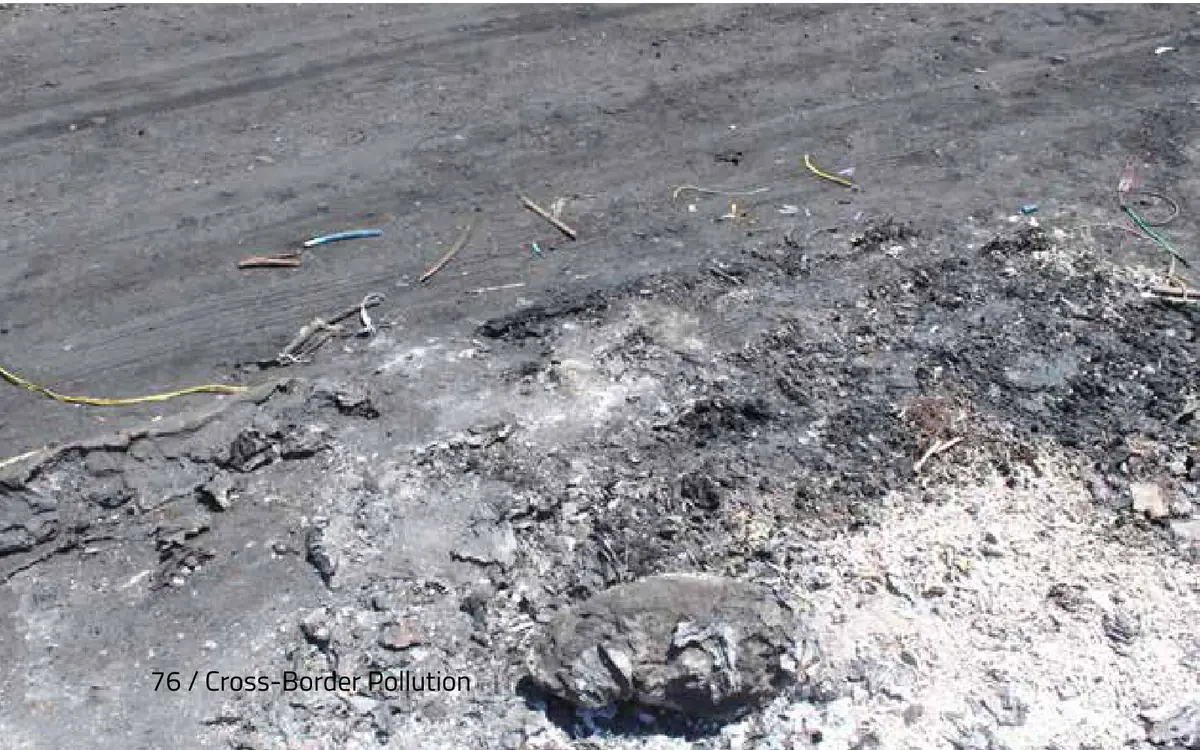
the struggle is bread.”60 Thousands more work in other villages and settings. Since 2014, the phenomenon has expanded. Prof. Jacob Garb from Ben-Gurion University estimates that tens of thousands are involved across the various frameworks.61 Electronic waste fires in the Hebron area cause severe health damage to residents of the villages and East Lachish.
Our survey in the region, information from Palestinian residents, research, and decade-long monitoring reveals about 300 “processing” sites of varying sizes.62 Some sites operate as metal extraction facilities for salvaging various components from the waste to sell or reassemble.63 These plants have employees, inventory tracking, and computerized documentation. Other sites are controlled by clans, and others yet are small piles “processed” by families, including child workers. Fieldwork and recent data show that electronic waste burning occurs daily, multiple times per day. East Lachish sometimes reports over 8 fires in one day, with some days having continuous fires and smoke. Decade-long studies indicate 40,000-60,000 tons of electronic waste annually transferred from Israel to Hebron villages alone.64
Many parties have long warned about the widespread transfer of electronic
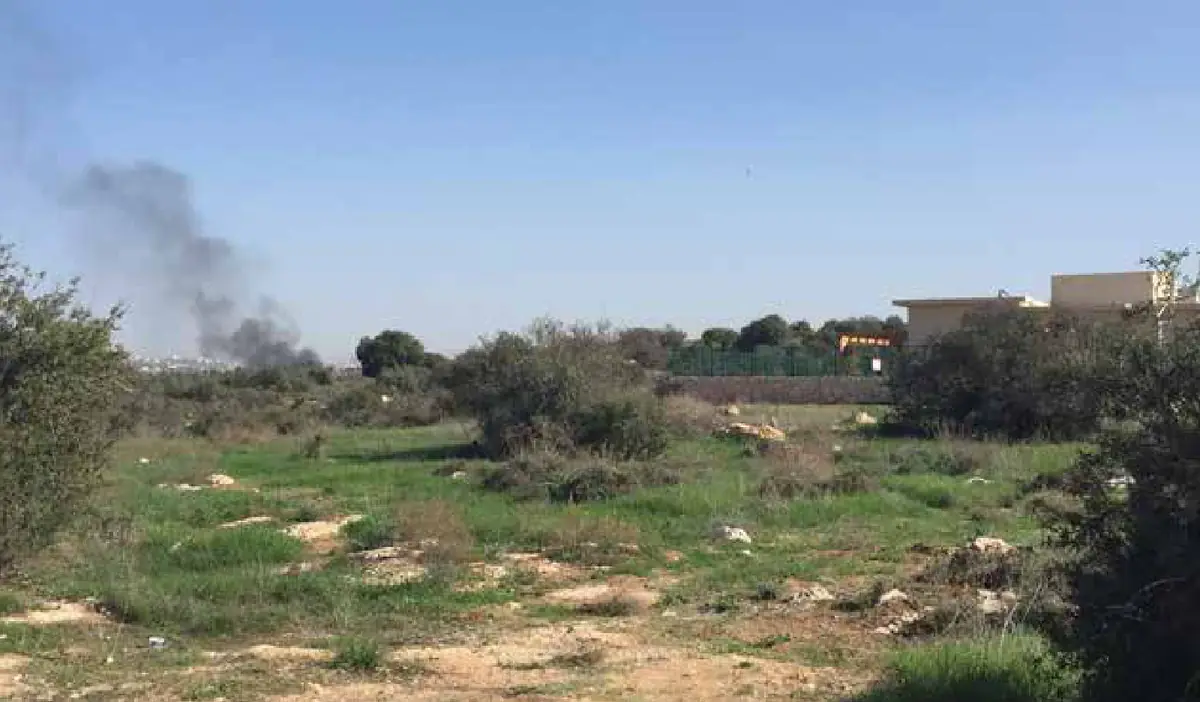
waste from Israel to Judea and Samaria, and the Israeli government is aware of this severe situation. For example, the explanatory notes to the abovementioned Decision Proposal stated: “Improper treatment of household waste, as carried out in Israel and parts of Judea and Samaria, leads to waste nuisances discarded in open areas and subsequently burned, causing severe and unreasonable air pollution, damage to open spaces and nearby water sources. Additionally, there is leakage of electronic waste transferred to the Judea and Samaria without permits, which is burned as hazardous materials in this waste disintegrate, creating severe environmental hazards.”
According to data by Prof. Garb from Ben-Gurion University, cancer rates in children residing in the area are four times higher than the average in Judea and Samaria.65
Because East Lachish residents have been suffering for many years from the failure of the State to adequately address the severe phenomenon of electronic waste transfer and burning in Judea and Samaria, especially the Hebron villages, residents had no choice but to file a petition against the State (in conjunction with Ashkelon Cities Association and Lachish Regional Council).66 Although this may appear to be a local problem affecting area residents, it is not: it is a broad hazard affecting residents even in distant communities, it is pervasive throughout Judea and Samaria, making local or temporary solutions insufficient.
It appears that Judea and Samaria serve as Israel’s neglected backyard, but the environmental hazards created there affect areas far beyond its boundaries.
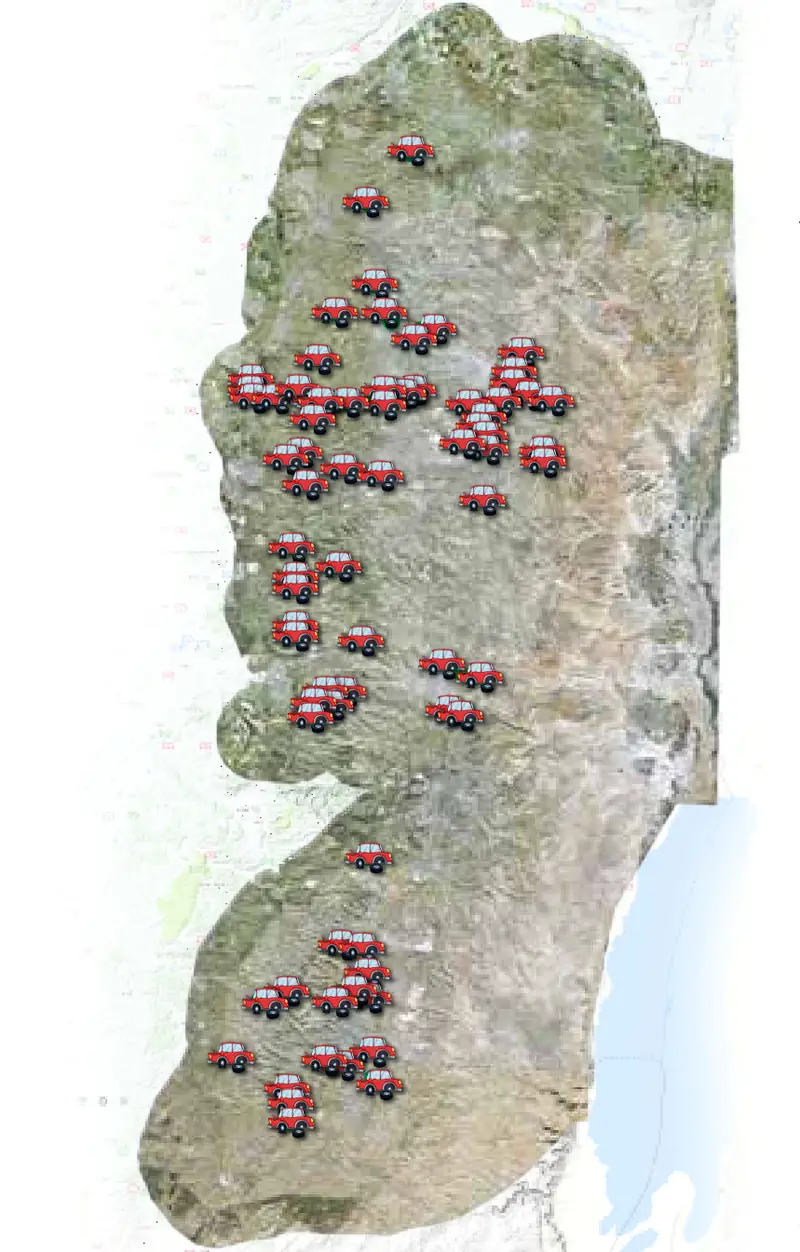
Junkyards
The disposal and dismantling of vehicles or vehicle wrecks in Israel are subject to various regulations, in addition to general legislation such as the Clean Air Law of 2008. For example, the Cleanliness Preservation Law, 1984 establishes, among others, a prohibition on disposing of vehicle wrecks in the public domain; local authority power for their removal; obligation of the local authority to designate and publicly announce a vehicle disposal site; and vehicle owners’ obligation to remove vehicles to a location designated by the local authority. The Used Vehicle Parts Usage
and Registration of Actions Law (Prevention of Theft), 1998, establishes, among others, a “prohibition against the use of used transportation products from Palestinian Civil Authority areas and a prohibition on vehicle repair in Palestinian Civil Authority areas.” The Tire Disposal and Recycling Law, 2007, is aimed at regulating tire disposal and recycling in a way that ensures environmental protection and the prevention of hazards, prohibiting uncontrolled burning and mandating a reduction of tire burial at waste sites. Businesses engaged in vehicle dismantling in Israel are subject to various directives such as the Business Licensing Order (Businesses Requiring Licensing), 2013, which establishes that businesses engaged in vehicle dismantling must obtain approval from the Israel Police and the Ministry of Environmental Protection, which sets environmental conditions.67
The list of environmental conditions in this matter serves as an indication of the numerous environmental hazards. For example, there are references and directives in various domains, including water pollution, soil pollution, air pollution, pests, odor, and noise. Additionally, there are specific references to various components such as hazardous materials, tires, batteries, cooling gases, oils, filters, dedicated fluids, fuels, various types of waste, asbestos, plastic, glass, aluminum, rubber, metals, fabrics, and electrical components. In practice, hundreds of thousands of vehicles in Israel find their way to illegal junkyards in Israel and Judea and Samaria operating in ways severely damaging to health and the environment.68 Thousands of dunams in Judea and Samaria, which were previously open spaces and “green lungs,” streams, wadis, mountains, fields, orchards, and vineyards have been transformed into vehicle accumulation sites, tire accumulation sites, junkyards (“vehicle slaughterhouses”) and trading sites for vehicles and spare parts (hereinafter, “vehicle parts sites”).
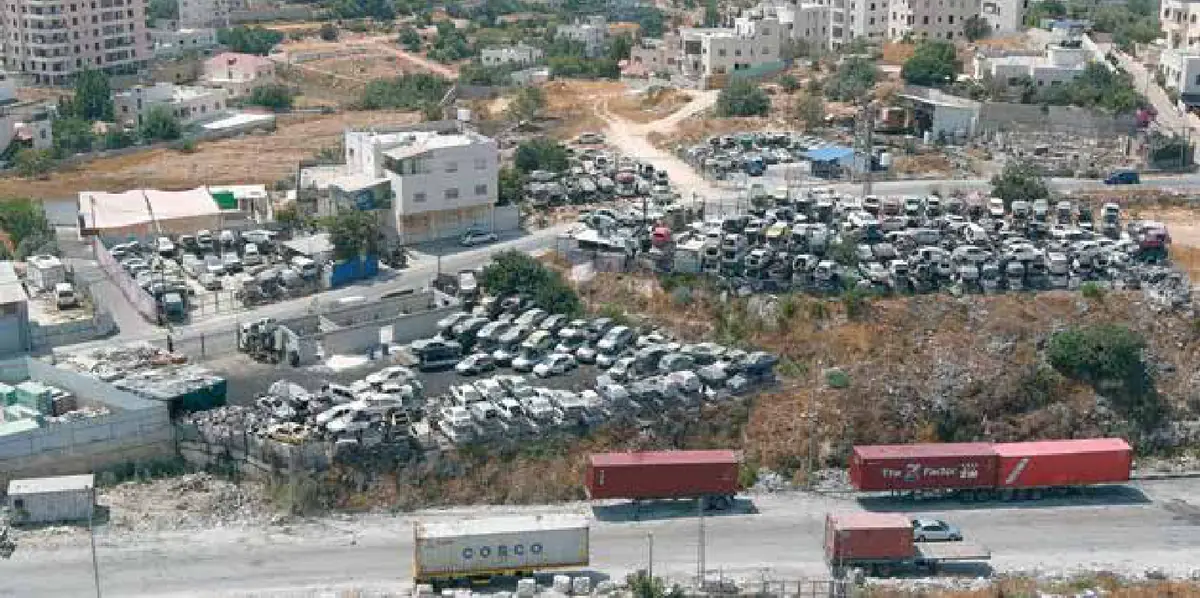
Along the roads in Judea and Samaria, one can observe tens of thousands of vehicles, destroyed and rust-eaten vehicle frames and large tire accumulations, some discarded as general waste and some at vehicle parts sites, the vast majority of which are illegal. This hazard causes landscape damage and severe environmental pollution of the soil and groundwater, air contamination, mosquito hazards, and more. It presents many safety risks and encourages theft and transfer of vehicles from Israel to Judea and Samaria.
Vehicle batteries
Lead-acid vehicle batteries contain lead and sulfuric acid. When improperly handled, these cause health damage and soil, water, and air contamination. They may also pose security risks because they can be used to manufacture explosives.
In Israel, there is one authorized facility for treating old batteries but the payment Israeli battery dealers receive for old batteries does not always provide an incentive for them to transfer batteries to this facility, and they sell the batteries at higher prices to various dealers, some of whom transfer the batteries to Judea and Samaria. Thus, although the annual quantity of vehicles in Israel continues to rise, the quantity of old batteries treated according to regulations continues to decline. Monitoring conducted by the Green Israel Forum found that local dealers in Judea and Samaria transfer batteries from
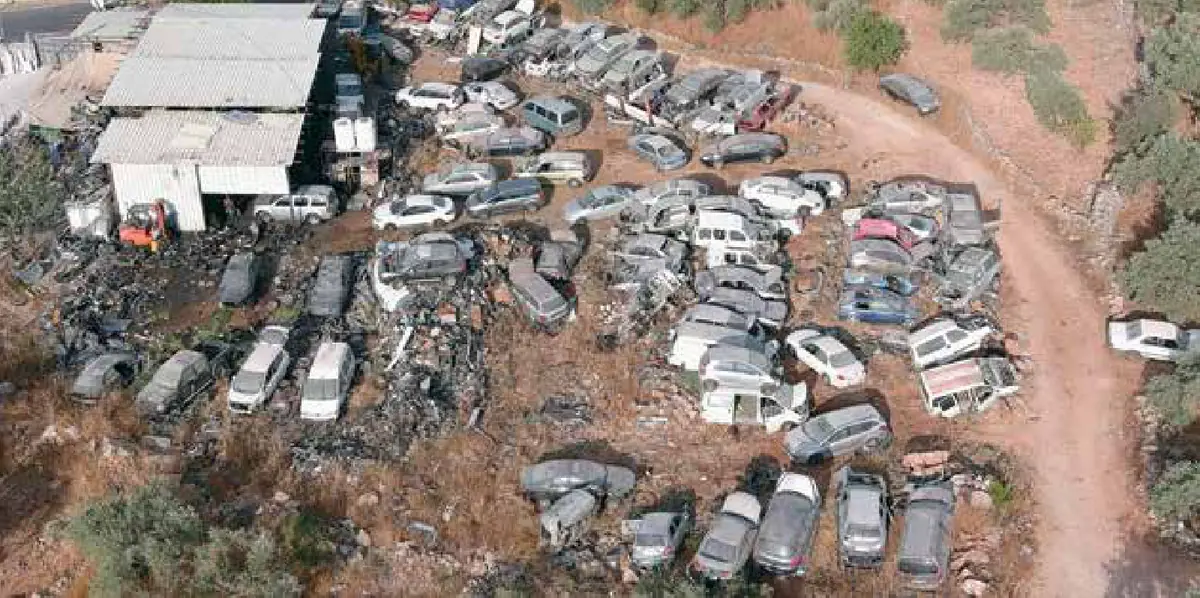
Israeli territories to Judea and Samaria, and some subsequently make their way to third-world countries, after illegal and polluting dismantling..
Tire collection sites
To protect the environment, prevent hazards from burning, and the disposal of tires in waste sites, the State of Israel enacted the Tire Disposal and Recycling Law, 2007. This law applies in Judea and Samaria only within Israeli settlement territories. In the remaining areas, tire-related damages continue to escalate. The tires constitute an intensive breeding ground for mosquitoes, which can spread disease because discarded tires contain cavities where water accumulates. Some tires are improperly buried, and flammable gases hazardous to the environment accumulate in tire cavities. Moreover, tires are made of flammable materials, and periodically piles of tires are set ablaze, causing particularly severe air, soil, and water pollution.
In northern Samaria, in the Shahak Industrial Zone, the Tirec tire recycling plant operates, struggling significantly with raw material shortages because of the lack of used tires reaching it because of regulatory issues with the Tire Disposal and Recycling Law. At the same time, enormous piles of tires are scattered throughout Judea and Samaria, polluting the environment. Implementation of legislation and enforcement of regulated tire disposal at recycling plants in Judea and Samaria could reduce environmental hazards from tires.
Generally, at sites trading vehicle parts in Judea and Samaria, where Israeli environmental regulation does not apply, there is no adherence to any environmental standards. Hazardous materials are disposed of into the environment, contaminating surface runoff, infiltrating groundwater, and polluting soil and air. The “treatment” of waste at sites for vehicle parts includes frequent burning of vehicles, vehicle parts, and tires, causing severe air pollution and endangering health and the environment, as well as odor nuisances. Additionally, sites for vehicle parts are related to criminal activity involving illegal trade and vehicle theft from Israel and Judea and Samaria. In 2022, vehicle theft reached 0.4% of all vehicles with comprehensive insurance coverage, causing approximately NIS 1.3 billion worth of damage. This phenomenon also led to a sharp increase in vehicle insurance prices in Israel in 2023 (Globes, 4.1.2023). Rigorous enforcement against illegal vehicle trading sites can, therefore, benefit both the economy and the environment.
Sewage
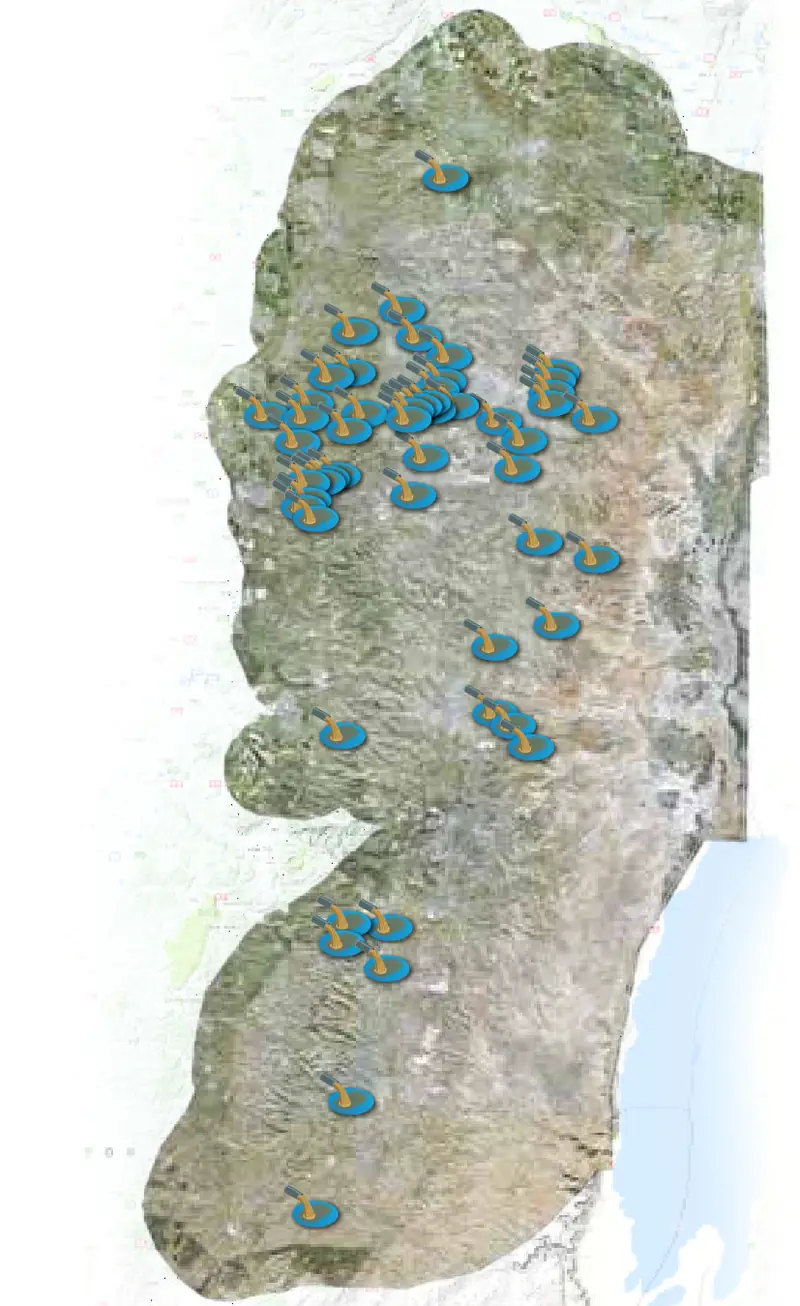
Untreated domestic sewage contains many and diverse pathogenic agents hazardous to human health. These include, for instance, intestinal bacteria (such as cholera and shigella), viruses causing polio and hepatitis, and intestinal parasites. To mitigate environmental risk from discharged sewage, treatment is necessary to reduce concentrations of organic matter, nitrogen and phosphorus compounds, and various other physico-chemical parameters. Only following such treatment can water undergo processing (for example, through filtration and disinfection) in a way that reduces pathogenic agent concentrations to non-hazardous levels and enables their reuse, for example, for the irrigation of certain crops). Urban sewage treatment occurs at facilities that are fullfledged industrial plants, situated in proximity to every modern city.
In smaller settlements, more antiquated treatment methods are sometimes deployed, using oxidation ponds and water retention reservoirs. The treatment process in modern facilities is relatively expensive. In Israel, by force of law, sewage levies and fees are collected from each household connected to sewage collection and treatment systems. The levy serves to finance the establishment of sewage treatment infrastructure while the fee is designated for financing routine sewage treatment. Populations of limited economic means and low sanitary-environmental awareness do not hasten to undertake such expenses. This principle applies to the majority of the Palestinian population and to economically disadvantaged populations in Israel.
Two distinct populations coexist in Judea and Samaria: the Palestinian population, numbering approximately 2.7 million persons, residing in 8 central cities and
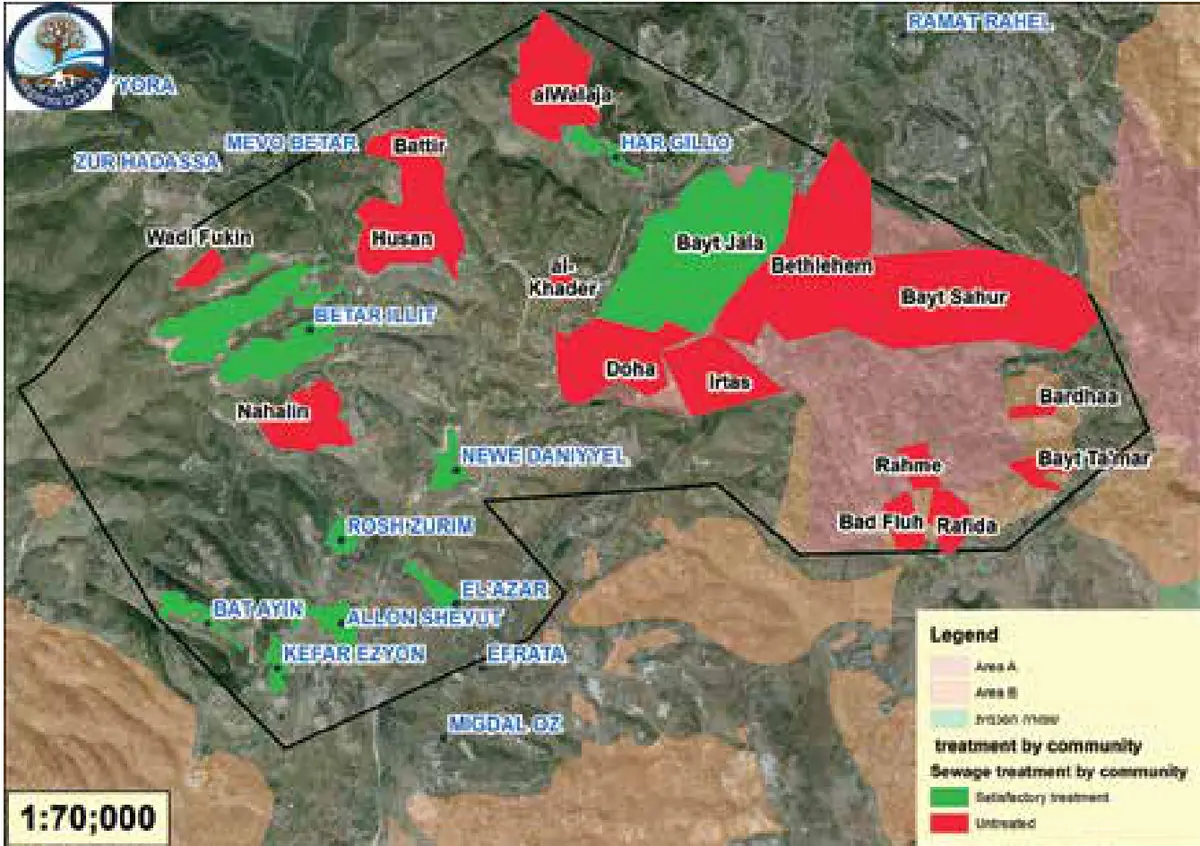
approximately 500 villages, and the Israeli settlement population, comprising approximately 500 thousand persons, organized within the framework of 23 local and regional authorities. It is estimated that approximately 90 million cubic meters of sewage are generated annually in Judea and Samaria, produced by both Palestinian and Israeli populations. Approximately 80% originates from the Palestinian population.
Shall we proceed with the next subsection, maintaining this level of analytical rigor and technical precision?
The Palestinian population connected to sewage conveyance and treatment systems (yet without disposal solutions beyond discharge into wadis and streams) is estimated at approximately 300,000 persons: Western Nablus – 85,000; Al-Bireh – 160,000; Western Bethlehem – 25,000; and the rest in small settlements).69 Approximately 2.4 million persons lack adequate sewage solutions. Of these, one may roughly estimate that 50% reside in settlements with sewage systems for disposal outside the settlement itself and the rest in villages using absorption pits.
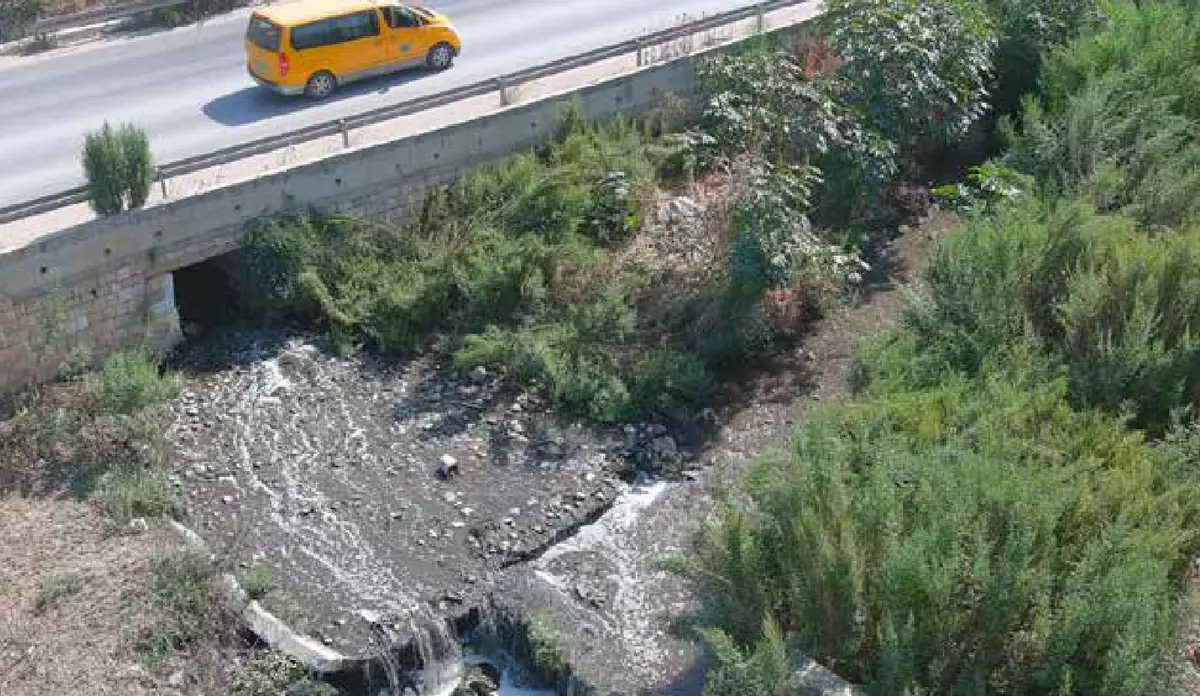
Approximately 38 million cubic meters of untreated sewage flow annually into streams or are disposed of in absorption pits. Almost all of it originates from Palestinian cities and villages. Concurrently, approximately 5 million cubic meters of sewage or poor-quality effluent from Israeli settlements still flows annually into the environment without treatment or without adequate treatment as required by law.
Currently, two modern regional wastewater treatment plants (WWTPs) operate for the Palestinian population: the Al-Bireh WWTP and the Western Nablus WWTP. Other cities (Ramallah and Jenin, for example) treat their sewage (wholly or partially) through oxidation ponds, producing effluent that fails to meet even the quality standards required for safe irrigation. In rural areas, treatment facilities are virtually nonexistent, save for demonstration facilities established by various NGOs. There is minimal utilization of effluent produced in Palestinian WWTPs, which is discharged into streams, causing contamination of natural habitats, groundwater pollution, and mosquito hazards. Palestinian farmers generally lack both the will and capacity to use treated wastewater for agricultural irrigation. This stems from the absence of a supportive research and development system, a lack of tradition in the efficient use of water resources in general and reclaimed water in particular, and an absence of economic support for infrastructure establishment, such as effluent reservoirs and conveyance systems from reservoirs to the fields.
The Palestinian urban sewage problem is exacerbated by industrial wastewater discharge. In Hebron, tannery industry effluent containing toxic chromium compounds is discharged into the municipal sewage system, subsequently flowing into Hebron Stream, Be’er Sheva Stream, and Besor Stream. This is compounded by stone industry effluent, which without preliminary particle sedimentation treatment, severely impedes any potential comprehensive sewage treatment method. Western Nablus sewage flows to a modern treatment facility; however, the effluent, of moderate quality, remains unutilized and is discharged into Nablus Stream, which reaches the Green Line and connects to Alexander Stream. En route, the effluent is “enriched” by discharge from approximately 70 olive presses scattered along the lower Nablus Stream. This effluent is rich in lipids and phenolic compounds toxic to flora and fauna. Additionally, local stone industry effluent flows into the stream. Consequently,
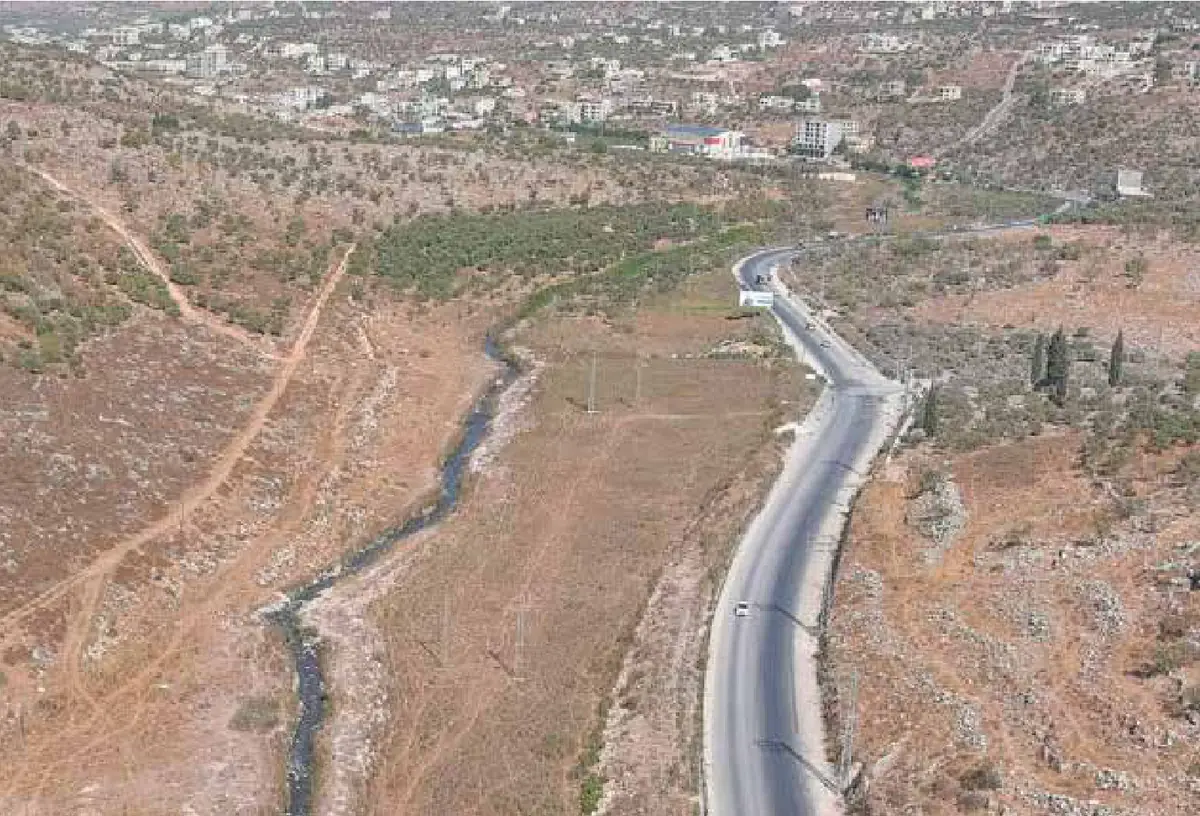
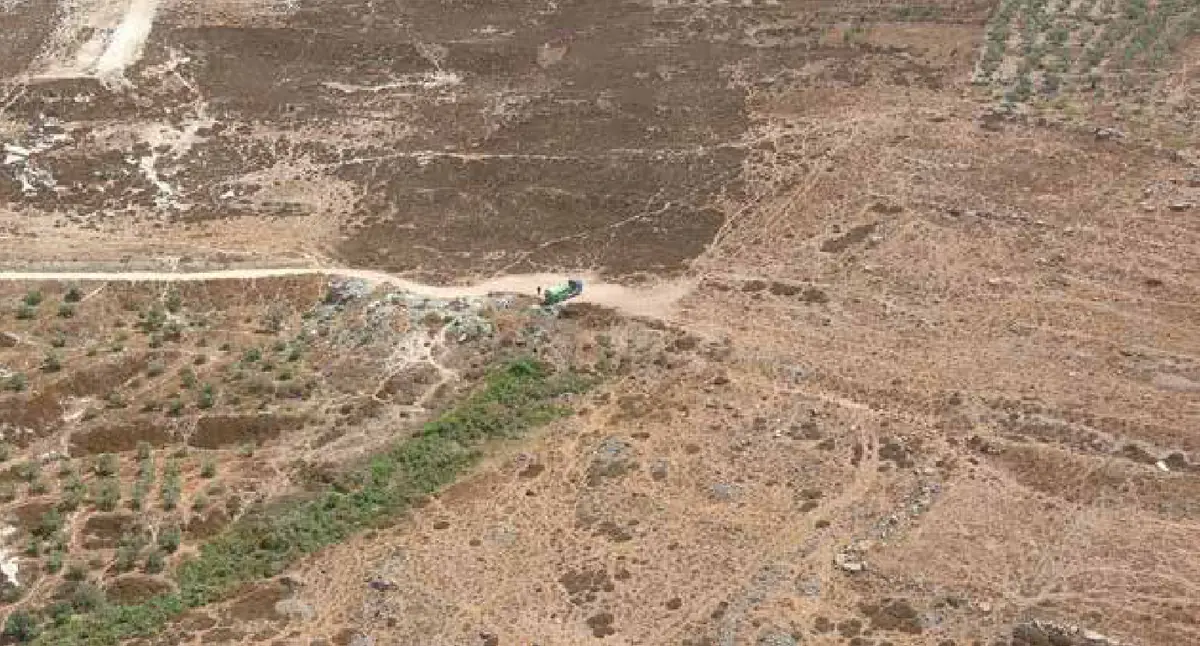
Alexander Stream receives, particularly during olive harvest season (October-November), a dense and lethal flow of urban effluent, oils, and stone sediments, preventing its full rehabilitation. This persists despite tens of millions of NIS invested thus far by various Israeli state agencies in environmental stream rehabilitation.
The majority of Israeli settlement sewage undergoes treatment in local facilities at varying treatment levels. Ma’ale Adumim and Givat Ze’ev sewage is treated with Western Jerusalem sewage. However, Ariel lacks a proper WWTP, and its partially treated sewage, together with effluent from Barkan Industrial Zone and Western Ariel Industrial Zone, flows into a wadi toward Yarkon Stream, contaminating the downstream Mountain Aquifer. This occurs in relatively close proximity to drinking water drilling sites in the Yarkon sources area. Several Israeli settlements (South Hebron Hills settlements, excluding Susya) lack sewage treatment facilities. In other locations (Eli, Shiloh, Shiloh Heights), existing facility capacity is insufficient for treating additional sewage resulting from population growth. Ofra awaits the establishment of a long-planned WWTP, following delays by the Civil Administration and a petition to the High Court.
Over 50% of Israeli settlement effluent in Judea and Samaria is used for irrigation, such as in the Gush Etzion region and Shiloh Valley. For comparison, within the State of Israel, over 90% of domestic sewage is collected and treated, of which 80% undergos tertiary or secondary treatment, enabling safe agricultural irrigation from sanitary and environmental perspectives. Almost 90% of effluent (over 80% of raw sewage) is used in Israel as a water source for irrigation, enabling prosperous agriculture despite chronic potable water scarcity.70 According to Water Authority data, in 2020, Israeli sewage treatment facilities received approximately 23 million cubic meters of sewage from the Judea and Samaria region.
Distribution by WWTPs and future quantity assessment (in million cubic meters annually):
| WWTP | 2020 | 2030 | 2040 | 2050 |
|---|---|---|---|---|
| Yad Hanna | 8,340 | 9,130 | 10,250 | 13,140 |
| Eastern Sharon South | 2,390 | 5,420 | 7,230 | 9,640 |
| Sorek | 5,000 | 7,650 | 9,840 | 11,670 |
| Shoket | 6,400 | 15,000 | 25,000 | 30,000 |
| Kishon | 900 | 2,000 | 3,500 | 5,000 |
| Total | 23,030 | 39,200 | 55,820 | 69,450 |
Various plans currently exist, some already in the implementation phase, for treating sewage from Judea and Samaria in facilities within the territory of the State of Israel (Bat Hefer WWTP, Eastern Sharon South, and others). Although these facilities will indeed prevent pollution in streams and stream segments within Israel (such as Alexander Stream and Yarkon Stream), they will not prevent Mountain Aquifer contamination resulting from the flow of sewage or medium-and-below quality effluent in permeable mountainous regions (such as Nablus Stream, Ayalon Stream tributaries, and Prat Stream).
Runoff water pollution as an obstacle in addressing central cities’ flooding
The sewage treatment deficiencies and inadequate effluent disposal in Judea and Samaria also generate stream runoff water pollution, thereby disrupting national efforts to advance flood water storage projects for beneficial utilization and flood risk reduction, particularly in cities of central Israel (primarily in the Yarkon-Ayalon basin). Contributing to this failure is the fact that the Drainage Law and the Stream and Spring Authorities Law do not apply in Judea and Samaria. Experience with the Kishon, Yarkon, Be’er Sheva-Besor, Lachish, and other streams demonstrates that the involvement of the drainage and stream authorities was crucial in advancing solutions for the cessation of sewage discharge into streams, concurrent with addressing downstream flooding and inundation issues.
The estimated total cost for the required sewage treatment in Judea and Samaria is approximately 4.15 billion NIS (see the Economic Analysis section). Most of the cost is required for establishing treatment facilities for Palestinian city residents.
The substantial disparity between sewage treatment within the State of Israel and Judea and Samaria derives from several factors:
- 1. Palestinian residents have, on average, lower economic status and reduced payment capacity and awareness of sanitation and environmental quality preservation matters. This manifests also in inadequate treatment of other water source pollutants, primarily the non-treatment of domestic and industrial waste.
- 2. Responsibility for environmental services to the majority of Palestinian residents resides with the Palestinian Authority. Environmental protection ranks low in Authority priorities (similarly to conditions in underdeveloped nations), therefore receives inadequate budgetary allocation.
- 3. For political and diplomatic reasons, the Palestinian Authority and municipalities demonstrate unwillingness to cooperate with Israel in establishing sewage treatment infrastructure serving both Palestinian and Israeli settlements. This results in increased facility costs for each entity, operational unprofessionalism, and chronic budgetary shortfall, leading to ongoing operational failures and causing the discharge of untreated sewage into the environment.
- 4. Fragmentation between Palestinian-administered areas as well as between Israeli-controlled ones impedes the connection of various settlements to regional facilities that would benefit from economies of scale.
- 5. Mountainous and dissected topography, substantially increases the cost of sewage line installation connecting adjacent settlements and subsequently to central treatment facilities. These are required to ensure reliable high-quality treatment and reduce day-to-day treatment costs.
- 6. Following the 1995 Oslo II Accords, a Joint Israeli-Palestinian Water Committee (JWC) was established to discuss and approve water and sewage projects. But Committee activity has been paralyzed since 2012 because of the state of relations between Israel and the Palestinian Authority, because of Palestinian unwillingness to establish treatment facilities serving both Israeli and Palestinian settlements, and because of their refusal to permit effluent utilization by Israel (although effluent utilization is virtually nonexistent on the Palestinian side). In the interest of fairness, Palestinians also maintain their own grievances about Israeli conduct in the Water Committee.
- 7. Absence of coordinated inter-ministerial government policy for formulation and implementation of sewage treatment facilities at specified quality levels, including solutions for proper utilization or disposal of effluent from sanitary and environmental perspectives. The quarrying sector supplies raw materials for the construction and infrastructure sector in Judea and Samaria and Israel.
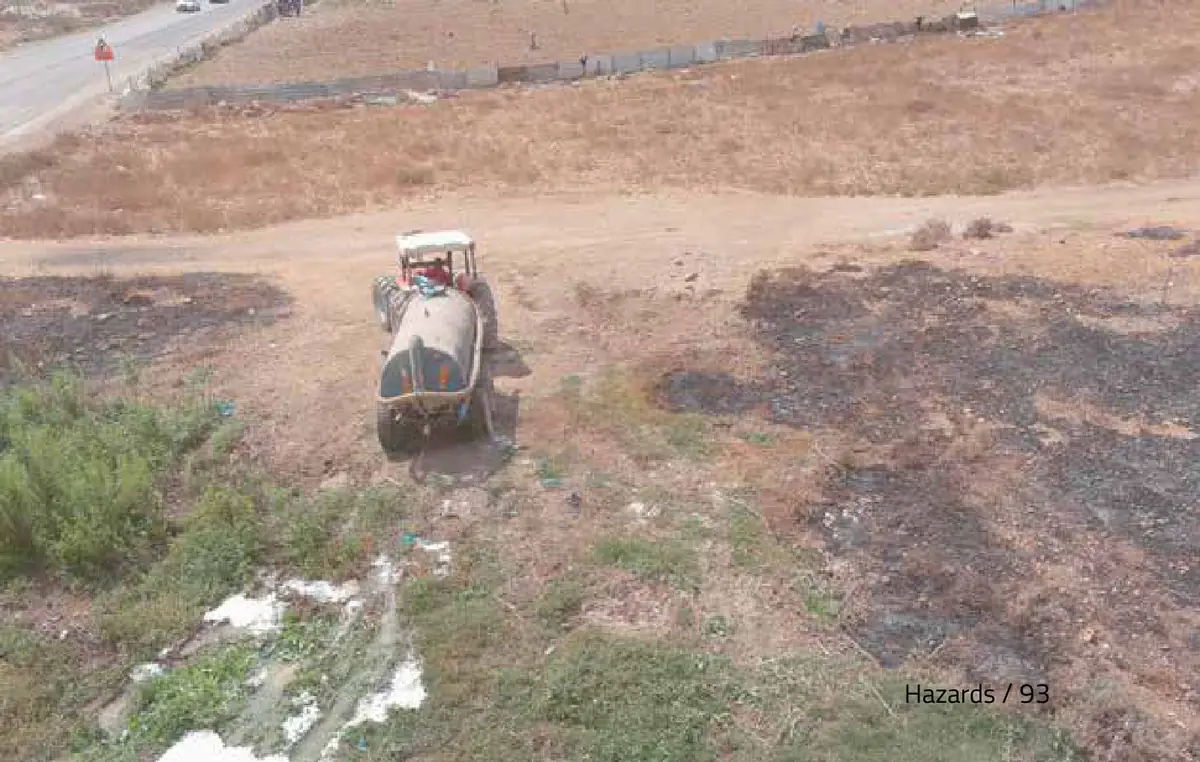
Water Sources
Background data
The national watershed line traverses the mountain ridges of Judea and Samaria from south to north, through Arad - Hebron - Jerusalem - Ariel - Umm al-Fahm. Flood waters created during storms flow from this line westward, toward the Mediterranean Sea, through streams and drainage channels. From the watershed line eastward, flood waters flow toward the Jordan Valley and the Dead Sea. The subsurface (underground) watershed line in this region, which determines groundwater flow direction, is situated slightly west of the surface watershed line.
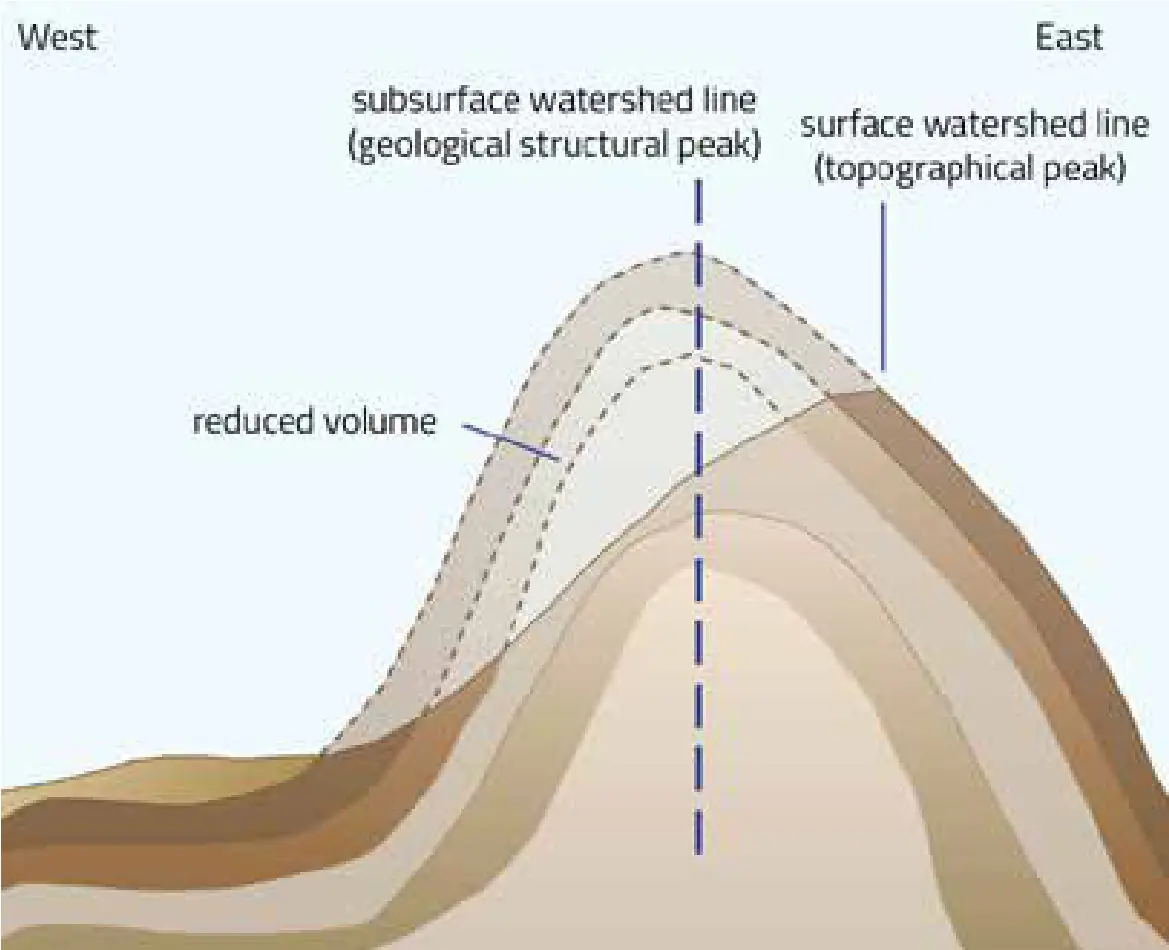
Rainwater percolates through rock strata until reaching impermeable layers, forming large subsurface water bodies within porous, water-saturated rocks, termed aquifers.
The Western Mountain Aquifer, also called the Yarkon-Taninim Basin after the springs at the head of Yarkon and Taninim Streams from which aquifer waters naturally formed historically, lies largely beneath Judea and Samaria. It constitutes Israel’s largest, highest quality, and most significant groundwater
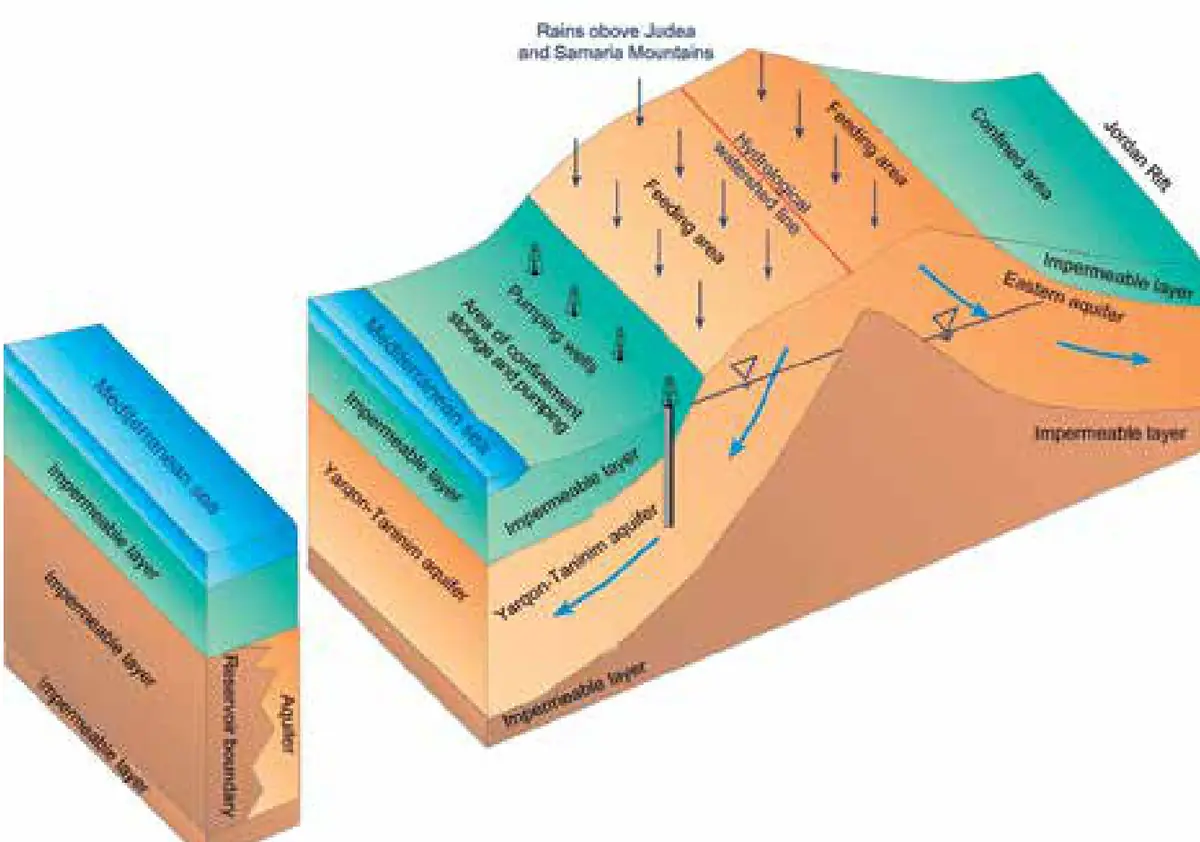
reservoir. The Mountain Aquifer also includes a northern basin (the Shchem-Gilboa Basin) and an eastern basin.
In the aquifer’s recharge zone, also termed the unconfined zone, annual aquifer replenishment occurs through direct rainfall. Consequently, groundwater levels (water height above sea level) may rise in winter because of rain percolation and decline in summer because of pumping. At the margins of the aquifer lies the confined aquifer portion, where the aquifer is overlain by an impermeable layer, and groundwater saturates the entire aquifer stratum from its base to its “roof,” which is the “floor” of the overlying impermeable layer. Rainfall percolates vertically into the aquifer in the unconfined zone and flows horizontally toward the confined zone, where pumping wells are typically located.
Average annual rainfall quantities falling on either side of the watershed line
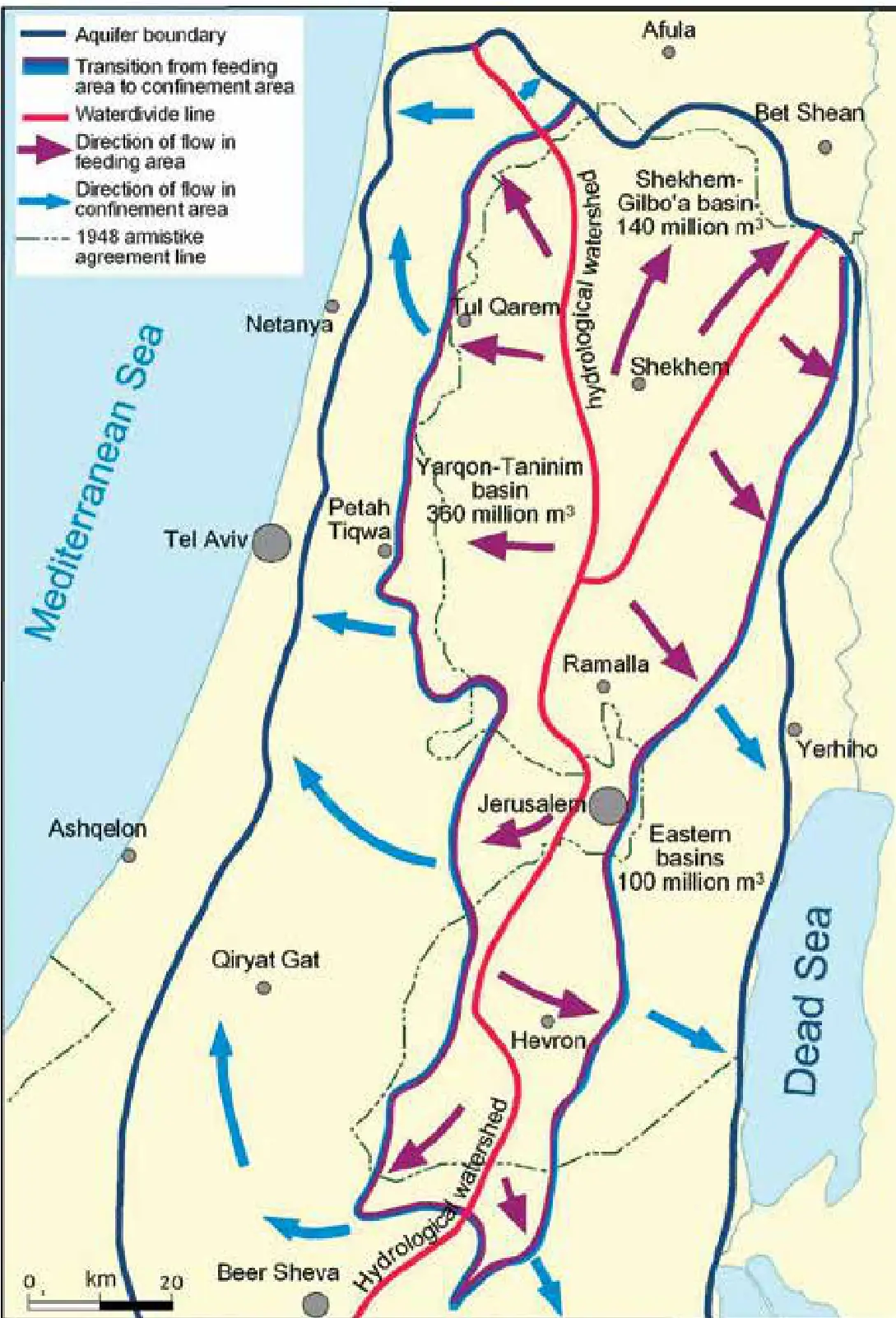
vary significantly. Above the western basin, approximately 500 mm/year falls (i.e., approximately 500 cubic meters of rain/dunam/year). Rainfall in the eastern basin diminishes eastward from 500 mm to 100 mm. Following the evaporation of approximately 60-65% of rainfall from the soil layer, the remaining quantity percolates into the groundwater. Eventually, a multiyear average of approximately 360 million cubic meters/year (MCM/year) are stored e in the Yarkon-Taninim aquifer, approximately 140 MCM/year in the northern basin, and approximately 200 MCM/year in the eastern basin. All renewable water is pumped annually, except in the eastern basin where approximately 100 MCM/year are pumped, with the remainder (approximately an additional 100 MCM/year) flowing underground to the southern Jordan or directly to the Dead Sea.
The Western Mountain Basin constitutes a crucial water source for both Israel and Palestinians because of its immense size. Additionally, water quality in most wells pumping from it is exceptionally high, suitable chemically, physically, and biologically for all uses, with minimal treatment.
Conversely, the Eastern Mountain Basin represents a water source of local significance, primarily for Jericho, Beth Shean Valley agriculture, the Tirza Stream area, and the Jordan Valley. Water quantities stored in the basin are smaller than its western counterpart, and water quality is inferior because of higher salt concentrations in some wells, affecting domestic supply capability (for drinking, cooking, and laundry), as well as agriculture for salt-sensitive crops. Nitrate concentrations in some wells are also relatively high, further reducing the usability of the water for drinking because it does not comply with the required drinking water quality standards.
Surface waters
In the past, all Judea and Samaria groundwater came from springs. The most substantial flow occurred at the Yarkon Springs, near Rosh Ha’ayin, with a flow rate of approximately 220 MCM/year, generating continuous flow in the Yarkon Stream throughout the year, from the springs to the sea. The second largest flow occurred at the Taninim Springs, near Caesarea, at a volume of 100 MCM/year. In the eastern basin, principal springs included Ein Zukim (approximately 80 MCM/year), Ein Qane-Samar Springs (35 MCM/year), Ein Gedi (3 MCM/year), Jericho Springs (13 MCM/year), Wadi Qelt Springs (5 MCM/year), Ein Auja (10 MCM/year), Ein Samia (5 MCM/year), and the Tirza and Wadi Malih springs. In the northern basin, numerous springs emerged at the Gilboa foothills and Beth Shean Valley, most notably Ein Amal (20 MCM/ year), Ein Shokek (12 MCM/year), Ein Muda (10 MCM/year), and Ein Homa (5 MCM/year). Additionally, numerous many are distributed throughout Judea and Samaria, as referenced in the Scripture: “a land of water streams, springs, and underground waters emerging in valley and mountain” (Deuteronomy 8:7).
However, from the early 20th century, intensive groundwater exploitation started, together with exploitation of the waters of Lake Kinneret and the Yarkon Springs. This provided water supply to Israel’s growing population, agricultural irrigation, and developing industry. Consequently, some significant western springs dried up and others experienced diminished flows. Following the Oslo Accords, Israeli water sources were also allocated to the Palestinian population, and following peace agreements with Jordan, to the Hashemite Kingdom as well. One consequence of this sustained exploitation was groundwater level decline across all water reservoirs, including the Mountain Aquifer. This resulted in a progressively intensifying decline in spring water flow to the environment.
Nevertheless, many springs remain distributed throughout Judea and Samaria, some used for irrigating adjacent orchards and surrounding plantations and field crops. Most notable among these is Ein Mabua, near Ma’ale Adumim, and Jericho Springs. Small springs are distributed across many locations such as the Eli area, the upper Modiin Stream, near Dolev, and many others. All Judea and Samaria streams, except the Prat and Tirza streams, are seasonal, carrying flood waters only during certain winter months. In the western basin, some Judea and Samaria streams (upper Kishon Stream, Nablus Stream, which is an Alexander Stream tributary, Modiin Stream, which is an Ayalon Stream tributary, and Hebron Stream, which is a Be’er Sheva Stream tributary) effectively serve for sewage disposal and conveyance, or relatively low-quality effluent compared to Israeli legislative requirements (“Inbar Standards”) toward Israeli coastal streams and from there to the sea. In the eastern basin, raw sewage flows from Nablus to Tirza Stream and from there to the southern Jordan. Similarly, Kidron Stream, in the southern Jordan-Dead Sea drainage basin, receives untreated raw sewage from East Jerusalem.
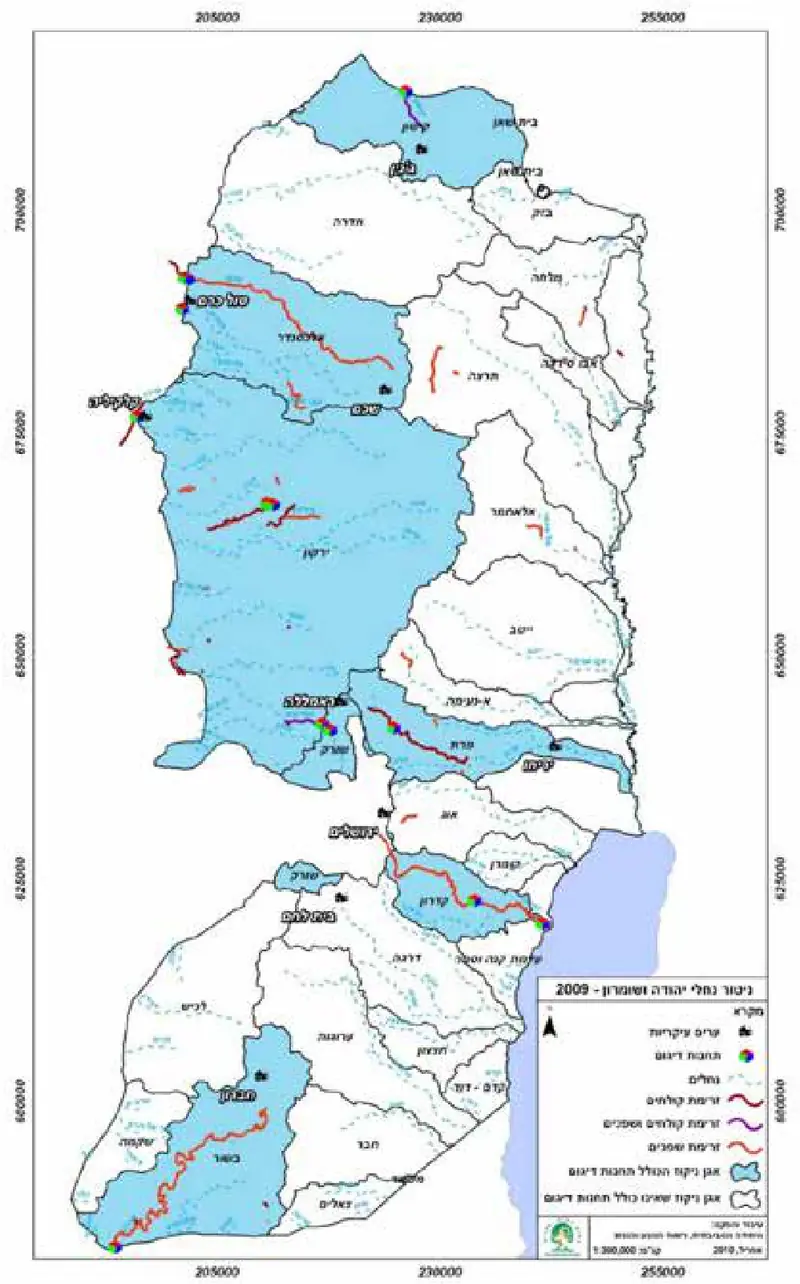
Water pollution
Water quality matters for drinking, agriculture, and industry (including food, chemical, drug, and electronics manufacturing). Israeli and international standards for household water include over 100 quality measures, covering physical factors (like cloudiness and color), chemical ones (salts, minerals, man-made organic compounds, drug traces), and biological ones (pathogens, including viruses, bacteria, and parasites). Many signs can indicate water pollution from human waste (like sewage) or animal waste, such as cattle, which can carry pathogens. The most common drinking water pollution comes from sewage leaks from waste systems into the environment and water sources, including groundwater. This can affect even deep groundwater as pollution moves from the surface through pores or gaps in rock layers above the water table. Since the drinking water wells in Haifa Bay were polluted by sewage in 1989, Israel has required cleaning all water sources, including groundwater once thought safe from pollution. However, cleaning does not work well for high levels of biological pollution and does not address chemical or physical pollution at all.
Pollution risk is higher when the source is near:
- 1. Surface water, like springs or streams, lack protection from soil and rock layers above. For example, springs in Tirza Stream supply drinking water to Palestinians, while sewage from Nablus flows in the stream, endangering users’ health. The Gilboa springs, in Israel, show rising pollutants (chlorides and nitrates), likely from upstream pollution and illegal water pumping, letting salty water mix with fresh water.
- 2. Aquifer outcrops, where water and pollutants can quickly seep into the aquifer.
- 3. Water wells, especially for drinking.
- 4. Wells serving many people.
- 5. Wells in aquifer outcrops without protection between ground level and the water layer, particularly near pumping wells. For instance, a drinking water well near Beit Fajar had to close because of sewage from the village flowing near it.
- 6. Wells built without enough protection from surface pollution. Water pollution affects more than human water use for drinking or agriculture. It harms nature too. In the natural environment of near-surface water bodies, like streams and springs, typical wetland plants grow (like willows or blackberries). Natural waters also support unique water-loving animals
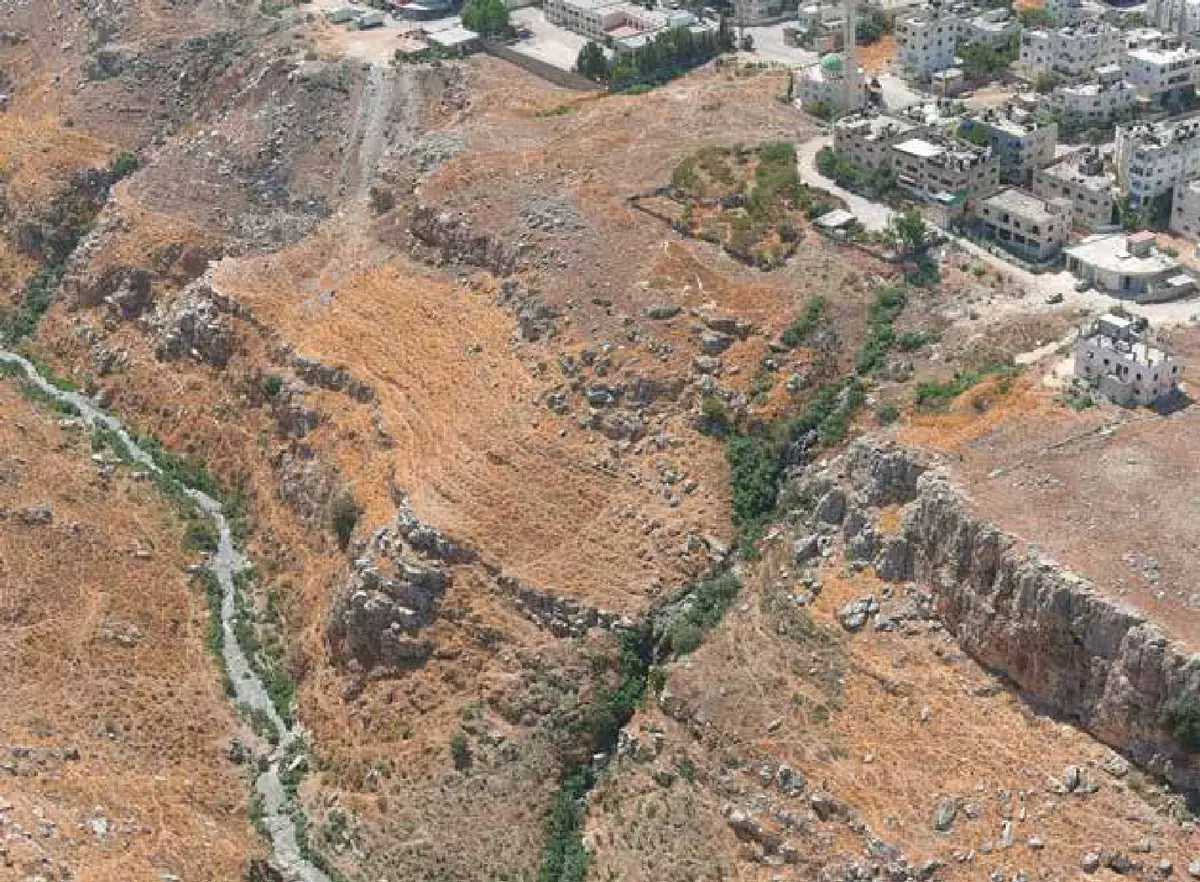
(like snails, crustaceans, and fish). When waters become polluted, depending on the level and severity, it badly harms plants and animals that need clean water for a healthy natural life environment.
A healthy habitat matters beyond the interest of nature lovers. To prevent mosquito problems, water bodies need mosquito predators living in and around them. These need enough oxygen in the water to live. When organic matter or nitrogen compounds enter from sewage or animal waste, they quickly use up the water’s oxygen, creating oxygen-free conditions. Such conditions kill mosquito predators. Moreover, sewage or waste entering water leads to decay and bad odors spreading from the water to its surroundings.
Quarries
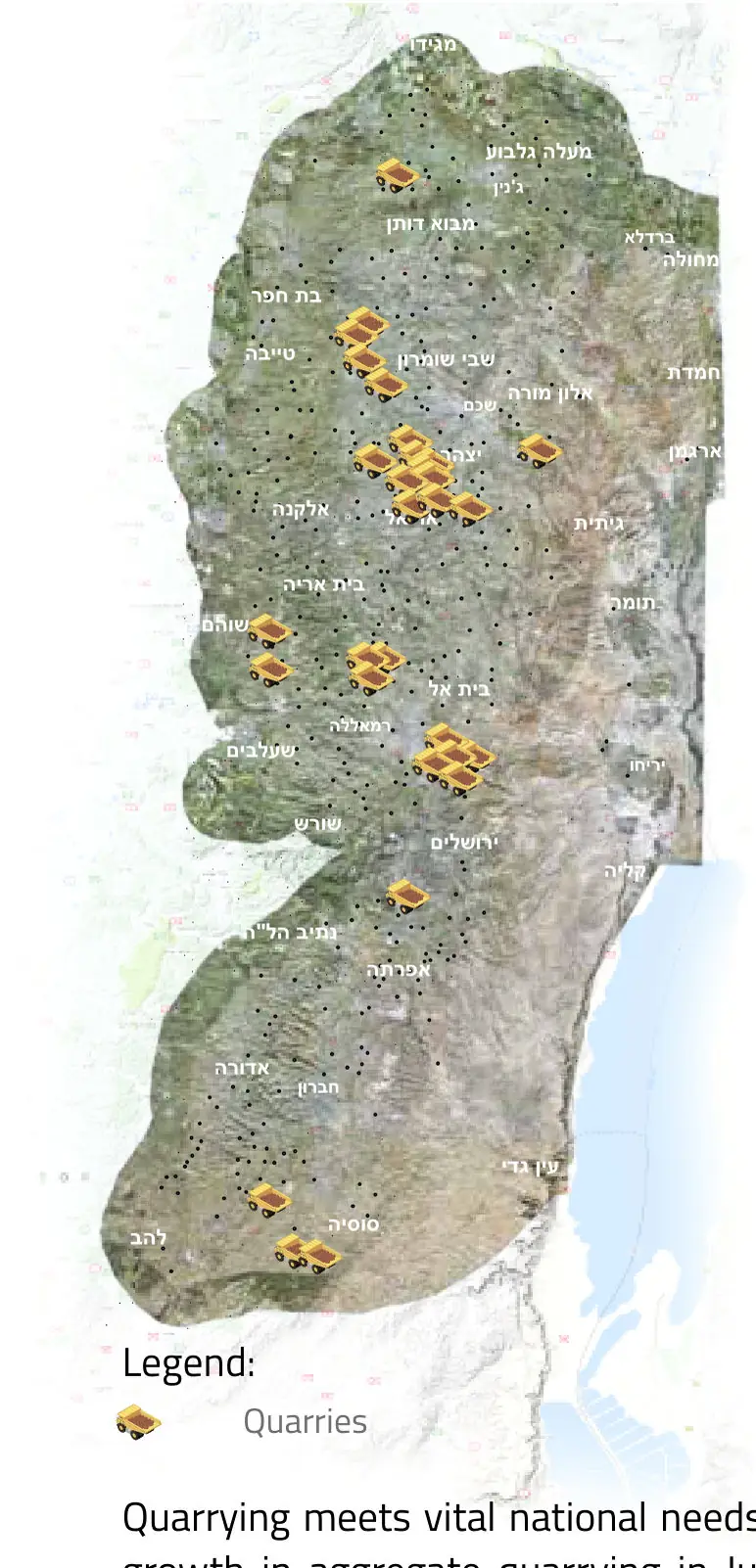
Industry demands are growing amid increasing shortages of raw materials, especially gravel, nearing crisis levels. In the past twenty years, half of Israel’s quarries have closed, severely affecting the construction sector. Meanwhile, the number of quarries in Judea and Samaria has grown, with dozens now operating—most illegally, exploiting the lack of regulation, oversight, and enforcement to gain a competitive advantage and quick profits. These quarries severely harm the environment, causing environmental damage, some of it irreversible. Most quarrying in Judea and Samaria occurs illegally, without permits or oversight, through criminal activities that exploit state and public resources.71
The quarries cause air, soil, and water pollution, threatening health and reducing the quality of life and property values for both Israelis and Palestinian Authority residents. They also damage landscapes, open spaces, wadis, and heritage sites.
Quarrying meets vital national needs in construction and paving. The rapid growth in aggregate quarrying in Judea and Samaria, expected to supply about 70% of Israel’s market needs by 2025, is central to Israeli planning.72 However, this positioning of Judea and Samaria as Israel’s main quarrying supplier requires careful, detailed planning for quarry construction and operation, emphasizing strict environmental regulation, operational oversight, monitoring, enforcement, and future planning for natural restoration of depleted quarry sites. Other critical aspects that need attention include the effects of quarries on traffic safety and security, issues that warrant separate analysis.
Beyond Israeli needs for quarry products, from the Palestinian perspective, the quarrying industry provides thousands of jobs, significantly increases Palestinian gross domestic product, and forms a main export component to dozens of countries73. These facts suggest that quarrying in Areas A and B will grow rapidly, with serious environmental consequences.
The management of quarries in Judea and Samaria
The quarrying industry in Judea and Samaria includes two types of quarries:
- 1. Stone quarrying for cutting (stone cutting sites), a traditional industry unique to Judea and Samaria.
- 2. Quarries producing aggregates for infrastructure and construction..
Stone cutting quarries
Regional Plan 52/1 is a partial regional plan defining quarrying areas in Judea and Samaria for cut stone production. Given the Civil Administration’s intent to advance this plan, it warrants consideration here. The plan aims to::
Establish zones permitting stone quarrying for cutting (covering 14,739 dunams for declared cut stone production)
Enable stone quarrying initiatives and related structures in designated sites up to 20 dunams through building permits and quarrying licenses, without detailed planning requirements.
This plan has many flaws, including environmental ones, and faced many objections, including :
- 1. Opposition by Green Now, which raised environmental concerns and aimed to protect environmental and public health in Judea and Samaria and Israel. It warned of severe, ongoing environmental harm from illegal quarry operations that would worsen if this plan gained approval.
- 2. Opposition by the Judea and Samaria Environmental Associations (November 2021), which addressed the lack of environmental background documents, damage to high-value natural areas, missing site restoration mechanisms, concerns about settlement proximity and public health, doubts about funding and legal enforcement, and detailed analysis of all 11 polygons in the plan.
- 3. Opposition by the Society for Nature Protection, which included the plan area mapping and environmental impact analysis. It showed severe biodiversity decline near quarries, cliff damage, harm to endangered species, and stream pollution. The proposed changes included aligning quarry operations with the National Master Plan (hereinafter, TAMA) 14B standards, requiring detailed plans with environmental impact studies for each polygon/quarry, and adjusting polygons based on the nature infrastructure survey of the Society.
- 4. Opposition by the Benjamin Regional Council, which asked to reject the plan, citing poor planning, administrative failures, lack of alternatives, use of irrelevant polygons, security risks, traffic hazards, permanent soil damage, inadequate site restoration planning, lack of regulation, missing archaeological, geological, hydrological, ecological, and landscape aspects, and economic harm to residents near quarry areas. These claims drew support from expert opinions, including former Israeli quarry commissioners, academics, and the heads of local authorities.
These objections brought important information not considered when TAMA 52/1 was submitted, such as Prof. Amos Frumkin’s analysis showing that some areas proposed for cut stone are geologically unsuitable, and Prof. Haim Gvirtzman’s finding that the quarry plan failed to address geological and hydrological features professionally and did not consider dual-use quarries (such as sites that could later serve for flood water infiltration). Beyond these objections, is it worth noting the response of the Green Israel Forum to the policy review team for mining and quarrying.74
After discussion in the Knesset Foreign Affairs and Defense Committee, in February 2022, TAMA 52/1 was returned to the Civil Administration for improvement, including refining the polygons and incorporating the objections that have been raised. In our view, addressing the various
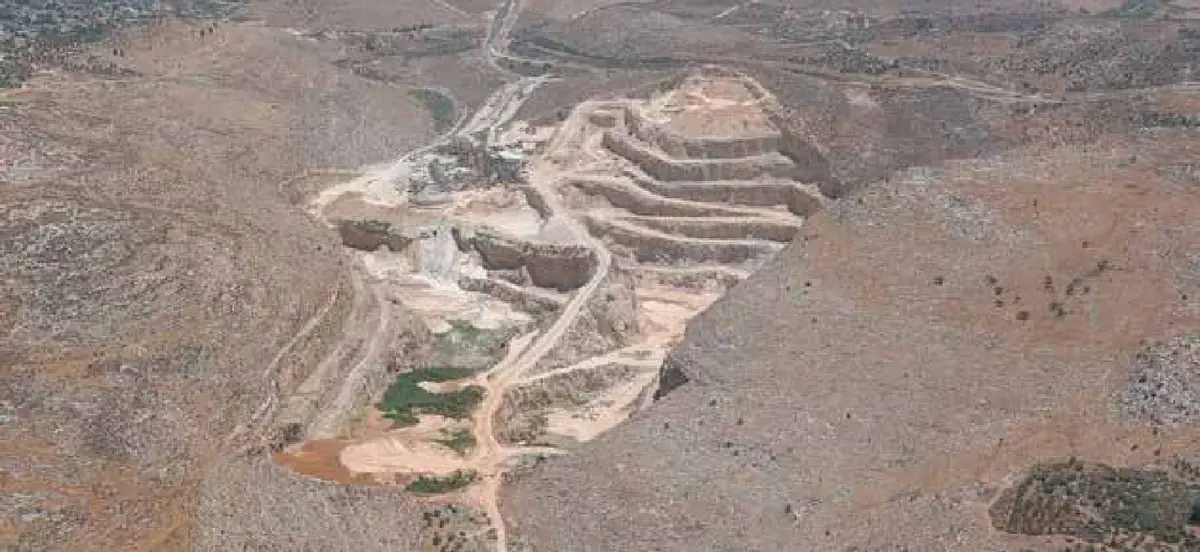
objections to TAMA 52/1 and including effective enforcement mechanisms to prevent severe environmental damage is critically important.
Aggregate quarries
Aggregate quarrying differs fundamentally from cut stone quarrying. Aggregate extraction uses planned explosions with explosive materials, mining, and crusher processing. These processes cause landscape damage, environmental harm, health risks, and sometimes archaeological damage. Thus, aggregate quarrying needs strict regulation and oversight. In Israel, aggregate quarrying falls under TAMA 14b control. In Judea and Samaria, dozens of aggregate quarries operate, most of them illegally and therefore without oversight. Although stated policy calls for equal standards for quarries in Area C and Israel, making no distinction between Israeli and non-Israeli quarries,75 Judea and Samaria lacks a parallel plan defining regulation and oversight of aggregate quarries. Therefore, severe environmental damage will likely grow rapidly unless an effective plan paralleling Israel’s TAMA 14b is implemented in Judea and Samaria.
Regulatory gaps
The regulation governing quarry operations, focusing on environmental protection, aims to minimize operational failures, and when these occur, to apply administrative and criminal proceedings against polluting entities. We should distinguish between quarries under Israeli regulation with business license oversight (a few of them Palestinia76n and mostly within Israeli local authority jurisdictions) and hundreds of illegal quarries. The overall regulatory picture of quarry operations in Judea and Samaria is grim.
Regulatory gaps stand out particularly between Area C, where Israel, through the Civil Administration, has quarry oversight responsibility, and Areas A and B, where oversight falls to the Palestinian Authority. Because quarry materials can enter Israel only from Area C, many quarries operate precisely at the boundary between Areas A or B and Area C. At these quarries, extraction occurs in Area A or B, free from Israeli oversight and regulation (and basic health and environmental protection standards), while crushing and loading happen in Area C to allow the marketing of quarry products in Israel. Thus, Israeli quarry owners in Area C complain of selective enforcement while adjacent Palestinian quarries operate without any regulation. Even TAMA 52/1 lacks solutions (such as regulatory amendments regarding the source control of quarry materials at stone-cutting sites as part of approval for entry into Israel) to illegally take advantage of the regulatory gaps described above, to the detriment of the environment.
Oversight and enforcement
Currently, improper and illegal quarry operations, numbering in the hundreds77 in Areas B and C, cause many environmental hazards as detailed above. Proper oversight, now lacking and in acute need of regulation, is key to sound operations. Moreover, because the Clean Air Law and Business Licensing Law do not apply in TAMA 52/1 polygon areas and most of Judea and Samaria, detailed environmental enforcement becomes critical. Oversight and enforcement must fully cover illegal Palestinian quarries in Area C (where the Civil Administration nominally holds authority), unlike current practice. The absence of such detailed oversight and enforcement planning will likely worsen environmental damage.
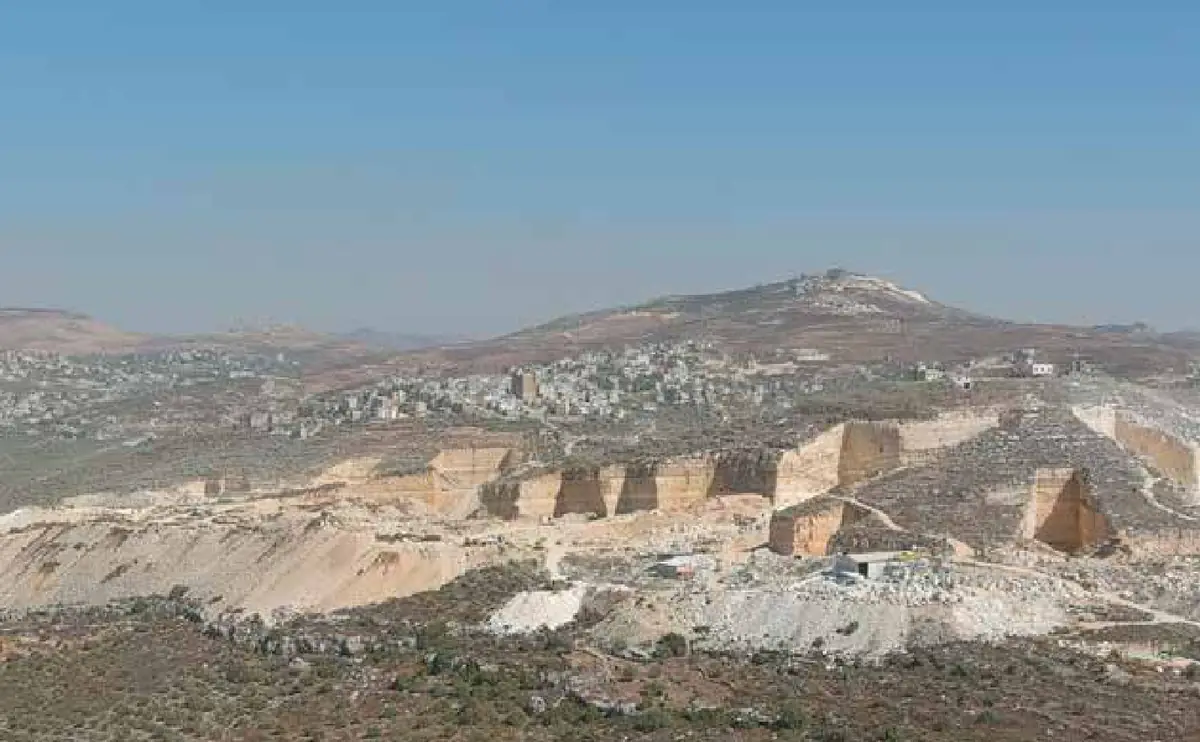
Quarry permit policy
The Civil Administration, aiming to strengthen the local economy, allows developers to operate stone quarries without completing regulatory processes. Furthermore, large quarries, including aggregate operations, work without approvals. While Israeli developers (like the Kochav Hashachar, Shafir, and Nahal Raba quarries) must meet regulatory and environmental rules, Palestinianoperated quarries face minimal scrutiny. Often, a Palestinian developer’s initial application suffices to enable extensive, environmentally harmful quarrying. Some quarries operate without any approval. Sound policy would favor supply from quarries following Israeli law, minimizing environmental and public health harm. Only in this way can legal quarries grow at the expense of illegal operations. Although this has economic implications, the Green Israel Forum notes: “Israel cannot allow substandard quarrying to reduce raw material costs or avoid opening new, regulated quarries within its territory, adopting NIMBY tactics. Judea and Samaria is not the backyard of a foreign entity whose affairs do not concern us, but an area where Israeli populations face direct harm from Palestinian quarries.”
Quarry restoration fund
Many abandoned quarries in Judea and Samaria have left behind massive damage in mountain areas. These sites invite illegal waste dumping, further harming soil and groundwater. Israel’s long-standing Quarry Restoration Fund works actively on restoration and preservation. A similar fund was started in Judea and Samaria about two years ago, collecting fees from Area C quarries, first from Israeli operations, later to include Palestinian ones. So far, the fund shows little activity in restoring the many damaged open spaces.
Summary
Except for regulated quarries, mostly within Israeli local authorities, quarrying lacks proper management in planning and operations (oversight, enforcement, regulation, raw material management, future reserves, restoration, etc.). Current illegal quarries cause widespread environmental harm including air, soil, and water pollution (notably threatening the Mountain Aquifer, as this report shows), noise, habitat destruction, landscape damage, and serious harm to heritage and archaeological sites. Some damage cannot be repaired. Mountains are “severely wounded,” valleys become hills, and hills become valleys.
Quarrying continues in full force in Judea and Samaria, despite causing serious environmental harm. This seems to reflect a view of the region as merely a source of raw materials for Israel, ignoring the environmental costs of mostly unregulated quarrying. This is especially true for Palestinian quarries, mostly illegal, operating in Areas C and B. Continuing the current situation will lead to more illegal quarries, increased extraction, and environmental damage felt throughout Judea and Samaria and bordering Israeli areas.
Given all this, we believe that quarrying, similarly to other environmental protection areas, should follow rules and standards that apply in Israel. At a minimum, it should follow their spirit. As written, TAMA 52/1 does not fully address environmental protection failures regarding stone-cutting sites and needs changes based on the many objections raised. Additionally, a dedicated plan paralleling Israel’s TAMA 14B should protect Judea and Samaria’s environment from aggregate quarries.
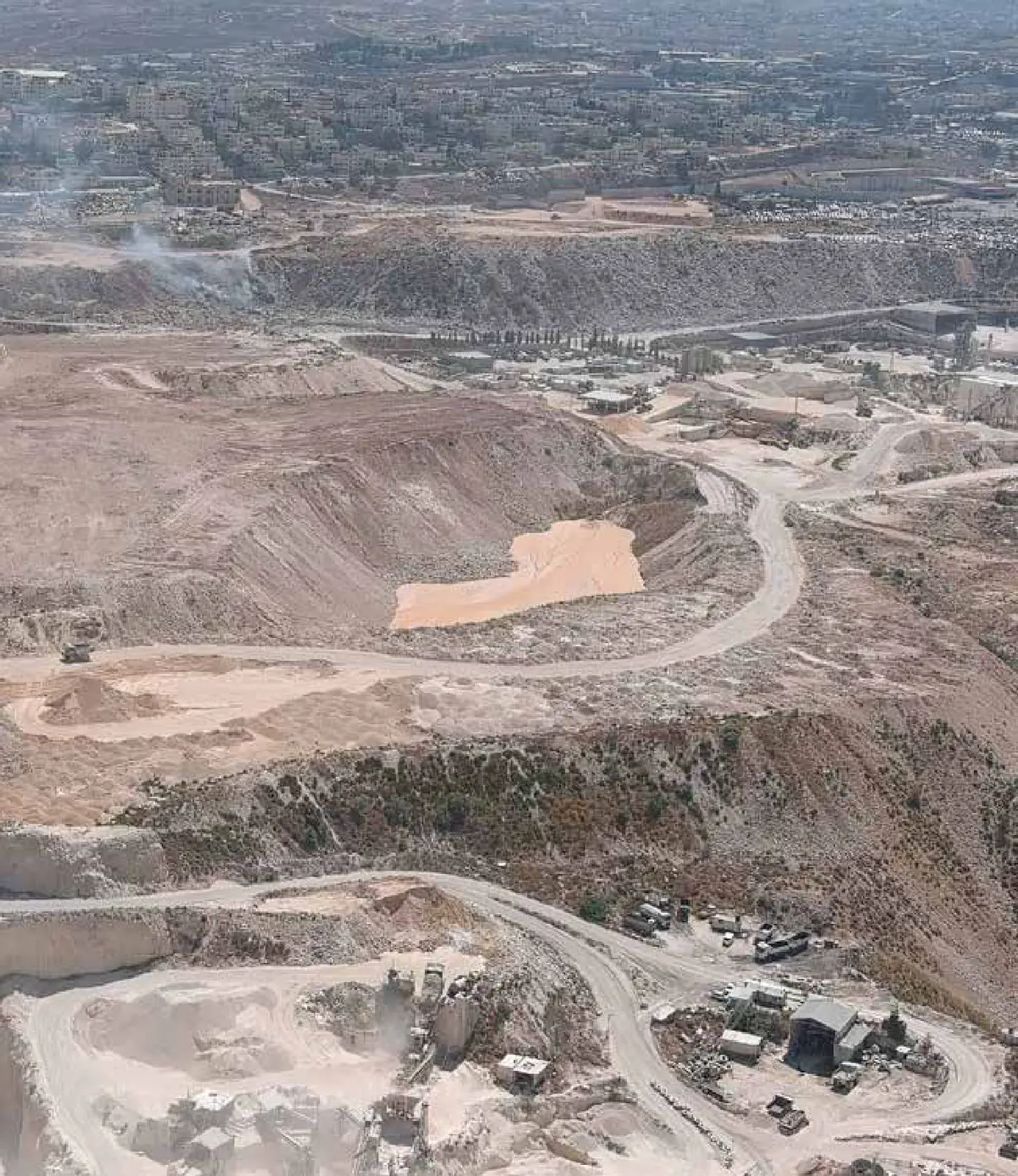
Economic Aspects
Pages 115–127
Infrastructure investment for sewage and waste treatment, including ongoing operations and maintenance, is substantial. However, economic damage from continuing the current situation is many times greater. This chapter presents damages from maintaining the status quo compared to estimated costs of building and operating needed sewage and waste treatment infrastructure in Judea and Samaria.
Health damage from air pollution
Amount of burned waste (annually)
Judea and Samaria
Israel
302,000
250,000
Waste burning releases dozens of air pollutants, including respirable particles and carcinogenic organic compounds. The section on waste in the present report discusses this in greater detail.
Air monitoring in Judea and Samaria occurs in Ariel and Gush Etzion but does not measure air pollution in waste-burning areas. Often, Israeli communities in Judea and Samaria and within Israel proper are affected by waste burning, but lack air monitoring systems to check burning impacts on relevant neighborhoods. Nevertheless, we have estimates for the economic cost of health damage from various pollutants in Israel. According to a 2017 OECD report,78 damage from premature death due to exposure to respirable particles (the most prominent pollutant from waste burning, responsible for most health damage) was estimated at 2.3% of gross national product.
According to the Central Bureau of Statistics, in 2022. Israel’s GDP was NIS 1,756 billion, indicating that early mortality damage from particle inhalation reached 40.4 billion NIS yearly.
A study published in 2014 found that PM2.5 emissions from waste burning comprised about 29% of global particle emissions of this type in 2010. This study may serve as a rough indication of Israel’s situation, suggesting that health damage associated with waste-burning in Israel (counting only deaths, not excess illness) reaches 11.7 billion NIS/year, resulting from the burning of about 250,000 tons of waste/year. Waste burning in Judea and Samaria amounts to at least 840 tons/day, or 302,000 tons/year (assuming unrealistically that all waste in northern Samaria and Judea goes to landfills), therefore, pollutant emissions from this source match those from waste burning across Israel.
Although calculating separate morbidity and mortality estimates for Palestinian and Israeli residents is difficult, considering that Israeli citizens in Judea and Samaria number about 500,000, and another 100,000 living near the Green Line who are directly affected by burning (such as Rosh Ha’ayin, the Lachish region, Hadera, etc.), comprising about 6.2% of Israel’s population, we can estimate at least NIS 0.8 billion/year in life expectancy damage to Israeli citizens, excluding non-Israeli Judea and Samaria residents (it should be noted that the State of Israel bears responsibility for preventing illness and death among these residents as well; they are excluded from this calculation only because of lack of available data about them). Over 20 years, this amounts to about NIS 16 billion.
These estimates include only early death damage, thus understating total harm. According to Becker and Friedman,79 the economic value (in 2018 prices) of each chronic bronchitis case is NIS1.5 million. Asthma damage is estimated at NIS 315,000, and lung cancer income loss and suffering at NIS 2.185 million. Thus, the above waste burning damage estimate likely rises by at least 50%, roughly considering annual cases over 20 years, totaling NIS 24 billion.
An Environmental Protection Ministry report from 2021 details the external costs (those unpaid by polluters and borne by the public) of air pollutant emissions, including from municipal waste burning. According to the report, total external costs from municipal waste burning in Israel reach NIS 976 million/year. As noted, annual municipal waste burning in Judea and Samaria exceeds Israel’s annual amount by about 20%, suggesting that external costs from burning might reach approximately NIS 1,180 million/year, or about NIS 23.58 billion over 20 years. We will use this figure.
Economic damage from unregulated vehicle part processing
The section on waste hazards discusses extensively the environmental damage from vehicle component dismantling and burning, largely based on vehicles stolen in Israel. This “industry” relies on illegal vehicle dismantling and disposal sites operating without regulation, oversight, or environmental enforcement. Insurance companies estimate the economic damage from vehicle theft in Israel at NIS 1.3 billion/year (2022 data), reaching NIS 26 billion over 20 years. Environmental regulation of the vehicle dismantling industry would likely sharply reduce the economic incentives for such theft.
Water resource damage
As explained in the section on water sources, western Judea and Samaria form the recharge area for the Yarkon-Taninim aquifer, Israel’s largest and highest quality natural water source.
Groundwater contamination risk from surface pollutants has been wellestablished globally and in Israel. Hundreds of Israeli drinking water wells closed because of agricultural fertilization and irrigation, sewage leaks, fuel facility leaks, and industrial plant leakage. Rehabilitating contaminated well production capacity is lengthy, expensive, and often impossible.
Surface contamination from dumps and sewage in Judea and Samaria has persisted for decades, but pollution levels rose sharply with population growth, living standards, and regular water supply to most settlements. Consequently, the risk to drinking water wells in Israel drawing from the Yarkon-Taninim aquifer increased significantly. The widespread well contamination pattern of the coastal plain that has been going on from the 1980s onward may reasonably extend to Mountain Aquifer production fields in coming years unless steps are taken to halt or at least moderate pollution from the main Judea and Samaria sources: sewage and waste.80
The average annual water production from the Mountain Aquifer is about 360 MCM/year. A reasonable estimate of disqualifying about 25% of wells for drinking water and food crop irrigation means losing about 90 MCM/year. The economic value of water in Israel, set by water rates since 2009 based on production costs currently (April 2023) stands at NIS 1.41/cubic meter. 81Thus, disqualifying 90 million cubic meters means damage of about NIS 127 million/year, adding up to about NIS 2.54 billion over twenty years. Although the shutting down of wells would be spread over decades, this calculation excludes resource reliability and scarcity.82 Many locations currently rely on local municipal wells for drinking water. Replacement with desalinated water from the national system cannot always occur quickly or easily using the national water rates. Additionally, groundwater in large aquifers can supply water even during multi-year droughts, resist war and terror actions (before the water enters delivery systems), and withstand disruptions in the supply of desalination components, as globally anticipated during COVID-19. Therefore, losing natural water sources causes far greater damage than water rates suggest, which considers mainly the production costs of desalinated water..
groundwater, and stopping pollution cannot prevent this process. This statement applies only to chemical or physical pollution components and only when the migrating pollution fraction exceeds the fraction adhering to soil and rock.
Total damage from unregulated waste, sewage, and vehicle parts management
The damage caused by waste burning and sewage disposal in the environment of Judea and Samaria is summarized in the table below.
| Type of damage | Annual damage (millions of NIS) | 20-year damage (millions of NIS) |
|---|---|---|
| Health and environmental damage from air pollution due to waste burning | 1,180 | 23,600 |
| Water system damage | 127 | 2,540 |
| Economic damage from burning and unregulated disposal of stolen vehicle components | 1,300 | 26,000 |
| Total | 2,607 | 52,140 |
Total damage from waste burning and sewage disposal to the environment in Judea and Samaria (in millions of NIS)
976
1,180
Damage Cost Comparison: Israel and Judea and Samaria (millions of NIS)
Judea and Samaria
Israel
150 127
External costs of air pollution
caused by burning trash
Damage caused by pollution of water sources
Waste management costs
Judea and Samaria has two waste disposal sites: household waste from Palestinian settlements in the southern Judea and Samaria region is transferred to the Al-Minya landfill near Bethlehem; in the northern Judea and Samaria waste is transferred to the Zahrat Al-Finjan site near Jenin. These sites suffer from poor operation and, critically, from the depletion of available waste disposal capacity in the coming years. We will not address the needed upgrade costs here because they have not yet been discussed in the appropriate forums. Central Judea and Samaria lacks any waste disposal site, leaving approximately 700,000 residents to “manage on their own,” resulting in widespread waste burning, including in immediate proximity to villages, Israeli settlements in Judea and Samaria, and communities within Israel proper.
Palestinian settlements completely lack waste sorting and recycling facilities.
The shortage of disposal sites is compounded by insufficient waste transfer stations, which are intended to streamline and reduce the cost of waste transport from settlements to recycling plants and disposal sites. Only six transfer stations operate in Judea and Samaria, which means one transfer station per approximately 1,000 square kilometers. Under these conditions, waste transport becomes expensive even before considering disposal site reception costs.
Currently, a new landfill near Rimonim (in Area C), the Ramon site, is in advanced planning stages. This site is intended to serve both Palestinian residents of central Samaria and of Benjamin Regional Council. But the Civil Administration plans to operate the site without sorting and separation for Palestinian residents, and under Palestinian operation, while waste from Israeli settlements will undergo sorting and separation by Israeli operators. It is necessary to plan new disposal sites to replace existing ones that will reach their capacity in the coming years. However, there is still no agreement with the Civil Administration regarding their location, and particularly regarding the need to establish sorting, separation, and recycling facilities that could reduce the amount of waste for disposal and lower waste management costs. Therefore, this matter cannot be discussed here.
The Ramon disposal site is planned to be established using aid funds from donor countries.
At least 10 transfer stations need to be established in central Samaria to improve efficiency and reduce the cost of waste collection intended for the Ramon site.
Assuming construction costs of approximately NIS 20 million per transfer station, this represents an infrastructure expenditure of about NIS 200 million. It is reasonable to expect that donor countries will cover part of the cost, and as a working assumption, Israel’s share will be 50%, namely NIS 100 million.
Operating the waste management system in central Judea and Samaria will involve the costs detailed in the following table:
| Transport to the transfer station | 20 |
|---|---|
| Processing at the transfer station | 30 |
| Transport to the disposal site | 50 |
| Disposal site processing fees | 70 |
| Total | 170 |
Waste management costs in central Samaria (NIS/ton)
These costs exclude the landfill levy, which currently stands at NIS 117/ton in Israel. At present, there is no legislation requiring the collection of landfill levies from Palestinian settlements.
According to various publications by the Ministry of Environmental Protection, the average waste generation in Israel is approximately 1.7 kg/person/ day, although significant variations exist between different settlements, depending on income levels and environmental awareness.
One can reasonably assume that waste quantities in Palestinian settlements are lower because of lower purchasing power. Therefore, for this analysis, we will use a quantity of 1.2 kg waste/person/day. This means that waste collection and treatment of 840 tons/day is required from Palestinian settlements in central Samaria, at a total cost of approximately NIS 119,000/ day, or about NIS 52 million/year. Although there is no transport on rest days, waste generation does not decrease on these days, so the processed amount and its cost remain uniform on average throughout the year. It is reasonable to expect that many residents receiving this service, particularly in the rural sector, will find it difficult or be unwilling to pay for it, and in practice, financial assistance from Israel will be required to maintain the new system. This would be necessary for at least several years, until the norm of waste collection and disposal, rather than burning, becomes established. As a working assumption, Israel’s share in financing ongoing operations will be approximately 50%, namely NIS 26 million/year..
Wastewater treatment costs
We made the following assumptions to estimate the required investment costs:
According to Palestinian Bureau of Statistics estimates, the Palestinian population in Judea and Samaria is approximately 2.7 million people. The Palestinian population connected to wastewater conveyance and treatment systems (but without disposal solutions beyond discharge into wadis and streams) is estimated at about 300,000 people (Western Nablus: 85,000, Al-Bireh: 160,000, Western Bethlehem: 25,000, and the remainder in small settlements). Thus, approximately 2.4 million people lack adequate wastewater solutions. Of these, for the purposes of this analysis and as an approximate order of magnitude, we can assume that about 50% live in settlements with sewage systems for wastewater disposal outside the settlement itself and the rest reside in villages using absorption pits. The estimated cost of establishing water supply and sewage services may be based on rates recognized by Israel’s Water Authority (Water and Sewage Corporation Rules, Construction Fees for Water and Sewage Systems, 2015, Appendix 1). Water and sewage corporations in mountainous areas (such as Nazareth and Upper Galilee, where elevation differences within settlements exceed 100m) may charge (in 2015 prices) approximately NIS 138/built m2 for low-density construction. One can assume that most settlements in Judea and Samaria are built at relatively low density on average and can be defined as mountainous settlements with significant internal elevation differences. Assuming that sewage services cost about 60% of water and sewage services, the cost of the wastewater treatment service (including proper conveyance, treatment, and disposal) is approximately NIS 83/built m2. The average Palestinian household size in Judea and Samaria is 4.8 persons, and the average residential dwelling size may be approximately 100 m2, taking into account the dominance of the rural sector. Hence, one can conclude that the order of magnitude of investment in wastewater treatment infrastructure is 2.3 × 106 × 100/4.8 × 83 = 3,977, namely approximately NIS 4 billion. A significant portion of the construction costs for treatment plants serving Palestinian residents will likely be covered by donor countries, as has been the case until now. Therefore, as a working assumption, the burden on the budget from Israeli sources will be about 40%, that is, NIS 1.6 billion. However, establishing sewage networks in all Palestinian villages and constructing regional treatment plants for them will likely take about twenty years. Therefore, realistically, a budget of about half this amount is required for a five-year plan that would address most major hazards, namely approximately NIS 0.8 billion.
The ongoing cost of wastewater treatment can be estimated from water and sewage fees practiced in Israel. The average water consumption per person in Israel in 2019 stood at approximately 89 cubic meters per capita.
The average water and sewage tariff in Israel, as of 2023, stands at NIS 9.059/m3. Of this, approximately NIS 5.95 is allocated for sewage treatment. Because the living standards of Palestinians are lower than that of Israelis, one can consider an average water consumption of 65 m3 water/year/capita. Of this, assuming minimal water use for gardening, approximately 80% of consumed water becomes wastewater, namely 52 m3 wastewater/capita/ year.
According to the working assumption mentioned above, only half the Palestinian residents who are not yet connected to sewage systems will receive complete wastewater treatment service during the first five years of implementing the environmental change program. This represents approximately 1.15 million people, generating about 60 million m3/year of raw sewage. The routine treatment cost in systems to be established under the proposed environmental quality program is estimated as follows: 60 × 106 × 5.95 = 357 × 106, that is, NIS 357 million/year.
Most of this cost should be paid regularly by users, namely residents benefiting from the service. Donor countries refrain, as a matter of principle, from funding the routine operation of environmental infrastructure. Israel may need to bear part of this cost, given the low socio-economic status of Palestinian residents in Judea and Samaria. As a working assumption, we’ll take 50% of ongoing treatment costs as the portion covered by Israel’s state budget, that is, NIS 179 million/year.
All Israeli settlements are connected to sewage networks, but some are not yet connected to treatment plants, or the treatment level is insufficient, or their sewage infrastructure is inadequate. These include Beitar Illit (a population of over 60,000) and Gush Etzion settlements, planned to connect to the new Netiv HaLamed-Hey treatment plant, Western Samaria settlements near Road 5 (Ariel, Barkan Industrial Zone, Bruchin, and nearby settlements), Ofra and nearby Palestinian villages (according to the High Court decision, construction costs in this case will be imposed on the state), as well as Kedumim and nearby settlements along Road 55. No special budget is required for establishing sewage treatment systems for Israeli settlements, which can use loans and grants from the Sewage Infrastructure Administration budget of the Water Authority. A grant is required for upgrading the Gush Etzion sewage treatment (the settlements have exhausted their repayment capacity) by connecting them to the new Netiv HaLamed-Hey treatment plant.
To complete the picture, the Kidron Valley project, currently under construction, should be mentioned. The project is designed to convey sewage from central and eastern Jerusalem, together with East Bethlehem’s sewage, to an advanced treatment facility on the slope of the Og Stream. This will stop the pollution of Kidron Stream by Jerusalem and Bethlehem sewage. The project is funded through loans from banks taken by the Jerusalem Municipality. The routine operation of sewage networks and treatment plants in Israeli settlements should be covered through sewage fees collected, as required by law, from each household connected to the sewage system, therefore, no separate budget is required for them.
The total budget required for improving wastewater and waste treatment in Judea and Samaria is detailed in the following table::
| Waste | ||
|---|---|---|
| Infrastructure setup | 100 | |
| Operation for 10 years | 260 | Until environmental responsibility norms mature among Palestinian residents and operations transfer to their management |
| Wastewater | ||
| Infrastructure setup | 800 | |
| Operation for 10 years | 1790 | Until environmental responsibility norms mature among the Palestinian population and treatment responsibility transfers to their management |
| Total | ||
| Infrastructure | 900 | |
| Operation for 10 years | 2,050 | |
| Total program cost | 2,950 |
Cost of improving wastewater and waste treatment conditions in Judea and Samaria
(in millions of NIS)
Benefit from hazard treatment vs. loss from continued neglect (in millions of NIS)
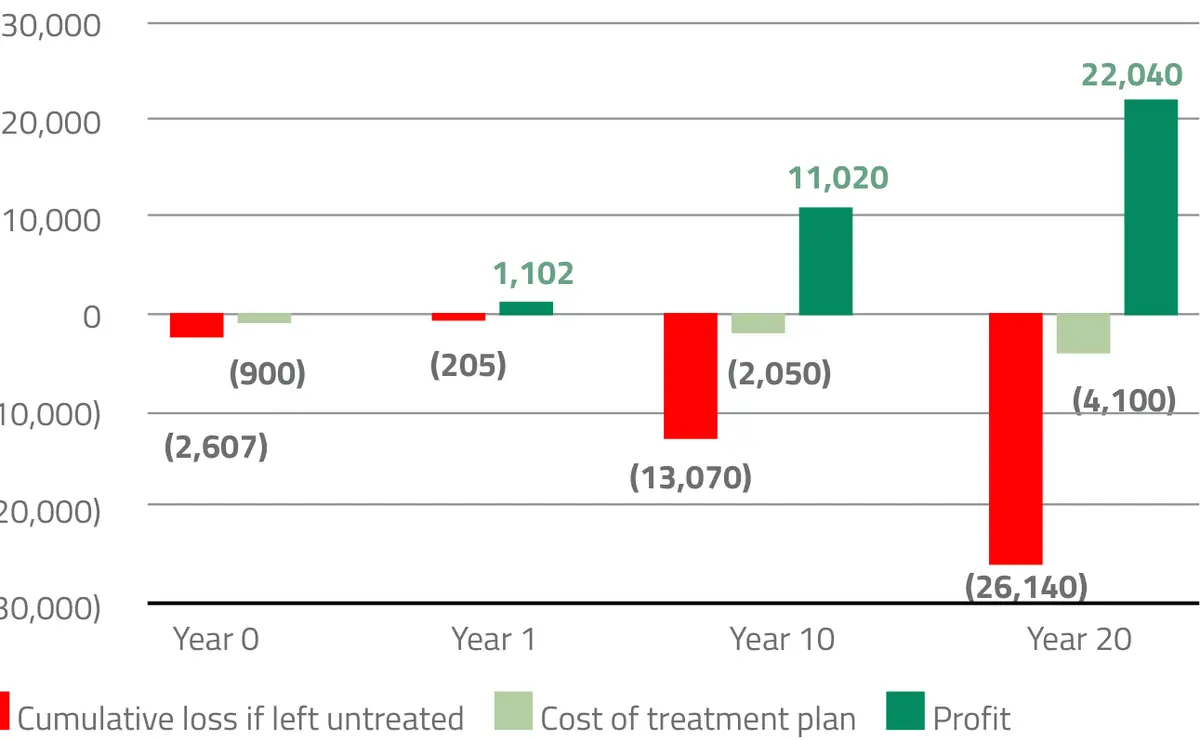
Analysis of the 3 tables above demonstrates that the benefit (rate of damage prevention) derived from establishing and operating appropriate waste and wastewater treatment infrastructure in locations where they are either non-existent or not yet operational substantially exceeds the associated costs. When considering additional factors such as impact on tourism, land value, quality of life, and considerations of water supply reliability and resource scarcity, the economic benefit from implementing the program proposed here (see the section on the roadmap for improving the situation) is even greater.
Recommendations and Summary
Pages 129–140
Legislation and supervision
In matters pertaining to environmental hazards, the international dispute and internal disagreement regarding the legal status of Judea and Samaria territories have created a paradoxical situation where all parties emerge disadvantaged. While the political dispute persists on the ground, immediate and sustained health and environmental damage affects the entire population in Judea and Samaria, both Israelis and Palestinians, and damages environmental resources: water, fauna, flora, and landscape.
These circumstances compel the State of Israel to act presently using all legal instruments at its disposal to halt environmental damage in Judea and Samaria, and where feasible, to enhance the environmental condition of these territories.
The State Comptroller’s reports have repeatedly identified supervisory and enforcement gaps in environmental hazard matters across all relevant entities, stemming from negligence, prioritization issues, insufficient staffing standards, and absence of statutory authority.
It is imperative to strengthen enforcement bodies and equip them with all necessary statutory and budgetary authority. However, equally important is the requirement to demand that these bodies use their current capabilities to their fullest extent..
Legislative recommendations
Direct application of environmental protection laws. Implementation of environmental legislation through specific statutory provisions that establish extra-territorial applicability of existing legislation and apply it territorially to Judea and Samaria, as exemplified by the Disengagement Implementation Law of 2005 and Section 5a of the Fire Services Law of 1959.
Application of Israeli legislation to Israeli residents in Judea and Samaria through the Law Extending the Validity of Emergency Regulations (Judea and Samaria and Gaza Strip: Jurisdiction over Offenses and Legal Assistance) of 1977.
Indirect application of Israeli law through jurisprudence, such as the High Court of Justice ruling that applied the principles of Israeli administrative law to the regional authorities’ exercise of governmental powers, and the labor courts’ decisions applying Israeli labor laws to employment contracts in Judea and Samaria through public international law’s choiceof-law rules.
Regional Commander orders implementing environmental legislation. Enactment of auxiliary laws: municipal bylaws and environmental bylaws for environmental associations.
Implementation of legislation and enforcement regarding proper disposal of tires to recycling facilities in Judea and Samaria.
Application of planning laws to Judea and Samaria. Extension of the Drainage Authorities Law and the Streams and Springs Law to Judea and Samaria.
Supervisory recommendations
Enhanced monitoring and control throughout Judea and Samaria and at crossings from Israel to prevent all waste-related hazards, including adapting standards, resources, technology, and authority. An example of supervision capability in Areas A and B is the monitoring teams preventing the over-extraction of water from wells in Areas A and B, operating since the Oslo Accords.
Because of security constraints, the Ministry of Environmental Protection faces difficulties in carrying out monitoring and enforcement activities. The Municipal Environmental Associations Samaria and Judea conduct most monitoring and enforcement work but suffer from severe understaffing. The roadmap for improvement of the situation must address staffing and budgetary gaps in these associations to enable enhanced monitoring and enforcement operations.
Planning laws, including environmental planning, do not apply in Judea and Samaria and consequently are not enforced. Beyond implementing these laws, operational capabilities must be secured for their enforcement, particularly regarding quarries and infrastructure as well as strategic environmental preservation projects across all sectors.
Effective crossing point supervision, including intelligence gathering, to prevent waste transfer from Israel to Judea and Samaria.
Protection of open spaces, including examination of required statutory measures.
Prevention of hazards from businesses, industry, auto dismantling facilities, agriculture, olive presses, and similar operations.
I’ll translate this section while maintaining scholarly analytical depth and precise legal-environmental terminology:.
Waste management
Waste management in Judea and Samaria is one of the most pressing environmental and health challenges, as it affects all parts of the environment. Common waste types include household waste, construction debris, agricultural waste, electronic waste, and scrap vehicles. All these are dumped, buried, or burned illegally, leading to serious contamination of soil, water sources, and air.
Palestinian and Israeli residents on both sides of the Green Line face many health problems from this widespread environmental pollution, including breathing disorders and cancers that stem from exposure to pollutants released into the air when waste is burned, especially electronic and industrial waste. The lack of laws and enforcement in Palestinian Authority areas makes this problem much more severe..
Recommendations
Set clear strategic goals for waste management in Judea and Samaria, mainly in the Palestinian sector, through education, reduced consumption, waste reduction at the source, less burying and burning, and more recycling.
Based on these goals, set and fund specific targets such as waste sorting, reuse, less burying, better waste market function, and building infrastructure for waste treatment and recycling.
Create systems that make environmentally sound solutions for waste and wastewater treatment financially viable.
Build sorting transfer stations, recycling facilities, and final disposal sites::
Create energy recovery treatment facilities Develop parks for recycling, waste recovery, and treatment Use financial tools to encourage businesses to build facilities for treating all waste types Manage waste in Judea and Samaria following the waste treatment hierarchy adopted by Israel’s Environmental Protection Ministry Treat waste as close as possible to where it is produced to build local responsibility Close illegal sites and reduce environmental harm, including preventing air pollution from fires in open areas Restore streams and land damaged by waste dumping, burial, and burning.
Wastewater
Wastewater treatment requires planning and building high-quality treatment facilities through cooperation between government ministries and regional authorities. Treatment facilities should combine proper health and environmental standards for treated wastewater use with a multi-year plan for funding and addressing problems based on their severity and health effects..
Recommendations
Plan and build solutions for Israeli settlements independently of Palestinian Authority agreement, meeting Israeli legal standards for treated wastewater quality and required monitoring. These facilities should also treat wastewater from nearby Palestinian settlements where local agreement is possible or by capturing wastewater after environmental discharge (similar to the Green Line facility on Nablus Stream). Payment for treating Palestinian wastewater will be carried out through tax revenue offset or another mechanism.
Capture Palestinian settlement wastewater flowing into Area C or reaching the border of Israel as far upstream as possible, or collect it at or near crossing points. Treat it to meet Israeli quality standards without needing Palestinian coordination. Payment will be carried out through tax revenue offset or another mechanism.
Use treated wastewater from Palestinian settlements within Palestinian Authority areas. Without agreement and implementation, direct treated water to Israeli settlements or Israel proper, subject to water source and environmental protection concerns.
Renew efforts to secure donor funding for Palestinian settlement wastewater collection and treatment infrastructure, both in Authority areas and in areas under Israeli sovereignty or responsibility. Israel will fund routine operations to protect its water and natural resources until reaching an agreement with a responsible Palestinian entity.
Make increased water supply to Palestinian users conditional on Palestinian agreement to take responsibility for wastewater created by this water supply.
Replace past policy of joint Israeli-Palestinian wastewater treatment (aimed at engineering and budget efficiency) with projects that do not depend on Palestinian agreement, considering the serious health and environmental effects of delayed wastewater treatment, which threaten the wellbeing, health, and welfare of all parties.
Israel sustains the greatest damage as the main user of mountain aquifer water and because it is located downstream from it, where hazards reach its territory. Therefore, it must adopt solutions without delay after decades of inability to act through agreement..
Priority for the treatment of hazards based on these parameters
- 1. Large-volume wastewater producers
- 2. Wastewater discharged into the environment that threatens strategic water sources in the region and Israel
- 3. Wastewater discharge that prevents infrastructure development, such as flood reservoirs. These reservoirs are vital both for improving water management and preventing downstream flooding, especially in densely populated areas like the Dan Region.
High-priority projects based on these considerations
Install the Raba Stream sewage collector to remove wastewater from Ariel, Salfit, Ariel West Industrial Zone, Barkan Industrial Zone, and other settlements (Israeli and Palestinian) to the Dan Region Wastewater Treatment Plant (Shafdan). Planning for this project began about twenty years ago but remains incomplete despite its critical importance. Treat wastewater from Modi’in Illit and nearby settlements by connecting to a regional treatment plant (Ayalon treatment plant).
Treat wastewater from western Ramallah that flows into Modi’im Stream and other streams in the Ayalon Basin (connection to the Jerusalem sewage collector).
Treat wastewater from Kedumim and its satellite communities in a local treatment plant or within Israel proper, including water reuse.
Complete the Kidron Stream sewage project to treat wastewater from East Jerusalem and Bethlehem-Beit Jala, currently discharged untreated into Kidron Stream, and direct treated water to agricultural users in the Jordan Valley. The project is under construction but progressing slowly. Treat wastewater (either locally or by connecting to the Rawabi treatment plant) from Palestinian settlements in the Haramiya Stream basin (between Ofra and Neve Tzuf). To the best of our knowledge, surface runoff (flood water) flowing in this stream does not reach the Shilo Stream into which it drains. This means that all wastewater rapidly seeps into the subsurface and groundwater. Haramiya Stream flows through relatively undisturbed areas and is of great value as an intact habitat..
Water Source Contamination
The Western Mountain Aquifer is a vital water source for Israel and the Palestinian Authority because of its high water quality and the large amounts drawn from it yearly. However, wastewater and treated effluent flowing from Judea and Samaria streams toward the coastal plain seriously harm the environment and pollute this important water source. This threatens the ability to keep drawing clean, high-quality water and points to the urgent need to properly treat wastewater and effluent from these areas.
The water source issue is not independent; threats to it stem from all the hazards noted above. Properly addressing these hazards will lead to adequate protection of the Mountain Aquifer.
Quarries
Quarry operations in Judea and Samaria need strict environmental monitoring and control, while protecting natural areas, avoiding hazards, and restoring damaged areas after mining ends..
Recommendations:
Develop policy, laws, planning, and enforcement tools for establishing and running quarries according to clear environmental guidelines as practiced in Israel, or at a minimum, follow these principles.
In its current form, TAMA 52/1 does not fully address environmental protection failures from non-metallic mining operations, and needs changes based on the objections raised.
Implement a specific plan, similar to TAMA 14b used in Israel, to protect the environment of Judea and Samaria from aggregate quarry damage.
Summary
The environmental situation in Judea and Samaria requires thorough, systematic management based on the understanding that pollution and environmental hazards do not recognize political, cultural or national boundaries. To improve environmental quality in the region and approach modern standards, at least those in force under Israeli law, The State of Israel cannot treat Judea and Samaria as its backyard.
Addressing regional hazards requires considering the Palestinian Arab population and its needs while recognizing that the Palestinian Authority is not a reliable partner in environmental matters, having repeatedly failed to address problems in this field. Although regional and international cooperation is desirable and could help improve the situation, protecting residents’ health and addressing environmental, natural, and economic damage should not depend on external parties that lack commitment to these issues.
Israel, as the de facto sovereign, must develop a policy that includes legislation, enforcement, monitoring, education, and public awareness, emphasizing sustainable solutions.
The external costs of environmental hazards in Judea and Samaria are very high, estimated at NIS 52 billion over twenty years because of health impacts, excess illness and death, loss of water sources, property value reduction, and other factors.
We estimate that preventing environmental hazards, mainly in waste and wastewater, will cost about NIS 3 billion over ten years and prevent most future damage. Thus, the required investment is only about 6% of the damage that would occur without it.
Israel’s failure to address environmental problems in Judea and Samaria vigorously, decisively and unilaterally is causing serious harm to residents, water, nature and landscape. Israel’s moral and legal duty is to take full responsibility and solve these problems.
Environmental hazards do not respect political boundaries, agreements, or territorial divisions, and they do not distinguish between Areas A, B, and C in Judea and Samaria and other areas under Israel’s control.
Judea and Samaria face many serious environmental hazards, including illegal waste burning, discharge of untreated wastewater into open areas, solid waste buildup, noise, radiation, unregulated construction and quarrying, and substandard handling of dangerous materials. To these, we can add harm to protected wildlife, infrastructure damage, and harm to natural and heritage sites.
Many factors contribute to environmental hazards in Judea and Samaria, including the complex geopolitical situation, distinct geographic and geological features, severe lack of suitable legislation and effective enforcement, and cultural and operational differences in environmental management between Palestinian and Israeli populations. Moreover, ongoing regional conflict worsens the situation, especially in areas like water pollution and waste treatment.
This report summarizes the main environmental hazards and their associated health and economic damage. It presents an economic analysis comparing pollution costs with the costs of an improvement plan and addresses complex legal aspects and the lack of environmental policy and enforcement in Judea and Samaria.
Some hazards presented in this report are already beyond repair. To prevent further deterioration, action must be taken now.
ירוק עכשיו (ע"ר) - 2008
Acknowledgments
Academic Center for Law and Science We wish to thank everyone who contributed to the preparation of this report and
the survey on which it is based.
Consulting contributors Prof. Haim Gvirtzman, Hebrew University of Jerusalem
Dr. Attorney Hagai Vinitzky Attorney Boaz Arazi, Regavim Mr. Yitzhak Meir, Former Director of the Samaria Environmental Association
Those who contributed knowledge, data, photographs, insights,
and comments to the report Ms. Naama Abramov, Yehuda Environmental Association
Ms. Lior Edri, GIS Regavim Mr. Benny Elbaz, Environmental Protection Officer, Civil Administration
Mr. Gilad Ben-Ari, Director of Samaria Environmental Association Mr. Shoni Goldberger, Director of Jerusalem District, Ministry of Environmental
Protection Mr. Guy Derech, Guardians of Eternity Movement Mr. Menachem Weiss, Hydrological Service, Water Authority
Mr. Yehuda Kiat, GIS Coordinator, Regavim Movement Dr. Nitzan Levy, Director of Yehuda Cities Association for Environmental Protection
Mr. Ariel Manor, Environmental Clinic at Sha’arei Mishpat Academic Center
Dr. Yossi Inbar, Environmental Consultant
Mr. Yoav Armoni, Academic Green Mr. Gideon Sagi, Yehuda Cities Association for the Environmental Protection